Picture it: a dozen tiny hot dogs with legs, ears flapping, little legs pumping, lined up in a makeshift starting gate at a local festival. The crowd is roaring with laughter. The announcer is making terrible wiener puns. It’s pure, chaotic, adorable joy. And then the gates open, and if you’re a doxie parent, your heart leaps directly into your throat.
You see the fun, you see the excitement, but all you can really see is that long, precious, uniquely engineered spine. This is the constant tug-of-war in the heart of a dachshund owner: wanting to let them be the joyful, energetic, surprisingly fast dogs they are, while living with the low-grade, constant hum of anxiety about their backs. The fear of one wrong jump, one bad twist, is always there. It’s a question that plagues us: is this adorable spectacle a fun day out, or an activity that puts their backs at serious risk? This conversation is central to understanding true dachshund exercise safety.
The All-or-Nothing Trap
When it comes to doxie activity, most people fall into one of two camps, and neither one feels quite right. On one side, you have the “let dogs be dogs!” crowd. They argue that dachshunds are tough, they love to run, and that we shouldn’t bubble-wrap them. They see the joy and focus on that, sometimes dismissing the very real anatomical risks of the breed.
On the other side, you have the bubble-wrap brigade. Every run is stopped, every jump off the sofa is a five-alarm fire, and the dog is discouraged from any vigorous activity. This approach, while born from love and fear, can lead to an under-exercised, overweight, and frankly, a bored and unhappy dog. A dachshund without a job or an outlet for their energy is a recipe for a frustrated pet and a chewed-up shoe collection.
Searching for answers online can be overwhelming. You’re hit with a confusing mix of viral videos of wiener dog races set to triumphant music, immediately followed by heartbreaking articles and forum posts from owners dealing with Intervertebral Disc Disease (IVDD). You’re left more confused and anxious than when you started, with no clear idea of what’s right for your long little dog.
The Real Enemy Isn't Running—It's Torque
After nearly two decades with Marley, Mia, and their predecessors, I’ve learned to reframe the entire question. The shift in thinking that saved my sanity was this: The problem isn't running. Dachshunds were bred to run, to chase, to dive into badger holes with grit and determination. They have powerful little engines. The real enemy isn't speed; it's torque. The danger lies in the sudden, explosive, twisting motions that their long spine simply wasn't designed to handle.
We need to stop asking, “Is running safe?” and start asking, “Is this type of running safe?” A sprint across a soft, grassy field is a world away from a frantic scramble out of a starting box on hard-packed dirt, surrounded by other dogs. Understanding this difference is the absolute core of responsible and effective dachshund exercise safety. It’s about managing the forces at play on that unique body, not eliminating the activity altogether.
A Doxie Parent's Safety Checklist for Any Activity
So, how do you decide what’s safe? I have a mental checklist I run through for any new physical activity with my dogs, whether it’s a new hiking trail, a dog park, or yes, even the theoretical wiener dog race. It empowers me to assess the risk myself instead of relying on confusing advice.
1. The Surface Matters More Than You Think
Imagine a gymnast doing a floor routine. Now imagine them doing it on concrete. That’s the difference a surface makes. Hard-packed dirt, pavement, asphalt, or even slippery indoor floors create high-impact shockwaves that travel right up your doxie’s legs and into their spine. For any high-energy activity, we want soft, forgiving surfaces. A lush lawn, soft sand at the beach, or a well-maintained dirt path with some give are all excellent choices. They absorb impact and reduce the strain on those delicate intervertebral discs.
2. Beware the “Rocket Launch” Start
The single most dangerous moment in a wiener dog race isn't the finish line; it's the start. Going from a dead stop in a cramped box to an all-out sprint in a split second puts an immense, unnatural strain on their entire body, especially their shoulders, neck, and spine. That explosive launch is a high-risk maneuver. Contrast that with a game of fetch in your backyard. Your dachshund might see the ball, get excited, and then build up speed more naturally as they run to retrieve it. This gradual acceleration is infinitely safer and more in line with how their bodies are meant to move.
3. The Chaos Factor: Other Dogs
A dachshund running a solo sprint is one thing. A dachshund running in a pack of a dozen other unpredictable, equally excited sausages is a completely different scenario. The risk of a collision is high. A sudden stop, a sharp pivot to avoid another dog, or getting tangled up in a puppy pile-up can cause the exact kind of twisting, jerking motion that leads to spinal injuries. Doxies are tenacious, but they are not agile cornering machines like a Border Collie. Their strength is in straight-line determination, something that a chaotic race doesn't guarantee.
4. A Strong Core is Their Best Back Brace
Is your dachshund more of a couch potato or a conditioned athlete? Be honest. A dog with a strong, well-developed core—the network of muscles supporting that long spine and ribcage—is far better equipped to handle physical stress. This is why daily walks, controlled play, and maintaining a healthy weight are non-negotiable. Think of those muscles as a natural, built-in back brace. Protecting their back isn't just about ramps and lifting them correctly; it's also about building their physical resilience from the inside out. It's a key part of how we 'Dachshund-Proof' our homes and lives for their wellbeing.
5. The Honest “Why” Check
Finally, I always ask myself this simple question: who is this activity really for? Is my dog genuinely loving this, or are they just feeding off the chaotic energy of a crowd for my entertainment? There are so many safer ways to honor their powerful instincts. We know that your dachshund's stubbornness comes from a place of intelligence and purpose—they were bred for a tough job. We can satisfy that drive with scent work games, chasing a lure in the backyard, or long walks exploring new smells. These activities give them all the mental and physical stimulation they crave, without the high-stakes gamble of a competitive race.
So, What's the Verdict on Wiener Dog Races?
After 20 years with this breed, my personal feeling is that the risk just isn't worth the reward. I’ll never forget seeing my first race years ago. I was charmed, of course. But I watched one little guy stumble right out of the gate, do a complete somersault, and then pop back up and keep running. The crowd laughed. My stomach turned to ice. He seemed fine, but I saw in that one clumsy, uncontrolled moment every doxie parent's biggest fear, a potential trigger for a life-altering condition like IVDD. I would never want to be the person who has to manage a long and difficult IVDD recovery because of a few seconds of festival fun.
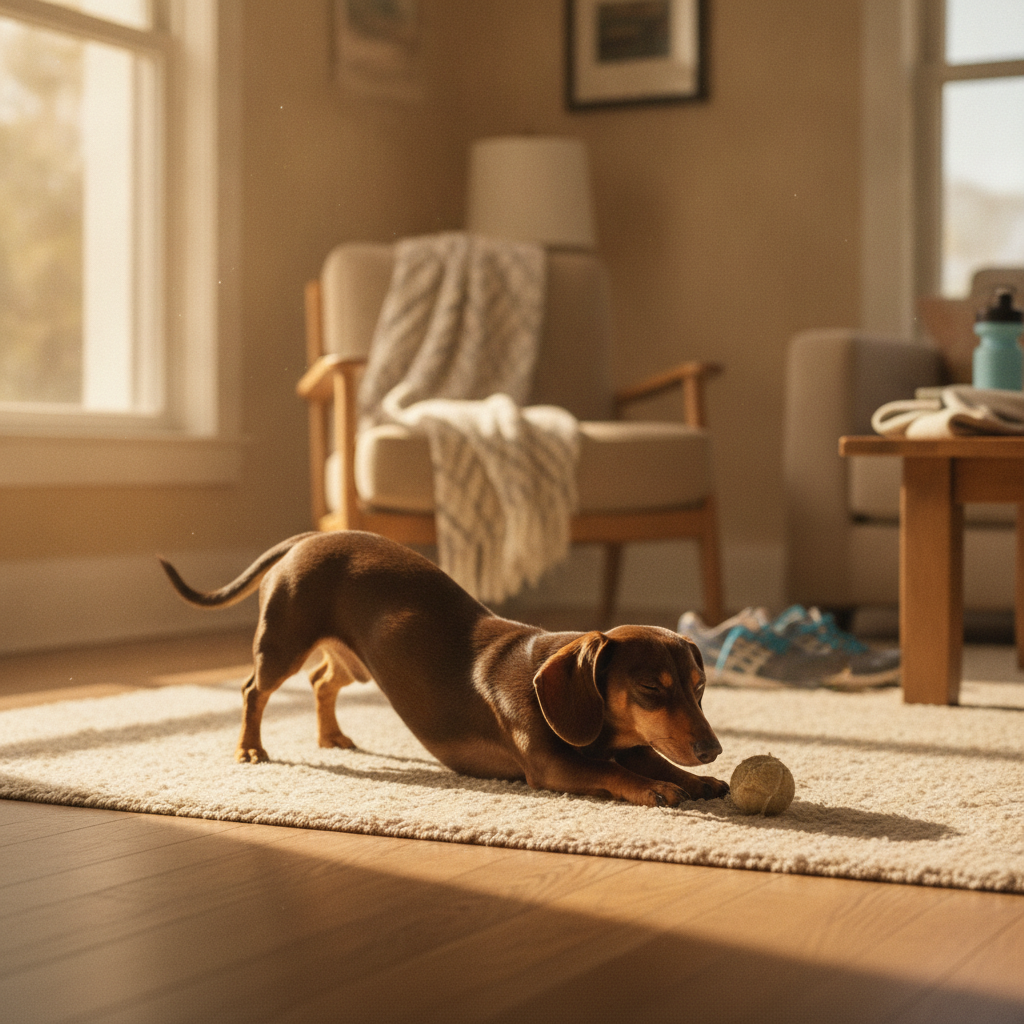
I much prefer watching my Marley and Mia experience the pure joy of a safe run. When Mia chases a ball across our lawn, her ears flying, she's in her element. She’s running just as fast as any race dog, but the start is gradual, the ground is soft, and there are no other dogs to dodge. She gets all the happiness and a fraction of the risk. That’s the goal. That’s sustainable, joyful dachshund exercise safety.
Ultimately, you are the expert on your own dog. But I encourage you to use this checklist to look at any activity with new eyes—to see the physics and the forces at play, not just the cute photo opportunity. Our job is to be their advocate and their protector, and that means making smart choices that let them live their longest, happiest, healthiest lives.
Understanding your doxie’s physical limits is just as important as understanding their quirky little minds. It’s all connected. If you want to become a more confident doxie parent who can tell the difference between a fun quirk and a warning sign, you need to understand the "why" behind what they do. That's why I created a guide to help you do just that. Get the free Dachshund Behavior Decoder and learn to speak their language, from their happy zoomies to their subtle signs of discomfort.
Frequently Asked Questions
What is the single biggest risk for dachshunds in wiener dog races?
The biggest risk is the combination of an explosive start from a standstill and the potential for sudden twisting. This puts immense torque and pressure on their long spine, which can lead to disc injuries like IVDD. The hard, often uneven surface of a racetrack only adds to the impact and danger.
My dachshund loves to run. What are safer alternatives to racing?
There are many wonderful alternatives! Lure coursing (in a controlled, non-competitive setting), fetch on a soft grassy lawn, or running freely on a sandy beach are all fantastic options. These activities allow your doxie to enjoy a full-speed run without the high-risk factors of a chaotic race start and potential collisions.
Does my dachshund's age matter for exercise safety?
Absolutely. Puppies have developing joints and growth plates, so their exercise should be short and playful, avoiding repetitive, high-impact activities. Senior dachshunds may have arthritis or reduced muscle mass, so they benefit from shorter, more frequent low-impact walks and gentle play. Always tailor the activity to your dog's specific age and fitness level.
Can conditioning really prevent a back injury in a dachshund?
While no activity is 100% risk-free, proper conditioning can significantly reduce the risk of injury. Building strong core muscles provides crucial support for the spine, acting like a natural corset. Maintaining a healthy, lean weight is also one of the most important things you can do for your dachshund's back health and overall dachshund exercise safety.
Are harnesses better than collars for running activities?
Yes, for any activity involving running or pulling, a well-fitting harness is far superior to a collar for a dachshund. A harness distributes pressure across their chest and shoulders, avoiding strain on their delicate neck and trachea. It also gives you better, safer control if you need to stop them suddenly.
dachshund health · IVDD · dog exercise · back safety