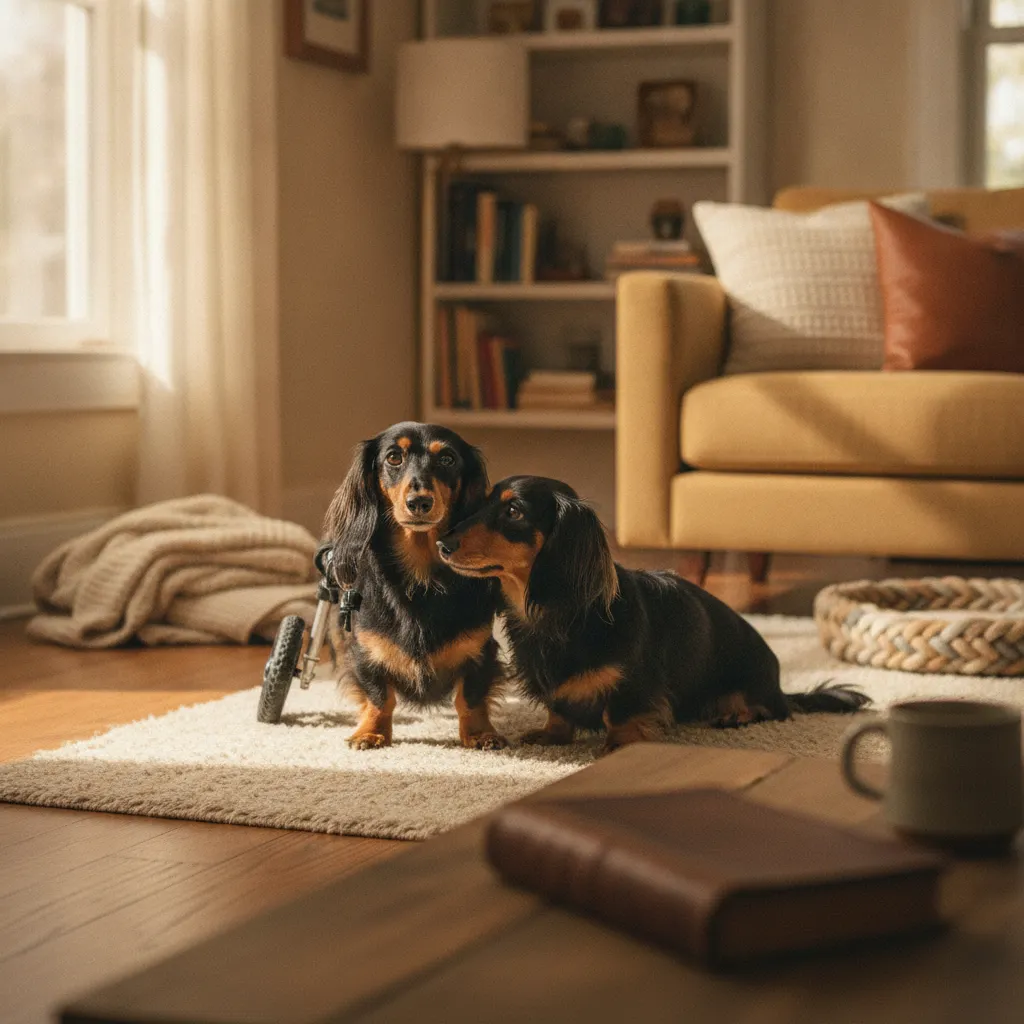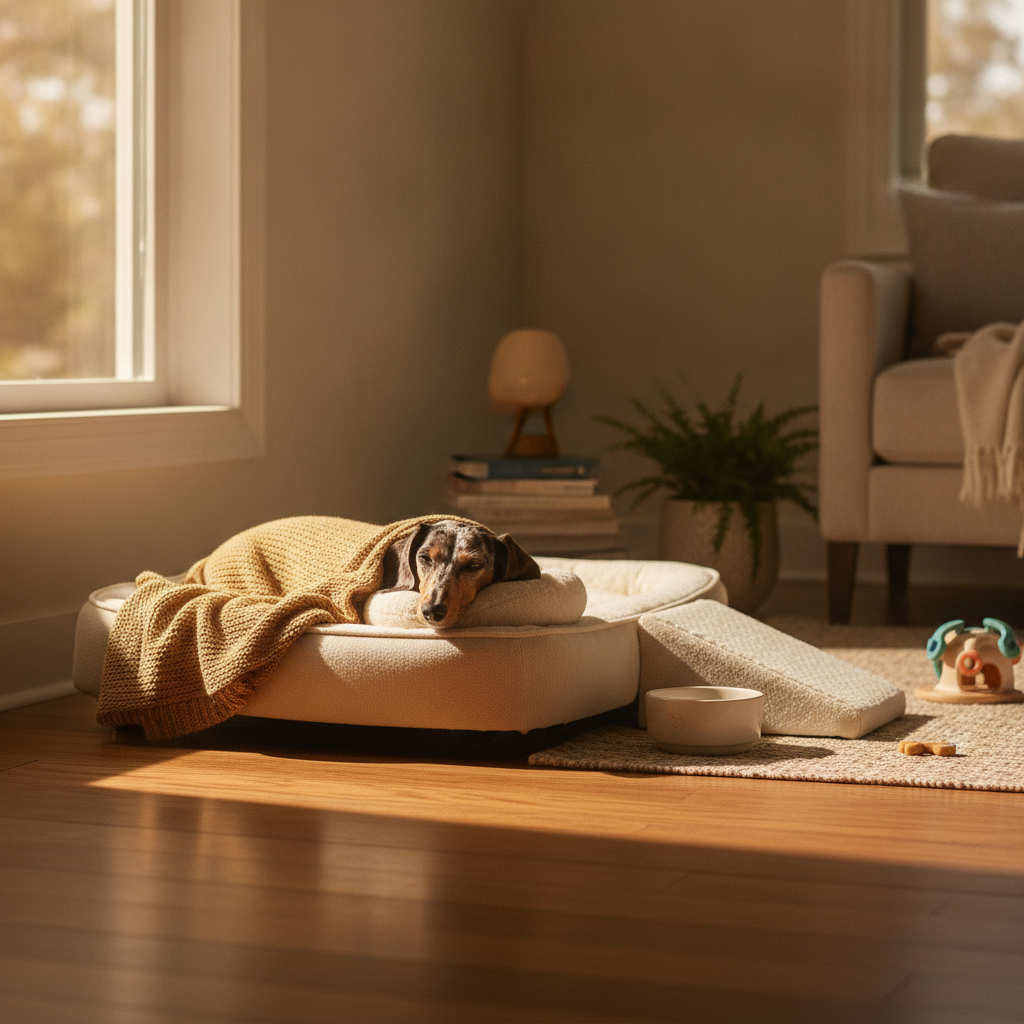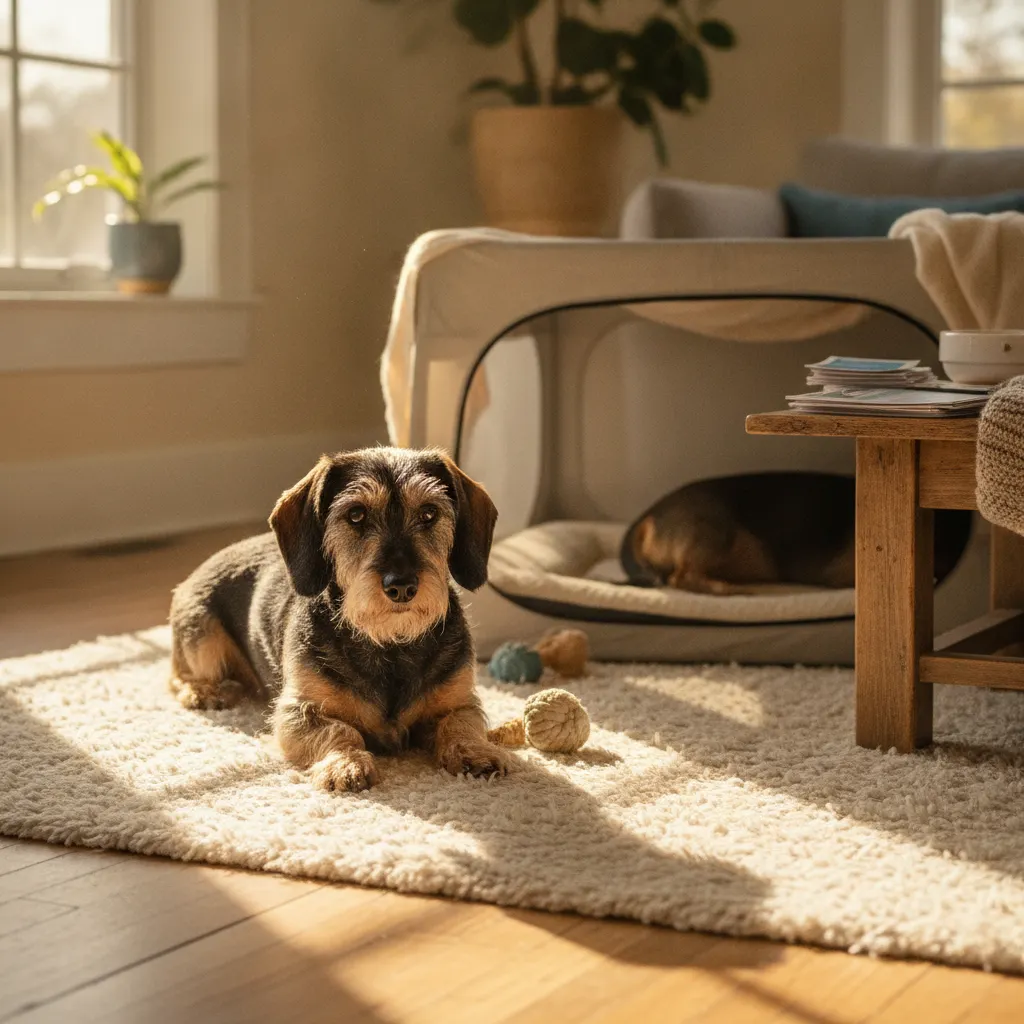
The silence was the first thing I noticed. After we brought Marley home from the emergency vet, diagnosed with IVDD and sentenced to eight weeks of strict crate rest, our house went quiet. Not peaceful quiet. It was the heavy, humming silence of a machine that’s suddenly missing a critical gear. The missing gear was Mia. My normally bossy, bouncy, shadow-of-a-sausage was just… gone. She’d lay by the back door, not asking to go out. She’d sniff her food bowl and walk away. She was a little ghost haunting the edges of our new, uncertain reality. My heart, already shattered for Marley, broke all over again for her. I was managing the care for one dog through IVDD recovery, and my other dog was clearly depressed. I felt like I was failing them both.
The Crushing Guilt: When You’re Juggling Two Kinds of Heartbreak
If you’re reading this, you know this feeling. Your world has been turned upside down by three little letters: I-V-D-D. You’re consumed with medication schedules, bladder expressions, and the constant, deep-seated worry every time your crated doxie shifts their weight. Your focus is a laser beam on the patient. And then you look over and see your “healthy” dog. They’re moping. They’re sighing dramatically from across the room. They might be acting out, suddenly chewing things they shouldn’t or having accidents in the house. And the guilt is a physical weight. You’re already stretched to your emotional and physical limits caring for one dog, and now you feel like you’re emotionally neglecting the other. It’s a special kind of heartache reserved for doxie parents, feeling like you have to choose which child to comfort when both are hurting.
You’re not just imagining it. The change in your healthy dog is real. The pack dynamic, the intricate social structure of your home, has been blown apart. The routines are gone. The play-wrestling is gone. The shared naps on the couch are gone. The very energy in your home has shifted from happy chaos to tense, quiet anxiety. And your healthy dachshund, a creature wired for routine and pack life, is lost in the wreckage.
Why Trying to “Cheer Them Up” Doesn’t Work
So, what have you tried? I know what I did. I tried to fix Mia’s sadness with things. I bought her a new squeaky toy. She looked at it with the kind of disdain usually reserved for a piece of kale that fell on the floor. I tried giving her extra high-value treats. She’d eat them, but the sadness would roll right back in the second the treat was gone. I tried to initiate a game of fetch in the living room, but she’d just drop the ball and look toward Marley’s crate with a worried expression.
Here’s why these common-sense solutions fail:
- You’re treating a symptom, not the cause. The problem isn't a lack of toys or treats. The problem is a fundamental disruption of their world. A new toy is like putting a tiny band-aid on a gaping wound. It doesn’t address the core anxiety of a broken pack.
- You’re adding pressure. When you try to force cheerfulness or play, you’re adding another layer of expectation onto a dog that is already stressed. They can sense your frantic energy, your desire for them to “just be happy,” and it can make them even more anxious because they don't know how to give you what you want.
- You’re rewarding the wrong state of mind. If you’re constantly showering a moping dog with treats and attention, you can inadvertently reinforce the very behavior you’re trying to change. They learn that being listless gets them goodies, which doesn't help them build resilience.
I got frustrated. I felt helpless. Nothing I did seemed to penetrate Mia’s fog of sadness. It wasn’t until I stopped thinking about her as “depressed” and started thinking about her as “unemployed” that everything clicked into place.
The Reframe: Your Healthy Dog Isn't Depressed, They're Unemployed
This is the most important shift you can make. Your healthy dachshund is not experiencing depression in the complex human sense. They are experiencing acute stress because their entire social structure and sense of purpose have vanished overnight. For hundreds of years, dachshunds were bred to work in a pack. They have jobs. In our homes, those jobs aren't about hunting badgers anymore. Their jobs are about being the play-starter, the co-napper, the alarm-barker, the wrestling partner, the one who cleans up the crumbs under the other’s chin.
When one dog is suddenly confined to a crate, the other dog’s job is gone. Their co-worker, their partner in crime, has disappeared from the daily workflow. Add to that the fact that their pack leader—you—is radiating stress, sadness, and anxiety. The whole system is broken. They aren't sad *for* their sibling in an empathetic way we understand; they are profoundly stressed because their world has become unpredictable and their role in it has been erased. This is a crucial distinction because you can’t fix “sadness,” but you absolutely can fix “unemployment.” You just have to give them a new job.
The Pack Reset: A 4-Step Plan to Restore Calm
Instead of trying to patch the holes, you need to create a new, temporary structure for your pack. This isn't about waiting for things to go back to normal; it's about building a new normal for the duration of the IVDD recovery. Your other dog needs this structure to feel secure again. I call this The Pack Reset.
Step 1: Acknowledge the New Pack Structure
Your pack of two is, for now, a pack of “one on the floor, one in the box.” Stop trying to pretend otherwise. Your role has changed from a simple owner to the crucial bridge between your two dogs. You are the communication link. You are the emotional thermostat of the house. Your first step is to accept this and project calm leadership. Take a deep breath before you walk in the room. Celebrate the tiniest wins—a peaceful moment, a wagging tail. Your dogs look to you to know if the world is safe. If you're frantic, they will be too. If you are calm and in charge, they can relax.
Step 2: Give Your Healthy Dog a New, Important Job
This is the core of the solution. An unemployed doxie is a stressed doxie. Their new job title is “Recovery Assistant.” This job has several important duties, all designed to be calm, structured, and rewarding.
- The Scent Reporter: Dogs experience the world through their nose. Keep the connection between your dogs alive through scent. Take a small blanket the crated dog has been sleeping on and give it to your healthy dog. Let them sniff it, lie on it, and process the information. Do the same in reverse. This tells them their sibling is still part of the pack, even if they can't physically interact.
- The Calm Companion: The new rule is that proximity to the crated dog must be calm. Place a comfy dog bed a few feet away from the crate. When you’re sitting with your recovering dog, invite your healthy dog to lie on their bed. Reward them with quiet praise or a gentle stroke for being calm and settled. Their job is no longer to wrestle, but to provide a quiet, steady presence.
- The Solo Explorer: This is non-negotiable. Your healthy dog MUST get out of the house for special, one-on-one time with you. These are not sad walks where you miss your other dog. Reframe them as “sniffing missions.” Their job is to go out, explore the world, and bring back all the interesting smells on their paws for their crated sibling. Let them sniff as much as they want. This mental stimulation is just as important as physical exercise and gives them a sense of purpose that is entirely their own.
Step 3: Create a Predictable “New Normal” Routine
The old routine is gone. Grieve it, and then build a new one immediately. Dogs thrive on predictability. A predictable schedule is the antidote to anxiety. Write it down if you have to. It might look something like this:
- 7:00 AM: Healthy dog out for a quick potty break.
- 7:15 AM: Breakfast for both dogs (one in crate, one in their usual spot).
- 8:00 AM: Your coffee time, with healthy dog on their bed near the crate for “Calm Companion” duty.
- 9:00 AM: Medication and care for crated dog. Healthy dog can observe from a distance.
- 10:00 AM: Healthy dog’s special “Solo Explorer” walk.
- And so on...
The specifics don't matter as much as the consistency. When your healthy dog knows what to expect, they don't have to spend all their energy worrying about what’s going to happen next. They can finally relax into their new role.
Step 4: The All-Important Vet Check (For Both Dogs)
This is my most critical rule, and it applies here more than ever. Quirks are consistent; problems are a change. A sudden, drastic behavioral change in your healthy dog—especially a total loss of appetite or extreme lethargy—warrants a call to your vet. It's easy to assume their behavior is purely psychological, but stress can absolutely impact a dog's physical health. It's always best to rule out any underlying medical issues. This isn't about being a panicked owner; it's about being a thorough one. When you're overwhelmed with the IVDD diagnosis, it's easy to miss things. Having a vet confirm your healthy dog is, in fact, healthy, will give you priceless peace of mind. If you're at the beginning of this journey, our guide on questions to ask your vet about IVDD can help you feel more in control during those overwhelming appointments.
How “The Pack Reset” Saved Our Sanity
When Marley was on crate rest, Mia was a mess. She was a whiny, sad, listless little sausage. The guilt was eating me alive. The moment I stopped trying to “cheer her up” and gave her the job of Recovery Assistant, the energy in our house shifted within 48 hours. Her new routine became our lifeline. She took her job as “Calm Companion” seriously, lying near Marley’s crate like a tiny, furry nurse. Our solo walks became our special time to decompress together. She wasn’t just a sad dog anymore; she was an important part of her brother’s healing team. She had a purpose.
It's a process, and it won't be perfect. There will be days when the stress feels overwhelming for everyone. But by providing structure, purpose, and calm leadership, you are giving your healthy dog the tools they need to navigate this incredibly difficult time. You're not just helping them cope; you're reaffirming that the pack is still intact, even if it looks a little different for a while. For those facing a longer-term change in mobility, thinking about these dynamics early is key. We learned so much that we later applied when living with dogs of different abilities, a journey we talk about in our guide to life with a paralyzed and an able-bodied doxie.
You are not failing. You are a loving doxie parent in an impossible situation. Be kind to yourself. You are doing the best you can, and your dogs know it. Focus on structure, give them a job, and lead with calm confidence. You will get through this, together.
Understanding these deep-seated pack dynamics is the key to a calmer home, both during a crisis and in everyday life. To go even deeper into the “why” behind your dachshund’s quirky behaviors, get my free guide. It translates their actions and helps you become a more confident, connected doxie parent. Get the free Dachshund Behavior Decoder.
Frequently Asked Questions
How long will my other dog be depressed during the IVDD recovery?
It's less about a specific timeline and more about adjustment. Most dogs begin to adapt once you establish a new, predictable routine. Instead of waiting for them to stop being sad, focus on giving them a new job and purpose; their mood will improve as their anxiety lessens and they feel secure in the 'new normal' of your home's IVDD recovery. Other dog behaviors should start to level out within a week or two of implementing a solid new routine.
Should I let my healthy dog see my dog with IVDD?
Yes, but in a calm, supervised way. Positive visual contact is important for maintaining their bond. Allow your healthy dog to lie near the crate or pen, but do not allow any jumping, pawing, or attempts at rough play. These quiet, parallel moments reinforce that they are still a pack, just in a different configuration for now.
My healthy dog is suddenly acting aggressive or guarding the crated dog. What should I do?
This is often a sign of stress and anxiety, not true aggression. The healthy dog may be trying to “protect” the injured one or is feeling insecure. Immediately manage the environment to prevent this, using baby gates if needed. Focus on creating calm, positive associations with being near the crate (e.g., giving the healthy dog a high-value chew on their bed nearby) and increasing their solo enrichment time to reduce stress.
Is it okay to give my healthy dog extra attention right now?
Absolutely, but focus on the quality of that attention. Mindless treat-giving won't solve the problem, but dedicated one-on-one time will. A 15-minute solo “sniffari” walk, a 5-minute training session, or a good cuddle on the couch (away from the crate area) does more to fill their cup and reduce stress than two hours of half-distracted petting while you worry.
What are the signs of genuine depression in a dog that require a vet visit?
While moping is expected, watch for sustained, severe changes. A complete and total refusal to eat for more than a day, extreme lethargy where they won't even get up for a walk, or a total lack of interest in things they normally love are red flags. A sudden behavioral change is always worth a call to the vet to rule out an underlying medical issue, as stress can sometimes trigger other problems in the seemingly healthy dog.
How can I manage my own stress so I don't upset my dogs more?
This is the hardest part. Your dogs are emotional sponges. Acknowledge that you can't be perfectly calm, but try to build small moments of peace into your day. Take five deep breaths before you give medications. Put on calming music. And, most importantly, give yourself grace. You're navigating a crisis, and it's okay to be stressed. Sharing a quiet, intentional cuddle with your healthy dog can be just as therapeutic for you as it is for them.
IVDD · dog behavior · dachshund health · multi-dog household