You’ve seen them online. The videos that make your heart clench and swell at the same time. A determined little dachshund, back legs still, front paws paddling furiously, cruising down a hallway in a tiny wheelchair. The “wheelie wiener.” We share these videos with captions like “so inspiring!” and “what a fighter!” And they are. They are monuments to doxie grit and the incredible love of their owners. But they are also our greatest teachers. Every single one of those sweet, rolling sausages is a lesson plan in **IVDD prevention**, and it’s a class every dachshund parent can benefit from.
That’s the fear, isn’t it? It’s the shadow that follows every doxie mom. It’s the heart-in-your-throat moment when they take a flying leap off the couch. It’s the quiet panic when they yelp for no reason. We live with a low-grade hum of anxiety about their long, precious backs. The diagnosis of Intervertebral Disc Disease, or IVDD, is the boogeyman in our closets. We feel a mix of terror and a terrible, looming guilt. “Could I have stopped this? Did I let them jump too much? Is this my fault?” That fear can steal so much of the joy of living with these hilarious, stubborn, wonderful dogs.
So, we try to fix it. We buy a ramp they promptly ignore, opting to launch themselves over it like a tiny Evel Knievel. We yell “No jumping!” a hundred times a day until our voice is hoarse and their ears are conveniently switched off. We scroll through forums at 2 a.m., getting conflicting advice that leaves us more confused than when we started. The problem with these solutions is that they are reactive, not proactive. They are attempts to put our dogs in a bubble, which is impossible. A dachshund’s spirit is too big for a bubble. They were bred for courage, not caution.
Here’s the reframe that changed everything for me: IVDD prevention isn't about stopping your dachshund from living their life. It’s about building a stronger dachshund and a safer world for them to live in. It’s not about fear; it’s about empowerment. We can’t change their genetics—that long, low chassis is what makes them a dachshund. But we can absolutely change the two other huge factors in the equation: their physical conditioning and their environment. The wheelie wieners aren’t a warning of an inevitable fate. They are a powerful reminder of the *why* behind our vigilance and a testament to the fact that life, even after injury, can be full of joy.
What Exactly is IVDD, and Why is My Doxie at Risk?
Let's demystify the scary medical term. Imagine your dog’s spine is a stack of bony rings (vertebrae). Between each ring is a tiny, squishy shock absorber, like a little jelly donut. This is the intervertebral disc. It’s what allows the spine to bend and twist. IVDD is what happens when that “jelly donut” goes wrong. The outer layer can harden, and the soft “jelly” inside can bulge or burst, pressing on the spinal cord. That pressure is what causes pain, weakness, and in the worst cases, paralysis.
Why dachshunds? It’s written in their DNA. They are a “chondrodystrophic” breed, a fancy word that means their cartilage develops differently, giving them their signature short legs. Unfortunately, this genetic trait also affects the discs in their spine, making them more likely to degenerate over time. So, no, you didn’t do anything wrong to cause this predisposition. It’s part of the dachshund package, just like their bossy bark and their talent for stealing socks. But knowing the risk is our superpower because it allows us to be proactive.
The Two Pillars of Proactive IVDD Prevention
You can’t control genetics, but you can control the world around your dog and the strength of their body. True prevention stands on two powerful pillars: building a “core of steel” and creating a “doxie-safe” environment. One without the other is like having a car with great brakes but bald tires. You need both for a safe ride.
Pillar 1: Building a 'Core of Steel'
Think of your dachshund’s body like a long bridge. The spine is the bridge deck. What holds it up? Strong support columns. For your doxie, those supports are their core muscles—the web of muscle in their abdomen, chest, and back. A weak core means the spine takes all the stress of daily movement. A strong core acts like a natural corset, stabilizing the spine and protecting those delicate discs from jarring impacts.
So, how do we build it? It's not about running them for miles. It’s about controlled, muscle-building activity.
- Weight Management is #1: This is the most critical factor you control. Every single extra pound on that long frame is like asking them to carry a weighted backpack 24/7. It puts immense, constant strain on their spine. You should be able to easily feel their ribs without a thick layer of fat, and they should have a visible “waist” when you look down at them. Be honest with yourself here; a chunky wiener might look cute, a lean wiener lives longer and safer.
- Controlled Walks: Leash walks are fantastic. They allow you to set the pace and prevent sudden, explosive movements. Walking on varied terrain, like gentle grassy hills, is even better. It makes them engage different muscles to stay balanced, which is a great core workout.
- Brain Games and 'Puppy Push-ups': Simple training exercises are amazing for core strength. Asking your doxie to go from a sit to a stand to a down and back up again is a fantastic, low-impact muscle builder. Check out our guide to easy brain games that do double duty for their body and mind.
- Safe Water Fun: Swimming is one of the best exercises for a dachshund, as it builds muscle with zero impact on their joints or spine. Of course, not all doxies are natural swimmers, so it requires supervision and a life vest. For a full breakdown, read our back-friendly guide to water fun.
Pillar 2: Creating a 'Doxie-Safe' Environment
This is where you become an architect of safety. You're modifying their world to reduce the daily micro-traumas that add up over a lifetime. It’s about making the safest choice the easiest choice for your stubborn sausage.
- Ramps Are Non-Negotiable: I know, I know. They can be an eyesore, and sometimes the dog treats them like a piece of modern art to be ignored. But the leap from the floor to the couch is a massive jolt to their spine. The key is training and consistency. Use high-value treats to lure them up and down the ramp. Block off other routes. Celebrate every time they use it. It’s a habit that can literally save their spine. You need them for couches, beds, and getting into the car.
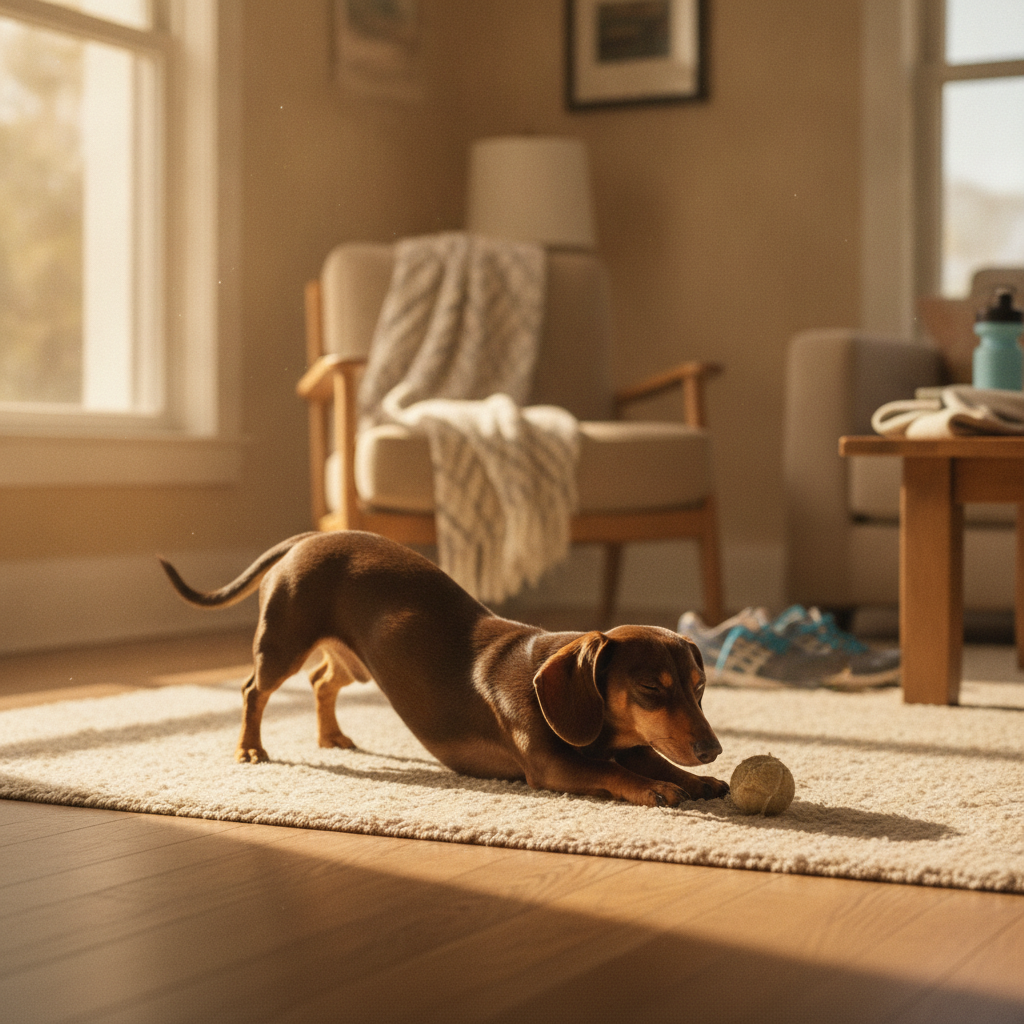
- Traction is Everything: Watch a doxie try to get traction on a slippery hardwood or tile floor. Their back legs can splay out, causing them to twist and strain their back. This can be a hidden source of strain. Runners and area rugs are your best friends. They provide grip for safe take-offs and landings, preventing the slips that can lead to injury. For a full home audit, see our guide on creating a back-safe doxie den.
- Lift and Carry with Care: Never, ever pick up a dachshund by their front legs or under their “armpits.” This lets their entire back half hang, putting all the weight and pressure on their spine. Always scoop them up with one hand supporting their chest and the other supporting their rump, keeping their spine as straight and horizontal as possible.
- Use a Harness, Not a Collar: When your doxie pulls on a leash attached to a collar, all that force is concentrated on their neck and the upper part of their spine. A well-fitting harness distributes that pressure across their chest and shoulders, which is much safer for their delicate structure. This is a simple switch with a huge payoff.
So, Is It All Just Genetic Luck?
I get this question a lot. It’s easy to feel fatalistic, to think, “If it’s going to happen, it’s going to happen.” And yes, there is a strong genetic component. Some doxies have worse-than-average disc health from the start. But that is not the whole story. Think of it like this: genetics loads the gun, but lifestyle and environment pull the trigger. You have tremendous power to keep that trigger from ever being pulled.
In my nearly 20 years with my doxies, Marley and Mia, and the ones who came before them, I’ve seen the difference this proactive approach makes. We’ve managed the environment and focused on keeping them lean and strong. We’ve avoided major back issues not through sheer luck, but through diligent, loving prevention. It’s not about being perfect; it’s about being mindful. Every ramp used, every pound kept off, every safe lift—it’s a deposit in their spinal health bank account.
Protecting their long little back is one of the most important jobs we have as doxie parents. But being a confident owner goes beyond just physical safety. It’s about understanding the “why” behind their quirky, hilarious, and sometimes baffling behaviors. To really connect with your doxie and decode their unique language, you need to understand what makes them tick. That’s why I created a free guide just for our pack. Get the free Dachshund Behavior Decoder and learn to see the world through their eyes.
Frequently Asked Questions
Is it ever too late to start IVDD prevention?
Absolutely not! While it's best to start when they're a puppy, implementing these strategies at any age can make a huge difference. Building muscle, managing weight, and reducing high-impact activities will help protect their spine, no matter if they are two or ten.
My dachshund hates the ramp I bought. What can I do?
Patience and high-value treats are key. Start by just rewarding them for sniffing the ramp, then for putting one paw on it. Gradually work up to them walking on it, using their favorite snack as a lure. Make it the only way to get on the couch, and be consistent—they are master manipulators, but they'll learn!
Are supplements like glucosamine effective for IVDD prevention?
Supplements like glucosamine, chondroitin, and omega-3 fatty acids can support overall joint health, which is beneficial. However, they are not a magic bullet. They should be considered a small part of a comprehensive **IVDD prevention** plan that prioritizes weight management, core strength, and a safe environment.
What are the first warning signs of a back problem?
Early signs can be subtle. Look for reluctance to jump or use stairs, a hunched back, crying out when touched or lifted, stumbling, or wobbliness in the back legs. A change is the key: if your normally active dog is suddenly quiet and hesitant, that's a signal to call your vet immediately.
Does the type of dachshund (mini, standard, wire-haired) affect IVDD risk?
All dachshunds, regardless of size or coat type, carry the gene for chondrodystrophy and are at a higher risk for IVDD than most other breeds. While lifestyle factors play a huge role, the fundamental risk is present across the entire breed. Proactive **IVDD prevention** is crucial for every single doxie.
How much exercise is too much for a dachshund?
It's less about the duration and more about the type. Long, rambling walks on a leash are generally great. What you want to avoid is explosive, high-impact activity: frantic games of fetch with sharp turns, jumping for frisbees, or wrestling with much larger dogs. The goal is consistent, muscle-building movement, not exhausting, high-risk acrobatics.
IVDD · dachshund health · back safety · dog wheelchair