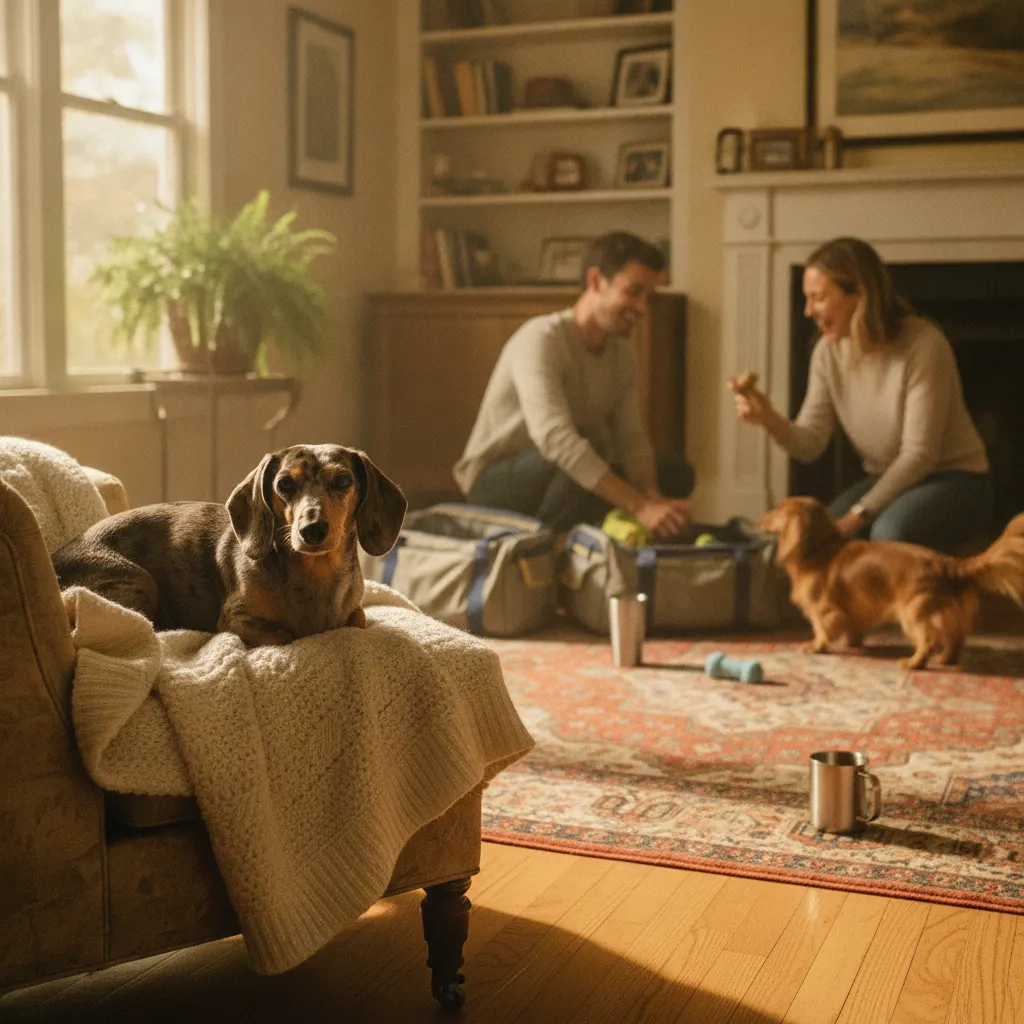
The sound of the key in the lock, a little different from yours. The rumble of suitcases on the driveway. The chorus of voices that are familiar, yet have been absent for months. And your dachshund, who was peacefully snoozing on the back of the sofa, erupts into a frenzy of barks that is part alarm, part excitement, part pure, uncut chaos. Your adult kids are home for the holidays. And while your heart swells, a little part of you is already exhausted. Managing a sensitive little **dog with house guests** isn't just about preventing them from tripping over a suitcase; it's about managing an entire ecosystem that you’ve so carefully curated for peace and quiet.
This is the strange push-pull of the empty-nester doxie parent. You crave the joyful noise of a full house again, but you also live to serve a tiny monarch who thrives on absolute predictability. The pain isn't that your dog is being 'bad.' It's the low-grade stress that hums underneath the happiness. It's the constant mental checklist: Is the door latched? Did someone leave food on the coffee table? Is the dog getting too wound up? Is he scared? You feel like a frantic diplomat trying to broker peace between two beloved parties who speak completely different languages. You find yourself snapping, "Don't feed him that!" or "Watch his back!" and you feel like the fun police. The joy of the reunion gets diluted by the anxiety of managing the four-legged family member.
So, what have we tried? We've all been there. There's the 'grin and bear it' approach, where you just let the chaos reign. You accept the frantic barking, the begging at the dinner table, the little dog getting constantly overstimulated. The result? By the time your kids leave, you and your doxie need a vacation from the vacation. Then there's the opposite tactic: 'Operation Lockdown.' You gate the dog in the kitchen or crate them in the bedroom to 'keep them out of the way.' This often leads to miserable, mournful barking that echoes through the house, making everyone, especially you, feel terribly guilty. And of course, there's the 'sergeant major' strategy, where you spend the entire visit barking orders at your adult children about dog protocol. While effective, it doesn't exactly create a warm, fuzzy holiday vibe. These methods fail because they only address the symptoms—the barking, the begging, the zoomies. They don't address the root cause: a complete and total disruption of your dachshund's world.
Why Your Doxie Isn't Being a Jerk, They're Just Overwhelmed
Here’s the perspective shift that changes everything: Your dachshund isn’t misbehaving. Your kids aren’t being inconsiderate. You are witnessing a clash of cultures. For 360 days a year, your home is a quiet kingdom where your dachshund is the center of a very predictable universe. They know the sound of your car, the time of their walk, the exact spot the sunbeam will be at 3 PM. They are masters of their domain. Suddenly, the 'big puppies' return—louder, faster, less predictable, and carrying giant, strange-smelling bags. Their entire sensory world is turned upside down. The noise level, the foot traffic, the new smells, the disruption to their nap schedule—it's a massive shock to their system. The problem isn't bad behavior; it's a legitimate case of sensory overload and routine demolition. Your job isn't to be a referee in this clash. It's to be an ambassador for your dog—to translate their needs to your guests and to create a structure that helps them feel safe amidst the happy chaos.
The Ambassador's Playbook: A 3-Step Plan for a Peaceful Full House
Instead of reacting to problems as they happen, we can create a plan that anticipates them. I call it the 'Prepare, Protect, and Preserve' framework. It’s about doing a little work upfront to make the entire visit smoother and more enjoyable for everyone, especially your sensitive sausage dog.
Step 1: Prepare the Kingdom (Before They Arrive)
Success with a **dog with house guests** begins before the doorbell ever rings. A little prep work can lower the initial shock and set a calmer tone for the whole visit.
The Scent Introduction: A week or so before your kids arrive, ask them to mail you a worn (but not gross!) t-shirt or a pair of socks. Just toss it onto the floor or near your doxie’s bed. Let them investigate it on their own terms. This simple act pre-introduces the scent of the 'invaders' in a calm, non-threatening way. When your kids walk through the door, their smell is already familiar, which can dramatically reduce the initial 'stranger danger' barking. It’s like giving them a friendly heads-up instead of a total surprise party.
Create a Designated 'Embassy': Your dachshund needs a safe space that is 100% theirs, a place where they can retreat and no one is allowed to bother them. This isn't a punishment zone; it's their private suite. If they are crate trained, their crate in a quiet corner of your bedroom is perfect. Drape a blanket over it to make it more den-like. If not, a comfy bed under a side table or in a quiet laundry room works too. The rule for everyone is simple: if the dog is in their embassy, they are left alone. No reaching in, no cooing at them. This gives them an essential off-ramp when the social energy gets too high.
The Pre-Visit Briefing: You're not nagging; you're setting everyone up for success. A few days before they arrive, send a lighthearted group text. Something like, "SO excited for you to get here! Quick doxie reminder since it's been a while: please keep your snacks on the counter and make sure the front door clicks shut. Marley's gotten really good at his 'food heist' skills!" Framing it with humor and as a reminder of the dog's quirks, rather than a list of demands, makes it go over much better. You’re just sharing the house rules, the same way you’d mention that the guest shower has tricky water pressure.
Step 2: Protect the Peace (During the Visit)
Once the guests have arrived, your role as ambassador is in full swing. Your job is to manage the environment to prevent problems before they start.
Master the Grand Arrival: The first five minutes sets the tone. Instead of letting your doxie rush the door in a barking frenzy, have them on a leash. When your kids come in, ask them to do something that feels counterintuitive: ignore the dog. Have them come in, put their bags down, and say hello to you first. This calm, low-energy entry tells your dog, "This is normal. No need to sound the five-alarm fire." After a minute or two, let the kids calmly greet the dog, maybe offering a treat. This prevents the moment from escalating into a high-pitched, over-the-top event that spikes your dog's adrenaline.
Be a Benevolent Architect: You don't have to give your dog and guests free rein of the entire house 24/7. Strategic use of baby gates can be a lifesaver. Gate off the kitchen while you're cooking a big family meal to prevent your doxie from getting underfoot or engaging in a little counter-surfing and food stealing. If your kids have a lot of stuff spread out in the guest room, gate the hallway to prevent a curious sausage from chewing on a phone charger. It’s not about restriction; it’s about proactively managing the space to keep them safe and out of trouble.
Advocate for Their Well-being: You know your dog better than anyone. Learn to spot the early signs of stress: excessive yawning when they're not tired, lip licking, showing the whites of their eyes (whale eye), or a stiff body posture. When you see these signals, it's your cue to intervene. Say, "Okay, I think Mia needs a little quiet time," and gently lead her to her 'embassy' with a favorite chew toy. You are their voice. You have to be the one to say they've had enough social time, because they can't say it themselves.
Step 3: Preserve the Routine (The Secret to Sanity)
This is the single most important part of managing your **dog with house guests**. Dachshunds are creatures of habit. The more you can stick to their core routine, the more secure and less anxious they will feel, even with a full house.
The Non-Negotiable Walk: Their daily walks are not just for potty breaks; they are for their mental health. This is especially true for their morning walk. Do not skip it or rush it. This is their time to check their 'pee-mail,' process the new smells in their territory, and decompress from the stimulating environment inside. A proper 'sniffari' where they get to lead the way and sniff to their heart's content is the best way to calm an anxious mind. I highly recommend reading up on how to conduct a proper 'sniffari' walk; it can make a huge difference. Invite your kids along if you like, but with the rule that this walk is on 'doxie time'—slow and sniffy.
Sacred Meal Times: With guests, meal times can become chaotic, all-day grazing events. It's crucial to feed your dachshund at their normal time, in their normal spot, and preferably in a quiet space away from the main hubbub. This predictable ritual is a powerful anchor for them in a day that otherwise feels unpredictable. It's a moment of comforting normalcy. And it goes without saying, but constantly remind your guests not to supplement this meal with tidbits from their own plates. This not only prevents stomach upset but also curbs the development of masterful begging techniques.
Enforce Naptime (For Everyone's Sake): Just like a toddler, an over-tired dachshund is a cranky dachshund. The constant stimulation of a full house is exhausting. Make sure they have opportunities for uninterrupted naps throughout the day, preferably in their safe 'embassy.' If everyone is settling in to watch a movie, that’s a perfect time to encourage your doxie to settle in their bed with a long-lasting chew. Don't feel guilty about enforcing downtime. A well-rested dog is a much better-behaved dog.
A Tale of Two Christmases
I remember the first Christmas after my son went to college. Marley and Mia were used to our quiet house. When he came home, with all the energy of a 19-year-old, the dogs were a wreck. Marley barked at him every time he entered a room, and Mia spent most of the week hiding under my desk. I felt horrible. I was so happy to have my son home, but the dogs' stress was a constant, nagging worry.
The next year, I tried this framework. I had him send home a sweatshirt. I set up Mia's crate in our bedroom as her official 'no-fly zone.' I sent the 'rules' text. But the biggest change was preserving their morning routine. No matter what, the three of us went on our slow, 45-minute sniffari every single morning before the rest of the house was really up and moving. It grounded them. It let them know that even though the house was different, their world was still intact. The difference was astounding. Marley still barked at the doorbell, of course—he's a dachshund—but it was an announcement, not an alarm. Mia came out for cuddles. The visit was just… easier. It was the happy, joyful chaos I had wanted, not the stressful kind.
Understanding *why* your dachshund acts out when their world is turned upside down is the key to compassion and effective management. They aren't trying to ruin the family reunion. They're just trying to make sense of it all. When you can see the situation from their perspective, you can stop being a frustrated referee and become the calm, confident ambassador they need you to be.
If you want to get even better at understanding the 'why' behind your doxie's quirky, and sometimes confusing, behaviors, our guide can help you connect the dots between their instincts and their actions. It makes being their ambassador so much easier. Get the free Dachshund Behavior Decoder and start speaking their language with more confidence.
Frequently Asked Questions
What if my dachshund is actually aggressive, not just anxious, with my kids?
True aggression (growling, snapping, lunging) is different from anxious barking and should be taken very seriously. The first step is management: use leashes, gates, and separate spaces to ensure everyone's safety. Never punish a growl, as it's a warning sign. The situation requires a consultation with your vet to rule out pain and likely a certified professional dog trainer or veterinary behaviorist to create a specific plan for your family and your dog.
My adult kids think I'm being a helicopter-parent about the dog. How do I get them to take the rules seriously?
Frame your requests around the dog's health and safety, which is harder to argue with than personal preference. Instead of "Don't let him jump off the couch," try "Please help me protect his long little back by lifting him down." Instead of "Don't feed him people food," say "His stomach is incredibly sensitive, and I really want to avoid a late-night vet visit." Connecting the rule to a tangible consequence, especially one involving the dog's well-being (and a potential vet bill!), often helps it land better.
Is it cruel to crate my dog when we have house guests?
Not at all, as long as the crate is positioned as a safe, cozy den and not a jail cell. A crate should be a comfortable space with a soft bed and a favorite toy, where your dog willingly goes to rest. It should never be used as a punishment for behavior you don't like. When used correctly, it's an invaluable tool for managing a **dog with house guests**, giving them a secure place to decompress away from the chaos.
How long will it take for my doxie to get used to the guests?
This really depends on your dog's individual temperament and their past experiences. Some easy-going dachshunds might adjust in a day, while a more timid or anxious one might remain on high alert for the entire visit. The key is consistency. By implementing this framework every time you have visitors, you teach your dog a new, predictable routine for when the house is full, which can speed up their adjustment period over time.
What can I do in the exact moment my dachshund won't stop barking at a guest?
First, increase the distance between your dog and the guest to lower the intensity. Don't yell over the barking. Instead, use a calm, upbeat tone to redirect their attention. Toss a high-value treat away from the guest for them to find. Ask them to do a simple command they know well, like 'sit' or 'touch'. If they're too worked up to listen, calmly lead them to another room with a puzzle toy or chew to help their brain switch gears and settle down.
Are calming treats or supplements a good idea for a dog with house guests?
They can be a helpful tool for some dogs, but they are not a magic solution and should never be the first or only thing you try. Always consult your veterinarian before giving your dog any new supplement. They can advise you on safe options and proper dosages. Remember, supplements can help take the edge off anxiety, but they can't replace the need for good management, a predictable routine, and a safe space for your dog to retreat to.
dachshund behavior · house guests · dog anxiety · routine management