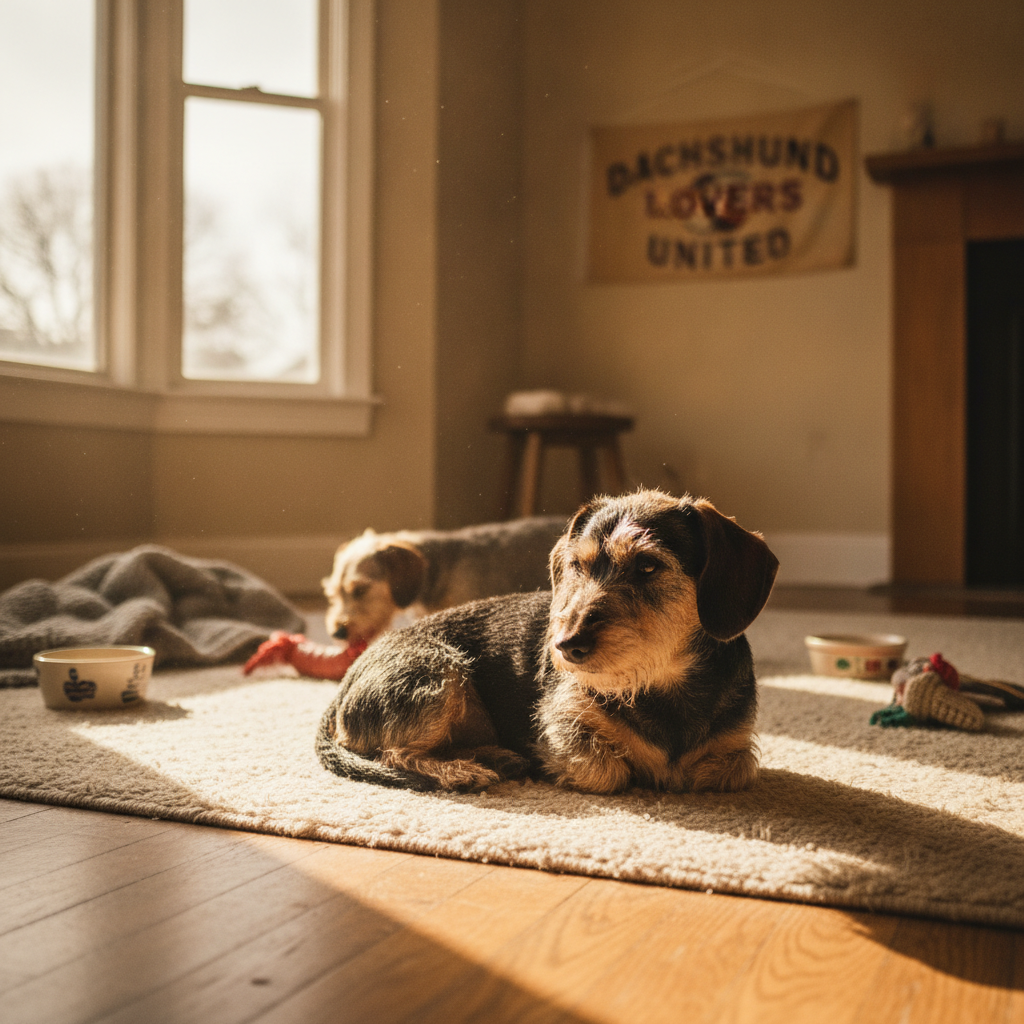
The first clap of thunder sends my long-haired cream, Mia, into a state of silent, trembling panic. She doesn’t bark. She doesn’t whine. She just vanishes. One minute she’s snoozing on the rug, the next she’s a ghost. I’ll find her wedged into the darkest corner of my closet, behind a row of shoes, shaking like a leaf. It used to break my heart into a million pieces. I felt so helpless. If you’re reading this, you know that exact feeling — the gut-wrenching worry when your little sausage dog is completely overwhelmed by a world that won’t quiet down.
You see your little companion, this brave badger hunter in a tiny body, reduced to a quivering mess by the roar of a vacuum, the pop of fireworks, or a distant storm. It’s a specific kind of pain, watching a creature you love so much experience overwhelming fear while you stand by, unable to explain that it’s all going to be okay. You have an anxious dachshund, and the guilt can be overwhelming. You wonder, “Am I doing something wrong? Is my dog broken?”
Why Hasn't Anything I've Tried Worked?
If you're like most doxie parents, you’ve probably scoured the internet and tried the standard advice. And you’ve probably found that most of it falls flat. People say, “Just ignore the behavior, don’t reward the fear.” So you try to act casual while your dog is hyperventilating under the coffee table, and you both just end up feeling more stressed. Or they say, “Coddling them makes it worse.” This one is the worst, because it makes you feel like your instinct to comfort your dog is actually harming them. It’s not.
Others might suggest flooding, or forcing your dog to “face their fear.” This is downright dangerous advice for a dachshund. Their entire history is built on a sensitive, intelligent, and deeply stubborn nature. Forcing them into a situation they perceive as threatening doesn’t teach them bravery; it teaches them that you are not a safe person to be around when they are scared. It shatters their trust. These cookie-cutter solutions fail because they don’t account for the unique wiring of a dachshund’s brain and body. They are not a generic “dog”; they are a highly specialized creature, and their fears are, in their own way, completely logical.
The Big Reframe: Your Doxie Isn't Irrational, They're Overwhelmed
Here’s the shift that changed everything for me and my dogs. Your dachshund isn’t being irrational. They aren’t being dramatic. They are experiencing a completely logical sensory overload. We have to stop seeing their fear from our human perspective and start imagining it from theirs — nine inches off the ground.
Think about it. Dachshunds were bred to have an incredibly acute sense of hearing. They needed to hear a badger rustling deep underground. That means the low-frequency rumble of thunder isn’t just a noise to them; it’s a physical sensation that vibrates through their little bodies. The high-pitched whine of the vacuum cleaner might be irritating to us, but to them, it can be like a dental drill right next to their eardrum. Fireworks are even worse — unpredictable, concussive booms combined with flashing lights. Their world is literally exploding.
When you realize their fear isn't a behavioral problem but a sensory one, everything changes. The goal is no longer to “fix” their fear, but to help them manage the overwhelming input. You stop being a frustrated trainer and become their trusted protector, their calm anchor in a world that is simply too loud for a little sausage.
The Safe Sausage Protocol: A 3-Step Framework for a Calmer Doxie
Managing a deeply anxious dachshund isn’t about finding a magic wand; it’s about creating a system of safety and predictability. I call it the Safe Sausage Protocol, and it’s built on three core ideas: creating a den, changing the association, and becoming their calm. It’s what I’ve used with Marley and Mia for years, and it works because it respects their nature instead of fighting against it.
Step 1: Create a Fortress of Solitude (The Den)
A dachshund’s first instinct when scared is to burrow. It’s in their DNA. The badger’s den was their workplace, but any dark, tight, enclosed space triggers that same feeling of safety. Your job is to create the ultimate safe space *before* the loud event happens.
This isn’t just a crate. It’s a five-star, sound-proofed, treat-filled bunker. Pick a spot — a crate, the space under a desk, a closet — and make it wonderful. Drape a heavy blanket over the crate to muffle sound and block light. Put their favorite, coziest bed inside. Add a worn t-shirt that smells like you. The most important part? This den must *only* be associated with wonderful things.
Feed them special treats in there. Give them a puzzle toy to work on inside the den. Never, ever use it for punishment. The goal is for them to choose to go there on their own. When the thunder starts, Mia doesn’t wait for me anymore. She trots directly to her blanket-covered crate because she knows it’s her safe room. We built that positive association during hundreds of calm, happy moments, so it’s there for her when she needs it most.
Step 2: Change the Forecast (Counter-Conditioning)
Counter-conditioning sounds clinical, but it’s simple. It’s about slowly changing your dog’s emotional response to a loud sound from “Oh no, the world is ending!” to “Oh, that sound means chicken is coming!” This is a marathon, not a sprint, and requires immense patience.
For Thunder/Fireworks: Find a high-quality recording on YouTube. Start by playing it at a volume so low your dog barely notices it. The second the sound starts, rain down the highest-value treats imaginable — tiny pieces of boiled chicken, cheese, or hot dogs. The second the sound stops, the treats stop. Do this for just 30-60 seconds. The next day, maybe you turn the volume up by one notch. If at any point your dog shows stress (panting, yawning, whale eye), you’ve gone too fast. Go back to the last successful volume. Over weeks and months, you are slowly rewriting their brain’s association with the noise.
For the Vacuum: This one is often harder because the machine is a physical monster in the house. Start with the vacuum turned off, sitting in the corner of a room. Every time your dog looks at it, or even exists calmly in the same room, toss them a treat. Then, have someone in another room, far away, turn it on for just two seconds while you feed treats. Slowly, you decrease the distance. This could take months. With Mia, we spent a whole week just rewarding her for being in the same room as the unplugged vacuum. Patience is everything. It's also a great time to engage them with other things, like some of the easy brain games that can stop mischief, to build their confidence around the object.
Step 3: Be Their Anchor (Managing Your Own Energy)
This might be the hardest step. Your dachshund is an expert at reading your emotional state. If the thunder rolls and you immediately tense up, thinking, “Oh no, here we go,” you have just confirmed to your dog that there is, in fact, something to be afraid of. Your anxiety fuels their anxiety in a vicious cycle.
When a storm is coming, your job is to become the most boring, calm, cheerful person in the world. Put on some calming music. Grab a book and a cup of tea. If your doxie comes to you for comfort, offer it calmly. Slow, long strokes, a quiet voice. Don’t say “It’s okay, it’s okay!” in a high-pitched, worried tone. Just breathe. Sit on the floor with them. Let them lean on you. You are not “rewarding fear.” You are providing security, which is what they desperately need. You are their pack leader, and the pack leader’s job is to signal that everything is fine.
It’s also crucial to remember that a sudden increase in anxiety can be linked to physical discomfort. An otherwise brave dog who suddenly becomes fearful might be dealing with something unseen. It’s always worth knowing the subtle signs a doxie tries to hide pain, because addressing a physical issue can sometimes resolve the behavioral one.
What if My Anxious Dachshund Needs More Help?
For some dogs, especially rescues with unknown histories or those with extreme phobias, this protocol may not be enough. And that is perfectly okay. There is no shame in seeking more help.
Your first stop should always be your trusted veterinarian. They can rule out any underlying medical issues that could be contributing to the anxiety. Pain, especially back pain from IVDD, can dramatically lower a dog’s tolerance for stress. Your vet can also discuss options like compression vests (like a ThunderShirt), calming supplements, or, in severe cases, prescription anti-anxiety medication. Medication isn’t a failure; it’s a tool that can lower your dog’s stress levels enough for training and counter-conditioning to actually be effective.
You might also consider working with a certified veterinary behaviorist or a positive reinforcement-based trainer who has experience with fear and anxiety. They can provide a customized plan for your individual dog. Remember, their bossy, brave-in-the-face-of-badgers attitude is part of their charm, but that same intensity can manifest as deep fear. Understanding this duality is key to helping them, something we explore in our guide to their 'big dog' attitude.
Living with a fearful dog is a journey of patience and deep empathy. But when you finally see your little one sleep through a distant rumble of thunder for the first time, you’ll know every moment was worth it. You’re not just managing a fear; you’re building an unbreakable bond of trust with your best friend.
Understanding their fear of loud noises is a huge step toward being the confident doxie parent your little one needs. But what about all their other quirky behaviors, from their selective hearing to their relentless burrowing? To truly get inside their head and understand the “why” behind what they do, you need a key. Get the free Dachshund Behavior Decoder and start speaking their language today.
Frequently Asked Questions
What can I give my anxious dachshund for thunder?
Always consult your veterinarian before giving your dog anything for anxiety. They can recommend safe options, which might include calming supplements with ingredients like L-theanine or tryptophan, or in more severe cases, prescription medications. Never give your dog human medication.
Can dachshunds grow out of noise anxiety?
It's unlikely for a dog to simply grow out of a deep-seated fear without help. In fact, noise phobias can worsen over time if left unmanaged, as each event reinforces the fear. Consistent, patient counter-conditioning and management are the best ways to help your anxious dachshund cope and improve.
Is a ThunderShirt a good idea for an anxious dachshund?
For many dogs, yes. A ThunderShirt or other anxiety wrap applies gentle, constant pressure, which can have a calming effect similar to swaddling an infant. It doesn't work for every dog, but it's a safe, drug-free tool that is definitely worth trying for a noise-phobic or generally anxious dachshund.
Should I crate my dachshund during a storm?
Only if the crate is already established as their happy, safe den. If your dog loves their crate and chooses to go there, it can be a wonderful comfort. If they associate the crate with being trapped or have any crate anxiety, forcing them in during a storm will only intensify their panic.
My dachshund is suddenly afraid of things they used to ignore. Why?
A sudden change in behavior, especially the onset of new fears, always warrants a trip to the vet. This can be a primary sign of pain or a medical issue. A dog experiencing discomfort, like from their back, has fewer emotional resources to cope with stress, making them seem suddenly anxious or fearful.
How long does it take for counter-conditioning to work?
This is a marathon, not a sprint. The timeline depends entirely on your dog's level of fear and how consistently you work on it. It could take weeks, months, or even longer. The key is to go at your dog's pace and celebrate small victories, never pushing them past their comfort level.
dachshund behavior · dog anxiety · noise phobia · fearful dog