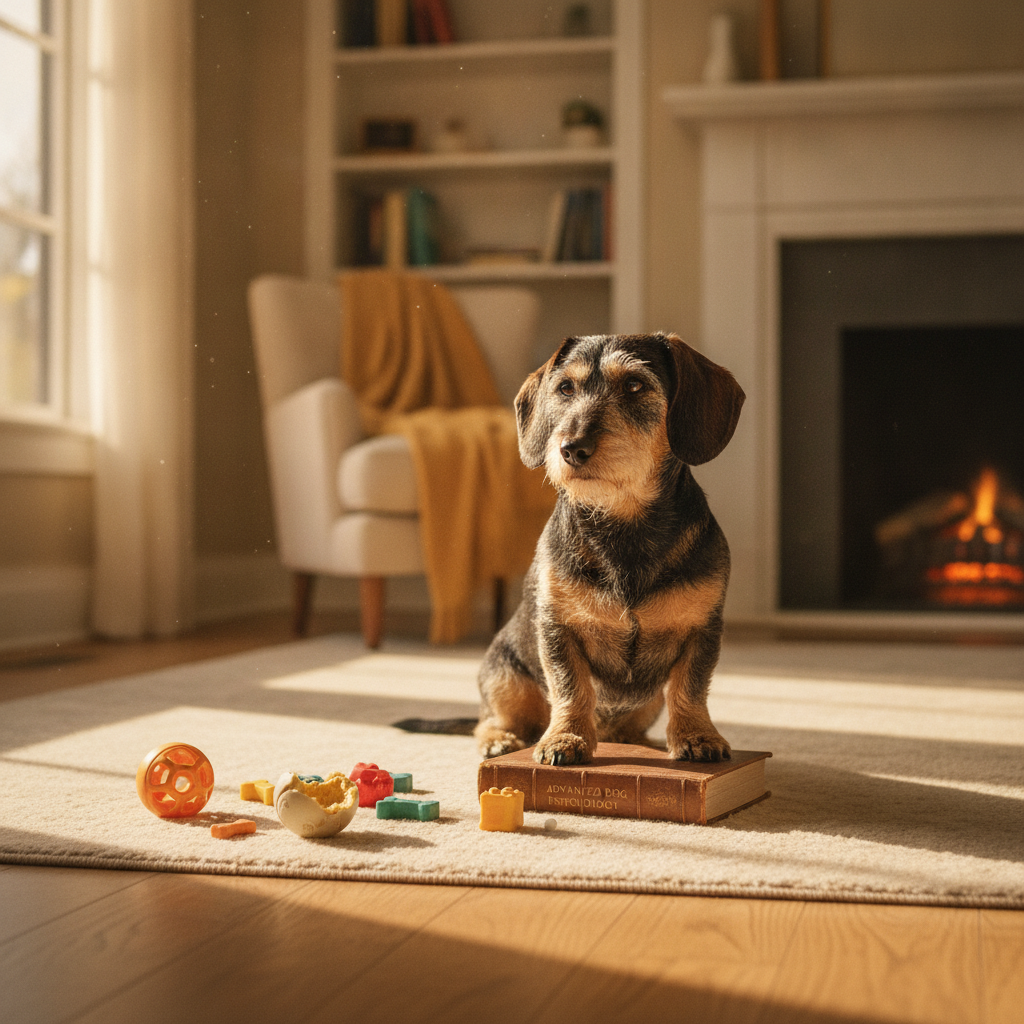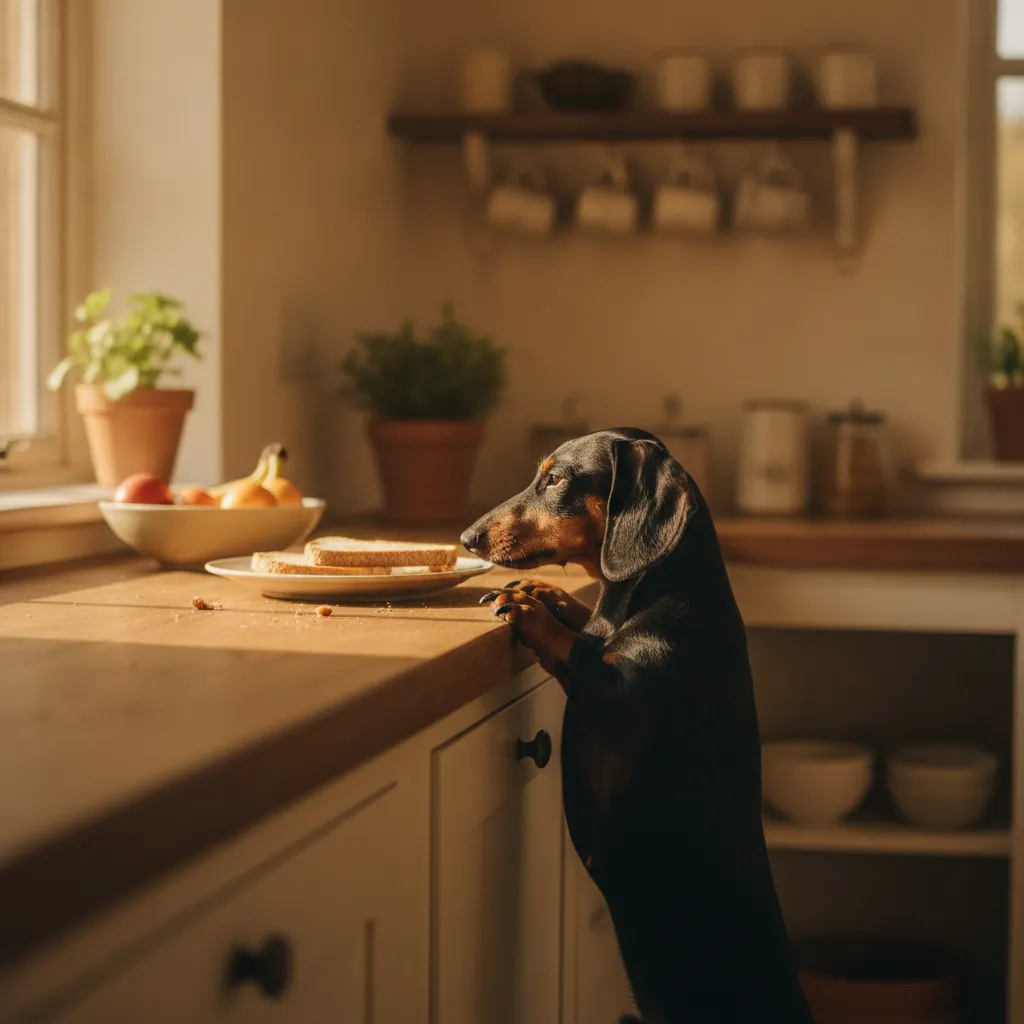
You turn your back for five seconds. Five. Seconds. You hear the tell-tale clatter of a fork hitting the floor, followed by a suspicious, incriminating silence. You spin around to see your little sausage dog, frozen mid-lick, with a smear of butter on their nose and a look that says, “Who, me?”
If this scene feels familiar, you are not alone. You are a doxie parent. Welcome to the club where we arrange our lives around the potential for low-level, food-motivated crime. The constant vigilance, the strategic placement of coasters over your coffee cup, the sinking feeling when you realize you left the butter dish too close to the edge—it’s exhausting. This isn’t just about a stolen piece of toast; it’s about the stress of knowing your clever, long-bodied companion is always waiting for that one moment of opportunity. The problem of dachshund counter surfing is one of the most common frustrations I hear about from fellow owners.
You feel like you’re living with a tiny, furry cat burglar. You worry they’ll eat something toxic. You’re embarrassed when your friend’s sandwich vanishes from the coffee table. And you’re tired of feeling like you’re constantly scolding a dog who seems to know exactly what they’re doing.
Why Hasn't Anything I've Tried Worked?
You’ve probably tried the standard advice. You’ve yelled “NO!” from the other room, only to find the crime has already been committed and your doxie just looks at you, confused. You might have tried a spray bottle, which just made them scared of you, not the counter. Maybe you tried swatting their nose, which accomplished nothing but damaging the trust you’ve worked so hard to build.
Here’s the hard truth: those methods fail because they don’t address the core of a dachshund’s being. They are built on a fundamental misunderstanding of what drives these dogs. Yelling after the fact is pointless. A dog’s brain connects a consequence to an action that happened within 1-2 seconds. By the time you find the evidence, the reward—that delicious, forbidden food—has already been claimed. To them, the yelling is just random, scary noise from their favorite person.
Punishment-based methods are even worse. They don’t teach your dachshund what you want them to do; they just teach them to be afraid of you and to be sneakier next time. They’ll wait until you’re not looking. They’ll perfect the silent snatch-and-run. You haven’t solved the problem; you’ve just created a more skilled adversary. The reason these solutions fail is that they try to punish an instinct that is 600 years in the making.
The Reframe: Your Doxie Isn't Bad, They're a Hunter
This is the most important shift you can make. Your dachshund is not being naughty, disobedient, or spiteful when they steal food. They are being a dachshund. They are being a successful hunter.
Let that sink in. Every time they snag a piece of cheese from the counter, their ancient badger-hunting brain lights up and screams, “SUCCESS! I have tracked, stalked, and acquired the prey! I am a very, very good dog!”
They were bred for centuries in Germany to have three key traits: an incredible sense of smell to track prey underground, an independent mind to make decisions without human direction, and a relentless drive to get what they want. Now, fast forward to your kitchen. That piece of chicken you left on the counter? To your doxie, it’s not your dinner. It’s a badger in a den. Their nose detects it, their brain formulates a plan, and their stubborn little heart executes the mission. They aren't breaking the rules; they are fulfilling their deepest, most hard-wired purpose.
Once you stop seeing it as a behavior problem and start seeing it as a fulfillment of their instinct, the entire game changes. You can stop being the frustrated enforcer and become the clever strategist who outsmarts the hunter by managing their environment and redirecting their powerful instincts.
The Doxie Heist-Proofing Plan: A Three-Part Framework
Solving dachshund counter surfing isn’t about one magic command. It’s a holistic approach that involves managing their world, training an alternative behavior, and ensuring their needs are met. We’re going to turn your kitchen from a tempting buffet into a boring, opportunity-free zone, and give that brilliant hunting brain a better job to do.
Part 1: The Fortress Kitchen (Management is Everything)
This is the most critical and non-negotiable part of the plan. You cannot out-train a self-rewarding behavior. Every time your doxie successfully steals food, it’s like they just hit the jackpot on a slot machine. It reinforces the behavior so powerfully that it becomes almost impossible to extinguish with training alone. Your first job is to make it impossible for them to win.
- The Clean Counter Code: Your counters must become pristine. Nothing edible is ever left out, ever. Not for a minute. Crumbs are wiped up immediately. Dirty dishes go straight into the dishwasher or are washed. Your counter should be the most boring place in the house.
- The 12-Inch Rule: For non-food items (like a coffee mug or a stack of mail), get into the habit of pushing everything at least 12 inches back from the edge of the counter. A dachshund’s reach is surprisingly long, but it’s not infinite. Make the effort not worth their while.
- Secure the Bin: A kitchen trash can is a treasure chest. Invest in one with a locking lid or one that’s tall and heavy enough that they can’t knock it over. This is non-negotiable.
- Supervision is Key: Never, ever leave food unattended. If you’re cooking and need to leave the room, the food is either moved to a high shelf or the dog is secured out of the kitchen with a baby gate. It only takes a few seconds for a heist to occur.
Management feels like a lot of work at first, but it quickly becomes a habit. And it’s the only way to break the cycle of reward. You are removing the opportunity for them to practice being a food thief.
Part 2: The Redirected Hunter (Give Them a Better Job)
Once you’ve made stealing impossible, you need to address the brilliant, bored brain that’s driving the behavior. A dachshund needs a job. If you don’t give them one, they will appoint themselves Head of Kitchen Security and Snack Acquisition. Here are two skills and one activity that will change everything.
1. Master the "Place" CommandInstead of yelling “No!” when they’re sniffing around the kitchen, give them a clear “Yes!” Tell them what you want them to do instead. The "place" command teaches your dog to go to a specific spot, like a mat or a dog bed, and stay there until released.
This is their "workstation." While you cook, their job is to be on their mat. Start small. Lure them onto the mat, say “Place,” and reward. Gradually increase the duration. Send them to their place while you open the fridge. Reward. While you chop a vegetable. Reward. Make the mat the best place in the house, where all the good things happen. This gives them a productive role during meal prep, turning them from a nuisance into a helpful (and stationary) partner.2. Teach a Rock-Solid "Leave It"
"Leave It" is a safety command, not a punishment. It should be taught with positive reinforcement, making it a fun game. Start by placing a boring piece of kibble in your closed fist. Let your doxie sniff and lick. The second they pull their head away, even for a millisecond, say “Yes!” and give them a high-value treat from your *other* hand. Repeat until they are automatically backing away from your closed fist. Then, progress to an open hand, then the floor. The rule is simple: ignoring the forbidden item gets them something even better. This teaches self-control and shows them that leaving things alone is more rewarding than stealing them.
3. Provide Mental EnrichmentA tired dog is a good dog, but a mentally tired dachshund is a saint. Their brains crave puzzles. Instead of feeding them from a bowl, make them work for their food. This satisfies their hunting and foraging instincts in a safe, approved way.
As I explain in my guide to brain games for dachshunds, activities like snuffle mats, puzzle toys, and slow feeders are fantastic outlets. A 15-minute session with a puzzle toy can be more tiring than a 30-minute walk. It gives that busy brain the workout it needs, so they’re less likely to go looking for their own “puzzles” on your kitchen counter.
Part 3: The Calorie Count (Are They Truly Hungry?)
Finally, let’s do a quick gut check. While most food stealing is instinctual and opportunistic, it’s worth ensuring their basic needs are being met. Are you feeding them high-quality food on a consistent schedule? Are they getting the right amount for their age, weight, and activity level? An always-famished dog will be more motivated to take risks.
Remember, many human foods are dangerous for dogs. A successful counter-surfing expedition could lead to them ingesting something toxic like onions, grapes, or xylitol. Even rich, fatty foods can trigger pancreatitis, a painful and serious condition. Protecting them from themselves is a core part of our job as their guardians. If you want to learn more about other health issues to be aware of, check out my article on common dachshund health quirks.
From My Kitchen to Yours: Marley the Bread Bandit
I speak from experience. My Marley, for years, was a notorious bread bandit. He could hear a plastic bread bag crinkle from three rooms away. He once managed to pull an entire loaf of sourdough off the very back of the counter. I was convinced he could levitate.
I had tried yelling. I had tried shaming him (which, for the record, they don’t understand—that “guilty look” is just appeasement behavior). Nothing worked. The change came when I stopped seeing him as a bad dog and started seeing him as an under-employed hunter. I implemented the “Fortress Kitchen” protocol. All bread now lives in a bread box. The counters are bare. It was an adjustment for the humans, but it worked.
Simultaneously, we made his mat his “job site.” He learned that when I was cooking, his job was to be on his mat, and that good things (like tiny pieces of carrot) would magically appear there. We also introduced a snuffle mat for his breakfast. He was so focused on his “work” that he lost interest in my work. The counter-surfing didn't just stop; the entire dynamic in our kitchen changed from a battle of wills to a peaceful co-existence. He had a job he enjoyed, and I could finally make a sandwich in peace. It proves that even the most stubborn, food-obsessed wiener, like my other boy Mia who often exhibits the classic selective doxie hearing, can learn new patterns when we meet them where they are.
Stopping the food heists isn't about winning a battle; it's about understanding the clever little mind you share your home with. It’s about respect for their instincts and smart management of their world. When you learn to decode their behavior, you can work with their nature, not against it. To get deeper into their quirky little brains and become a more confident doxie parent, I’ve put all my best insights into one place. Get the free Dachshund Behavior Decoder.
Frequently Asked Questions
Why does my dachshund steal food even when they're not hungry?
It's less about hunger and more about instinct and opportunity. For a dachshund, finding and acquiring food is a deeply rewarding, self-reinforcing behavior that mimics the hunt they were bred for. The thrill of the chase and the prize at the end are often more compelling than an empty stomach.
Will punishing my dachshund for counter surfing stop the behavior?
No, punishment is ineffective and often counterproductive. It can create fear and anxiety, and it teaches your dachshund to be sneakier, not to stop the behavior. Effective training for dachshund counter surfing focuses on managing the environment to prevent success and teaching them alternative, positive behaviors.
Is dachshund counter surfing dangerous for them?
Yes, it can be very dangerous. Many human foods are toxic to dogs, including onions, garlic, chocolate, grapes, and artificial sweeteners like xylitol. Stealing cooked bones can cause choking or internal damage, and ingesting rich, fatty foods can lead to a painful and serious condition called pancreatitis.
My dachshund is a puppy. How can I prevent counter surfing from ever starting?
Prevention is the best strategy! Start with management from day one. Never let your puppy be rewarded for putting their paws on the counter or stealing food. Keep counters clear, use baby gates to manage their access to the kitchen, and provide plenty of appropriate chew toys and puzzle feeders to keep their minds engaged.
What if I can't watch my dachshund every second I'm in the kitchen?
This is where management tools are essential. Use a baby gate to keep your dachshund out of the kitchen while you're cooking or unable to supervise them directly. Alternatively, you can use a crate or a playpen in a nearby room with a special chew or puzzle toy to keep them happily occupied.
dachshund training · counter surfing · dog behavior · food stealing