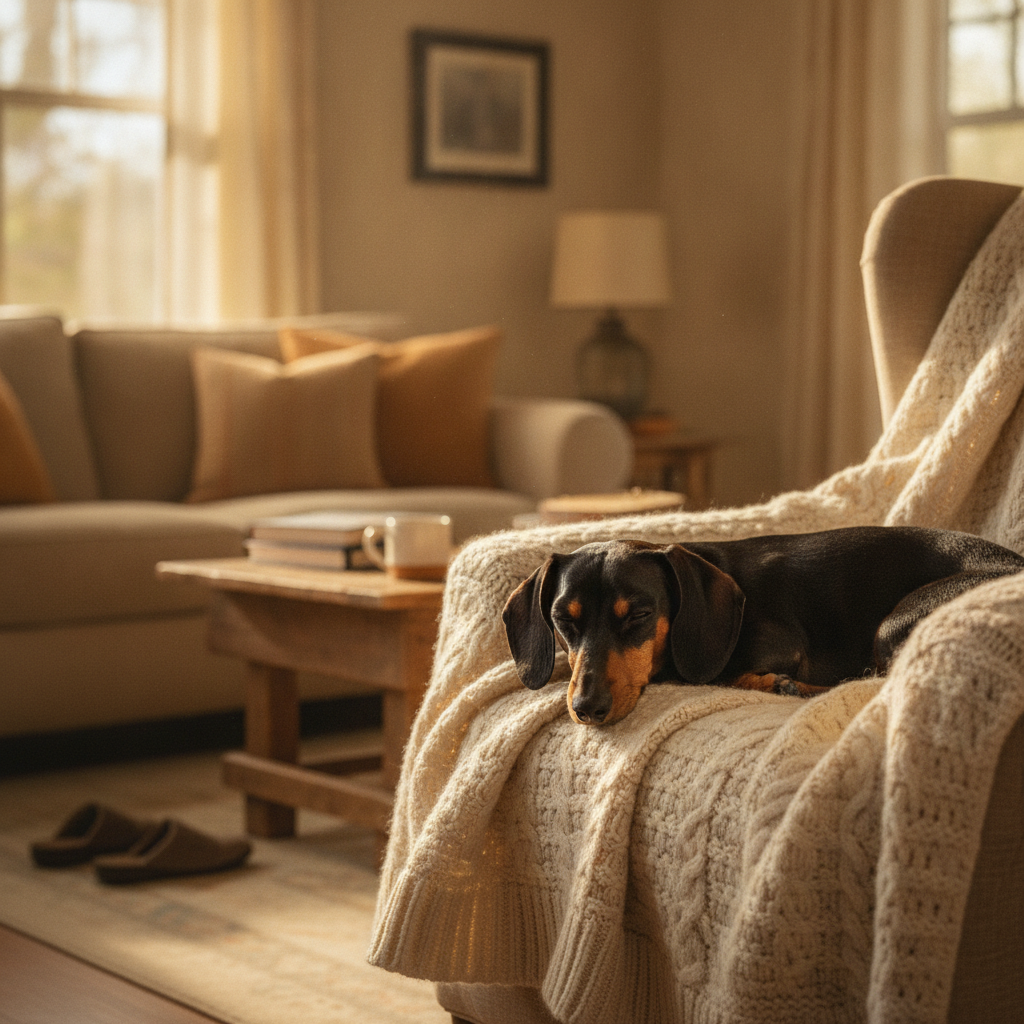
Why Does My Dachshund Beg So Much?
You sit down with a plate of food. You haven’t even taken the first bite, but you can feel it. A presence. Two big, brown, soul-piercing eyes are locked on your fork, tracking its every move from plate to mouth. Then comes the sound. It starts as a faint, almost imperceptible whimper. A little puff of air through the nose. If that doesn't work, it escalates to the full-throated, heart-wrenching Wiener Whine. This is the soundtrack to dinner in a dachshund house. If you're reading this, you know exactly what I'm talking about. The masterful art of dachshund begging isn't just a nuisance; it's a form of psychological warfare waged by a 15-pound general.
A quick note before we get started: this guide is for managing the consistent, lifelong begging that's part of the doxie charm. If your dog has suddenly become ravenously hungry or started begging intensely when they never did before, that kind of abrupt change is always worth a call to your vet. It's important to rule out any underlying health issues first. But if you're dealing with a seasoned professional who has been honing their craft for years, you're in the right place.
For nearly two decades, my life has been narrated by the hopes and dreams of my doxies, Marley and Mia. I’ve seen every trick in the book. Mia had this pathetic little tremble she’d do with her lip, making her look like a starving orphan in a Victorian novel. Marley was more direct—he’d just rest his long chin on my knee and sigh with the weight of a thousand forgotten snacks. It’s funny, it’s cute, but it’s also deeply frustrating. You feel guilty for eating your own dinner. You worry you're spoiling them, or worse, contributing to weight gain that could harm their long little backs. You just want a peaceful meal, but you feel like you're being held hostage by a tiny, furry dictator.
The Cycle of Guilt: Why 'Just Saying No' Doesn't Work
So, what have you tried? I'm willing to bet the list looks familiar. First, there's the firm "No!" This often results in the dachshund looking at you with a slight head tilt that seems to say, "Fascinating. Anyway, about that chicken..." To a dachshund, any attention is good attention. A stern word is just the opening volley in a negotiation, not the end of the discussion. They are not like other dogs; their persistence was honed over centuries of badger hunting. They don't give up.
Next, you tried ignoring them. This is, perhaps, the most heroic and foolhardy strategy. You stare at the TV, you talk to your partner, you pretend the low-frequency hum emanating from the floor doesn't exist. But a dachshund sees your silence and raises you a paw on the leg. Then a nudge with the nose. Then a bark. They are masters of escalation. They will find the one sound, the one action, that you simply cannot ignore. Your willpower is finite; their hope is eternal.
And that leads to the final, fatal mistake: giving in "just this once." Maybe you're tired. Maybe they're just too cute. Maybe you toss them a tiny piece of carrot to buy yourself five minutes of peace. What you've just done is activated the Las Vegas slot machine principle in their little brains. It's called intermittent reinforcement, and it's the most powerful force in behavioral psychology. By paying out randomly, you've taught them that the jackpot might come on the next pull, or the next, or the next. You haven't stopped the begging; you've made it ten times stronger. You've created a gambler who will now whine, paw, and stare with even more conviction, because they know that eventually, it pays off.
The Big Reframe: Your Doxie Isn't Bad, They're a Dachshund
Here’s the most important thing I can tell you: You are not a bad dog owner, and your dachshund is not a bad dog. You have simply been outmaneuvered by a creature genetically programmed for persistence. The frustration you feel is valid, but it’s aimed at the wrong target. The problem isn't the dog; it's the system—or lack thereof.
Dachshunds were bred to be independent thinkers. Deep in a dark tunnel, face-to-face with a furious badger, they couldn't look to a human for instructions. They had to make their own decisions, be relentless, and communicate loudly. That DNA doesn't just vanish because they now live in a cozy house with fluffy blankets. Their begging isn't malice; it's instinct. They are communicating a desire—*"I want that delicious thing!"*—in the most effective way they know how. They are, in their own way, hunting your dinner.
The behavior we call "begging" is just a hunter's focus without a job to do. Our task isn't to punish the focus, but to give them a better job.
When we see it this way, everything changes. We stop seeing a naughty dog trying to manipulate us and start seeing a brilliant, driven creature whose instincts are spilling out sideways. You haven't failed; you've just accidentally trained them that the job of "Whine at the Human" has a great, albeit unpredictable, paycheck. The solution, then, is not to get angry or to fight their nature. The solution is to offer them a new, more rewarding, and much quieter job during mealtimes.
The Mealtime Treaty: A 4-Step Plan for Peace and Quiet
We're not going to fight 600 years of breeding. We're going to redirect it. This framework is about teaching your dachshund what you *want* them to do, instead of just punishing what you *don't* want. It requires patience and consistency, but the payoff is a lifetime of peaceful dinners.
Step 1: Create the 'VIP Lounge'
Your first step is to define a designated spot for your dachshund to be during your mealtimes. This is not a punishment corner; it is their exclusive, high-value 'VIP Lounge.' Choose a comfy dog bed or a special mat. Place it somewhere you can see them from the table, but not so close that they're still underfoot. The key is to make this spot the best place on Earth. For the first week, long before you ever use it during a meal, you will "charge" this spot with positive associations. Randomly toss super high-value treats onto the bed. Give them their favorite toy *only* when they're on the bed. The goal is for them to think, "Wow, amazing things happen here!"
Step 2: Introduce the 'Place' Command
Once they love their VIP Lounge, we give the behavior a name. Lure your doxie onto the bed with a treat. The moment all four paws are on it, say "Place!" in a happy, upbeat voice and give them the treat. Repeat this over and over in short, fun sessions throughout the day. Don't add duration yet. Just: get on the mat, hear the word, get a treat. We are building a powerful, positive association with the act of going to their spot on command.
Step 3: The Long-Lasting 'Job'
This is the secret weapon against dachshund begging. Your doxie needs a job to do that is more interesting than watching you eat. Before you sit down for your meal, you will give them a special, long-lasting chew toy *only* in their VIP Lounge. A frozen Kong stuffed with peanut butter or pumpkin, a bully stick, or a safe dental chew are all great options. This becomes their "meal." It occupies their mouth, their paws, and their powerful little brain. They learn that when the humans eat, they get something even better.
Step 4: Putting It All Together (and Surviving the Whine)
Now, it's go time. Before you serve your own plate, lead your dachshund to their VIP Lounge. Give them the "Place" command. Once they're settled, give them their special Kong or chew and praise them. Then, go eat your dinner.
They *will* get up. The first few times, they might finish their Kong and wander over to see what you're having. Do not say a word. No scolding, no negotiating. Simply get up, gently take them by the collar or harness, and lead them back to their spot. Then sit back down. The first time, you might do this ten times in one meal. It will be frustrating. But your calm, boring consistency is the message. The only fun, rewarding place to be during dinner is the VIP Lounge. Everywhere else is boring.
Be prepared for what behaviorists call an "extinction burst." When a behavior that used to work suddenly stops working, the animal will often try it one last time with maximum effort. The whine will get louder. The stare will get more intense. This is the final test. If you can ride out this wave without giving in, you are on the home stretch. This is the moment they learn, for good, that the old way is broken and the new way is the only way.
From My Pack to Yours: It Really Works
With Mia, the lip-trembling drama queen, this process was a battle of wills. The first week, I felt like a yo-yo, getting up and down from the table to lead her back to her bed. She let out whines so pathetic I thought the neighbors might call security. But I held firm. I remembered she wasn't being bad; she was just confused about the new rules. By the second week, she was only getting up once or twice per meal. By the third, she'd chew her Kong, and when she was done, she'd often just curl up and fall asleep in her VIP Lounge.
The peace was incredible. It wasn't about "winning" or "beating" her. It was about creating a routine that worked for all of us. She was happy and occupied, and we were relaxed. We replaced a source of constant conflict with a moment of shared, peaceful routine. It's a testament to the fact that even the most stubborn sausage dog can learn when we communicate clearly and kindly. It's not about being a stern disciplinarian; it's about being a benevolent leader who sets clear, consistent boundaries. And understanding the 'why' behind their behavior is the first step.
If you want to become fluent in the language of your dachshund—to understand why they burrow, why they bark at the mailman, and why they give you that classic doxie side-eye—it all comes down to their core instincts. Learning to see the world through their eyes is the key to a happier life together. That's why I created a guide to help you do just that. To understand the 'why' behind their quirky behavior and become a more confident doxie parent, Get the free Dachshund Behavior Decoder.
Frequently Asked Questions
What if my dachshund cries or barks when I send them to their place?
This is very common and is often part of the "extinction burst." They are trying their old, successful tactics one last time. The key is to remain calm and neutral. Don't scold them, but don't give in. Consistently and boringly lead them back to their spot. If they have a high-value chew, most will eventually settle.
Can I ever give my dachshund table scraps?
The safest rule is to never feed them directly from your plate or the table again. This creates a direct link between your food and them getting a reward. If you want to give them a dog-safe human food treat (like a piece of carrot), put it in their bowl long after you have finished eating. The context is everything.
How long will it take to stop the dachshund begging?
This depends entirely on your consistency and your dog's level of established habit. Be prepared for it to take several weeks, or even a couple of months for a very persistent dog. Every time you are inconsistent, you reset the clock. But with perfect consistency, you will see progress within the first week or two.
What if I have two dachshunds and only one begs?
Train them both together! Create a VIP Lounge for each of them. When you implement the Mealtime Treaty, both dogs go to their respective places and both get a special chew. This prevents the non-beggar from getting jealous and learning to beg from their sibling.
Is it cruel to ignore their begging?
It's actually much kinder to teach them clear, predictable boundaries. Living with constant uncertainty and trying to get what they want through whining is stressful for a dog. Providing a calm, structured routine where they know exactly what to expect is a gift that reduces their anxiety and strengthens your bond.
My dachshund begs for things other than food, like attention. Does this method work for that too?
Absolutely. The principle is the same: ignore the unwanted behavior (demand barking/whining) and teach them a polite alternative. For example, if they bark at you for attention, teach them that bringing you a toy is what earns them playtime. You are redirecting the same instinct—communicating a need—into a more appropriate channel.
dachshund training · dog begging · positive reinforcement · dachshund behavior