Is Crate Training a Dachshund Even Possible?
You close the crate door, and the countdown begins. Three... two... one... and there it is. A sound that could shatter glass and your willpower simultaneously. A high-pitched, operatic shriek of protest that says, “How could you betray me like this?” You stand on the other side of the door, heart sinking, wondering if you’re a monster. Is this little wire box a torture chamber? A doxie dungeon? This is the exact moment where so many loving doxie parents give up on crate training a dachshund, convinced it’s a cruel and impossible task for such a famously stubborn breed.
The guilt is real. You see those big, soulful eyes staring at you through the bars, and every instinct screams to open the door and scoop them up. You’ve tried everything, right? You tossed in their favorite squeaky toy. You lined it with the softest blanket you own. You even left the TV on for them. But the moment you walk away, the protest begins. It feels personal. It feels like they hate you, and they hate this cage you’re forcing them into. You start to believe the narrative: maybe dachshunds just can’t be crate trained. Maybe they’re too smart, too stubborn, too bonded to their people.
Why Your Previous Attempts at Crate Training Failed
Here’s the thing: you aren’t a bad dog owner. And your dachshund isn’t being “bad” or manipulative. The reason your efforts have failed is that you’ve been trying to solve the wrong problem. Tossing in a toy or a soft blanket is like putting a band-aid on a broken arm. You’re addressing the surface-level symptom (boredom or discomfort) instead of the root cause: your dachshund sees the crate as a trap, not a territory.
Think about it from their perspective. This weird box appears. You, their trusted leader, lure them in and then... you lock them in and walk away. For a dog bred for centuries to burrow deep into the earth to face down a badger—a creature that thrives on tight, dark, safe spaces—this reaction seems backward, doesn't it? The issue isn't the box itself. The issue is that we, as humans, have presented it as a prison. We focus on the door, the lock, the confinement. We project our own feelings about being “caged” onto them. And our dogs, masters of reading our energy, pick up on that anxiety and mirror it right back at us. Your previous attempts failed because they were all about making a prison cell more comfortable, not about changing the fundamental meaning of the space itself.
The Reframe: It's Not a Cage, It's a Den
This is the most important shift you will ever make in your approach to crate training. Stop thinking of it as a crate. From this moment on, it is a *den*. It is your dachshund's private bedroom, their safe space, their personal burrow where nothing bad can happen. Dachshunds are instinctual burrowers. They dig in blankets, tunnel under pillows, and shove their noses into the deepest crevice of the couch. This is not a quirk; it’s a deeply embedded genetic drive for safety and security. A proper den is a place of ultimate safety.
When you successfully reframe the crate as a den, the entire dynamic changes. You are no longer “locking them up.” You are “giving them access to their safe space.” The goal isn’t to teach them to tolerate confinement. The goal is to cultivate such a deep love for their den that they choose to go in on their own. My little Mia used to be the queen of crate protest. Now, when my other doxie, Marley, is being too rambunctious, she will voluntarily trot into her crate and curl up for a nap. She’s not being punished; she’s retreating to *her* room. This is the goal. Not tolerance, but preference. It’s not a doxie dungeon; it’s a cozy den. And once you truly believe that, you can start teaching your dog to believe it, too.
The Cozy Den Method: A Step-by-Step Guide to Crate Training Your Dachshund
Alright, let's get practical. This isn't a race. The biggest mistake people make is moving too fast. With a dachshund, patience isn't just a virtue; it's a non-negotiable requirement. We’re going to build a new foundation of positive association, brick by brick.
Phase 1: The Open-Door Policy (Duration: 3-7 Days)
For the first several days, the crate door does not close. Period. Your only job is to make the crate the single greatest place in the entire house.
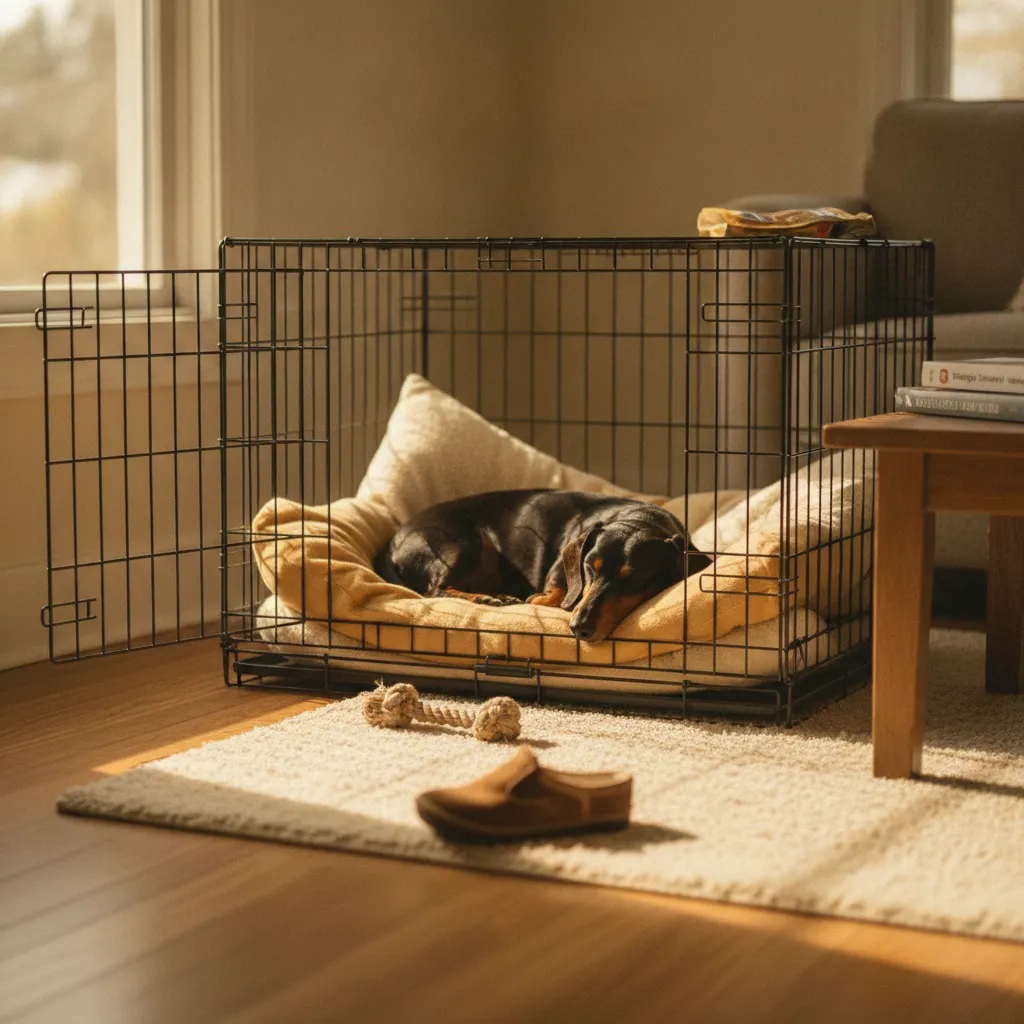
- Location, Location, Location: Place the crate in a central part of your home, like the living room. You want it to feel like part of the pack's territory, not an isolated cell in a spare bedroom.
- Make it a Five-Star Hotel: Put the coziest, most comfortable bedding inside. A blanket that smells like you is a fantastic choice.
- The Magic Food Dispenser: From now on, all good things happen in the den. Feed every single one of your doxie’s meals inside the crate. Just place the bowl at the very back. At first, they might just stick their head in. That's fine! Let them. The door stays wide open.
- High-Value Treats Only: Start randomly dropping super high-value treats (think tiny pieces of chicken, cheese, or freeze-dried liver) into the crate when they aren't looking. Let them “discover” these treasures on their own. The den should become a place where magic food appears.
- No Force, Ever: Do not push, pull, or shove your dachshund into the crate. Your job is to make it so appealing that they *want* to go in. Let them explore it on their own terms. If they walk in, sniff, and walk out, that’s a win. Praise them calmly.
Phase 2: The Door is Not Lava (Duration: 2-4 Days)
Once your doxie is willingly going into the crate to eat and nap with the door open, you can begin to introduce the door. We're talking baby steps here. Micro-steps, even.
- The One-Second Close: While your doxie is inside eating a high-value treat, gently swing the door closed, and immediately open it again. Don’t even latch it. Just close-open. Then give them another treat. Do this a few times. We are teaching them that the door closing is not a scary event; in fact, it predicts another treat.
- Add a Latch: Once they are comfortable with the close-open game, do the same thing, but latch it for one single second. Latch, unlatch, open, treat. The entire process should take two seconds.
- Gradual Increase: Slowly, over many repetitions, increase the duration. Two seconds. Four seconds. Five seconds. The key is to open the door *before* they have a chance to get anxious or start whining. If they whine, you’ve gone too fast. Go back a step to a shorter duration where they were successful.
Phase 3: Building Duration and Your Departure
This is where the real training begins. Your doxie can now handle the door being closed for a minute or two while you're sitting right there. Now, we add distance and time.
- The Crate-Only Jackpot Toy: Find a toy they go absolutely crazy for, like a puzzle feeder or a frozen Kong stuffed with peanut butter. This toy *only* comes out when they are in the crate. It's their special den activity. This helps them associate the crate with a super fun, engaging task, which is a great distraction from your absence. This is also a fantastic way to redirect some of that powerful doxie urge to chew. If you're struggling with destructive chewing, our guide to dachshund chewing can offer more ideas.
- Leave the Room: Give them their jackpot toy in the crate, close the door, and walk out of the room for 10 seconds. Come back in *before* the toy is finished and *before* they start to whine. Act completely casual. Don't make a big deal of it. Open the crate and go about your day.
- The Departure Drill: Dachshunds are smart. They learn our departure cues—jingling keys, putting on shoes, grabbing a coat. These cues can trigger anxiety before you even leave. Practice these things *without* leaving. Pick up your keys and go sit on the couch. Put your coat on and watch TV. This desensitizes them, teaching them that keys don't always mean you're abandoning them forever. For doxies with more serious separation anxiety, you might find our guide to helping an anxious dachshund helpful.
What NOT To Do: The Cardinal Sins of Crate Training
- Never Use the Crate as Punishment: This is the fastest way to undo all your hard work. The den must always be a sanctuary, never a jail cell. If you’re having a potty training issue or they chewed a shoe, putting them in the crate will only teach them that the crate is where they go when you’re angry.
- Don't Let Them “Cry It Out”: This is outdated and damaging advice. Letting a dachshund scream in the crate doesn't teach them to self-soothe; it teaches them that they are alone, unsafe, and no one is coming to help. It builds panic and anxiety, creating a much bigger problem. If they are crying, it means you’ve moved too fast. Go back to the last step where they were successful and build up more slowly.
- Keep Hellos and Goodbyes Boring: A huge, emotional farewell or a frantic, excited greeting puts too much emotional weight on your departure and arrival. When you leave, give them their toy and a simple “be back soon,” then walk out. When you return, ignore them for the first minute while you put your things down. Let them out calmly. This teaches them that your coming and going is not a major life event.
Remember the golden rule of dachshund training: quirks are consistent; problems are a change. If your dog has always been a bit fussy about the crate, that's a training issue. If your perfectly crate-trained dog suddenly starts panicking, that's a signal. A sudden behavioral change warrants a conversation with your vet to rule out any underlying pain or discomfort. Your vet is always the ultimate authority on your individual dog's health.
Crate training a dachshund is not about breaking their will; it’s about speaking their language. The language of dens, of safety, of burrows. My Marley and Mia both have their own crates, and they are their little private apartments. It gives them a sense of security, and it gives me peace of mind knowing they are safe and sound when I can't supervise them. It’s a tool of love and safety, not confinement. When you see it that way, your stubborn little sausage will, too.
Understanding the 'why' behind their crate behavior is a huge step. But what about why they burrow in your laundry, why they give you that intense stare, or why they insist on barking at the mail carrier like it's a personal insult? These aren't random quirks; they're clues to how your doxie sees the world. To become a truly confident doxie parent, you need to learn to decode that behavior. That's why I created a free guide to help you do just that. Get the free Dachshund Behavior Decoder and start understanding the brilliant, stubborn, loving little mind of your sausage dog.
Frequently Asked Questions
What if my dachshund cries and barks in the crate?
Crying and barking are signs of distress. It means you've likely moved too fast in the training process. Avoid the "cry it out" method, as this can increase anxiety. Instead, go back to a shorter duration where your dog was comfortable and build up again much more slowly, ensuring every experience with the crate is a positive one.
How long can a dachshund stay in a crate?
An adult dachshund can typically stay in a crate for up to 4-6 hours, but never more than 8. Puppies need much more frequent breaks—a good rule of thumb is one hour for every month of age, plus one (e.g., a 3-month-old puppy can handle about 4 hours). Never use the crate to warehouse your dog for an entire workday without a break.
Should I put food and water in the crate?
For short periods, it's not necessary. For longer stays, a sturdy water bottle or a spill-proof bowl is a good idea. It's also great to provide a puzzle toy or a safe chew to keep them occupied. Feeding meals in the crate is a core part of making crate training a dachshund a positive experience, as it builds a strong association with good things.
My rescue dachshund is terrified of the crate. What do I do?
With a rescue, you may be dealing with past trauma where a crate was used improperly or for long-term confinement. The process is the same, but you must go incredibly slowly and be extra patient. It may take weeks just to get through Phase 1. For more specific advice, consider reading our guide on adopting a rescue doxie.
Can I start crate training an older dachshund?
Absolutely! It's never too late. An older dog may have more established habits, so the process might take longer than with a puppy, but the principles of positive association are exactly the same. The key with an older dog is patience and consistency to help them unlearn any old anxieties and learn that the den is a safe, wonderful place.
crate training · dachshund behavior · puppy training · dog anxiety