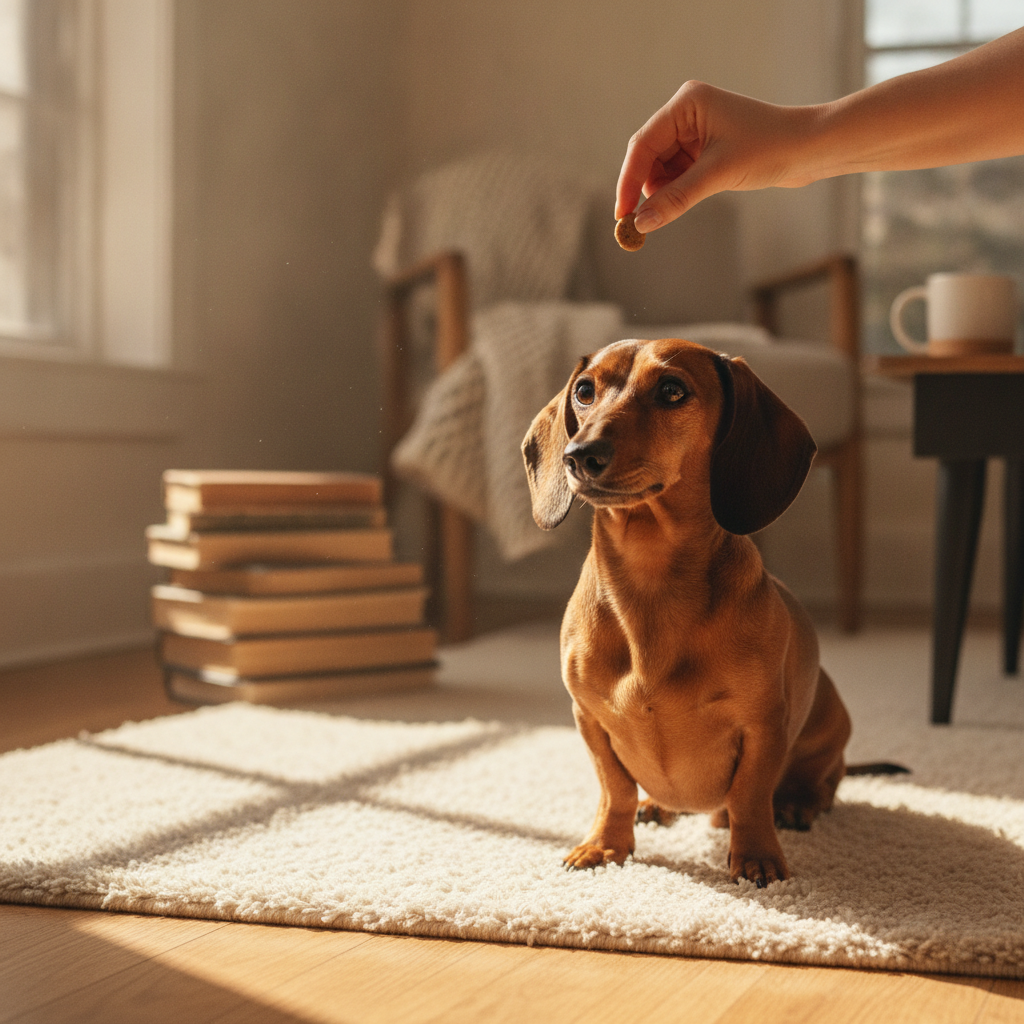
I once spent a solid ten minutes trying to teach my dachshund, Marley, to ‘shake.’ I had the tastiest bit of chicken in my hand. He looked at me, looked at the chicken, looked back at me, then deliberately laid down with a sigh that could curdle milk. He wasn’t confused. He was communicating, very clearly, that this whole song and dance was beneath him. He wanted the chicken, sure, but on his own terms. It wasn’t a negotiation; it was a refusal to entertain my nonsense. And in that moment, I had the thought that every doxie parent has: is my dog a genius, or am I just losing my mind?
The Great Dachshund Standoff: Why You Feel Like You're Failing
Let's be honest. You've seen those videos of Border Collies learning a new trick in three tries. You’ve watched your neighbor's Labrador sit patiently for minutes on end. Then you look at your own sausage dog, who seems to be weighing the pros and cons of your 'sit' command like it’s a complex stock market trade. It’s easy to feel like a failure. You start asking yourself, are dachshunds hard to train, or is it just me? You feel a mix of frustration, confusion, and maybe even a little embarrassment when your long little dog decides to play deaf at the park.
The pain is real. It’s the feeling that you’re not connecting with your dog. It’s the worry that their stubbornness will lead them into danger, like ignoring a ‘come’ command near a busy street. You love this quirky, bossy, blanket-stealing creature more than words can say, but you can’t shake the feeling that you’re locked in a battle of wills you can’t possibly win.
Why Standard Dog Training Fails Your Doxie (Miserably)
So you did what any good dog parent would do. You bought the books, watched the videos, and maybe even signed up for a puppy class. You learned about positive reinforcement, clickers, and consistency. But when you tried it at home, it fell flat. Why? Because most dog training advice is written for dogs who were bred to be people-pleasers—Retrievers, Shepherds, Spaniels. These dogs were created to work in close partnership with humans, looking to them for the next command.
Your dachshund was not. Your dachshund was bred to dive into a dark tunnel, hunt down a ferocious, toothy badger, and make all the life-or-death decisions on its own, without any human input. Repeating ‘sit’ fifty times to a dog with that resume is like telling a special forces operative to fill out TPS reports. They can do it, but they’re going to find it profoundly boring and pointless.
The ‘one-size-fits-all’ approach fails because it doesn't respect the core of what a dachshund is. They aren't motivated by a simple desire to please you. They are motivated by self-interest, problem-solving, and a deep, instinctual drive to do what they were bred for. Trying to force a people-pleaser mindset on a badger-hunter is a recipe for frustration for both of you.
The Reframe: Your Dachshund Isn't Stubborn, He's the CEO
This is the most important thing I’ve learned in nearly 20 years with this breed: you have to stop thinking of them as stubborn. Stubborn implies they’re refusing to do something they know they should. In reality, they are making a calculated decision based on what they believe is the best course of action. They aren't disobedient; they're independent contractors. As I've said before, your dachshund isn't stubborn, he's a badger hunter.
Imagine being deep underground, facing a cornered animal. You can't look back to your human for help. You have to decide, right now, whether to attack, retreat, or hold your ground. That level of independent judgment is baked into their DNA. When you ask them to ‘stay’ and a squirrel runs by, their brain isn't thinking, “I must obey.” It's thinking, “Threat detected. Must investigate. The human can wait.” They aren't ignoring you; they are prioritizing what their instincts scream is more important. The key to training isn't to break their will, but to convince them that your plan is the better business decision.
How Do You Train a Dog That Thinks It's Your Boss?
So, if the old ways don't work, what does? You have to become a Doxie Diplomat. It’s less about giving commands and more about cutting deals. It’s about understanding their currency and making them an offer they can’t refuse. This approach transformed my relationship with my dogs, Marley and Mia, and it will for you, too.
1. The Currency of Kings: Find Their Price
A boring, dry biscuit is not going to cut it. You are negotiating with a tiny, furry CEO, and you need to bring your A-game. For a dachshund, the question is always, “What’s in it for me?” Your job is to make the answer incredibly appealing. This means finding their high-value treats. For Marley, it’s tiny shreds of cooked chicken. For Mia, it’s a specific brand of stinky salmon treat. Forget their regular kibble; that’s their salary. Training treats are their performance bonuses. They need to be rare, special, and absolutely irresistible. You’ll know you’ve found it when their eyes glaze over and their brain temporarily re-routes from “hunt badger” to “get that thing.”
2. The Art of the Deal: Short, Sweet, and Rewarding
Dachshunds have the attention span of a gnat for things they find uninteresting. A 30-minute training session is their version of corporate torture. Instead, think in two-to-five-minute bursts, multiple times a day. Keep it light, fun, and end on a high note. Always stop before they get bored. If you successfully get three ‘sits’ in a row, stop, have a party, give them the jackpot treat, and walk away. This leaves them wanting more, thinking, “Hey, that was a pretty good deal. I’d do that again.” It turns training from a chore into a fun, profitable game.
3. The Potty Training Problem: A Special Kind of Negotiation
Ah, potty training. The Mount Everest for doxie parents. They are notoriously difficult to housebreak for a few key reasons: their short stature means the wet, cold grass is right in their face, and their burrowing instincts make them want to do their business inside where it’s safe and warm. The trick here is relentless positive reinforcement. When they go outside, throw a party. I mean it. Treats, praise, happy dances—the whole nine yards. They need to believe that going potty outside is the single greatest achievement in the history of dogkind. Conversely, when an accident happens inside, clean it with an enzymatic cleaner (to eliminate the smell that tells them “this is a toilet”) and show zero reaction. Getting angry just teaches them to be sneaky about it.
4. Work With Their Brain, Not Against It
You will never train the dig out of a dachshund. You will never train the bark out of them. These are not bugs; they are features of the breed. Trying to suppress these instincts is like trying to stop the tide. Instead, you redirect them. Does your doxie love to dig in your flowerbeds? Great! Get them a designated sandpit or digging box and bury high-value toys in it. Teach them *where* it’s awesome to dig. Do they bark at every leaf that blows by? Thank them for the alert (“Good speak!”), then teach a “Quiet” or “Enough” command, rewarding them lavishly for the moment of silence. You’re acknowledging their instinct and then showing them the next step in the process. You are channeling their energy, not fighting it. For more ideas on this, check out these back-friendly games and activities that work with their natural drives.
From Frustration to Fascination: My Doxie Story
I get it. This all sounds like a lot of work. But I promise you, the moment it clicks is pure magic. I used to see Marley’s selective hearing as a personal insult. Now, I see it as a fascinating puzzle. I don’t get mad; I get curious. What is he smelling? What is he thinking? What deal can I offer that’s better than the dead worm on the sidewalk? It changed everything. Our walks became less about a power struggle and more about a partnership. Our training sessions became games. I started celebrating his intelligence instead of cursing his stubbornness.
You’re not just training a dog; you’re learning to communicate with a highly intelligent, independent being. It’s a process that requires more patience, more creativity, and frankly, more respect than training a more biddable breed. And once you crack the code, you’ll have a bond built not on blind obedience, but on mutual understanding. It’s a deeper, richer connection, and it’s worth every single piece of chicken you’ll have to hand over.
You aren't a bad dog owner. You're just living with a toddler who has a PhD in manipulation. The moment you embrace that, the fun really begins. If you're just starting out on this wild ride, our survival guide for first-time owners can help you start on the right foot.
Understanding their unique logic is the first step to a happier life together. It’s about learning to see the world through their eyes. Once you understand the ‘why’ behind their quirky behavior—from stealing your spot on the couch to ignoring your commands—you’ll be a more confident and connected doxie parent. To get a head start on cracking their code, Get the free Dachshund Behavior Decoder.
Frequently Asked Questions
Why are dachshunds so stubborn?
They aren't stubborn in the way we think of it! They were bred for independent decision-making while hunting badgers underground. What we see as stubbornness is actually a highly developed sense of self-preservation and problem-solving, as they weigh whether your command is worth their time and energy.
What's the hardest thing to train a dachshund to do?
Potty training is famously the biggest challenge for most dachshund owners. Their short legs put them uncomfortably close to cold, wet grass, and their burrowing instincts make the cozy indoors a more appealing bathroom. Consistency and over-the-top positive reinforcement are the keys to success.
Are dachshunds hard to train compared to other dogs?
Yes, if you use standard, one-size-fits-all training methods. Because they are not motivated by a deep desire to please their humans, many people find are dachshunds hard to train. They require a different approach based on negotiation, high-value rewards, and working with their powerful instincts rather than against them.
At what age should I start training my dachshund?
You should start the day you bring them home! Use positive reinforcement for simple things like potty training and name recognition. Keep sessions extremely short (1-2 minutes) for young puppies. Early, positive training sets the foundation for a lifetime of learning together.
Is it true that some dachshunds are impossible to train?
No dachshund is impossible to train, but they do require immense patience and the right strategy. Owners who think are dachshunds hard to train and give up are often the ones who tried to force a 'big dog' training style on them. By understanding their unique motivations and making training a fun game, any doxie can learn.
Can you train a dachshund to be reliable off-leash?
This is extremely risky and generally not recommended for the breed. Their powerful prey drive and scent-hound nose mean that if they catch an interesting smell, their instincts can completely override their training. For their safety, especially near roads, it's best to keep them on a leash or in a securely fenced area.
dachshund training · stubborn dachshund · dog behavior · positive reinforcement