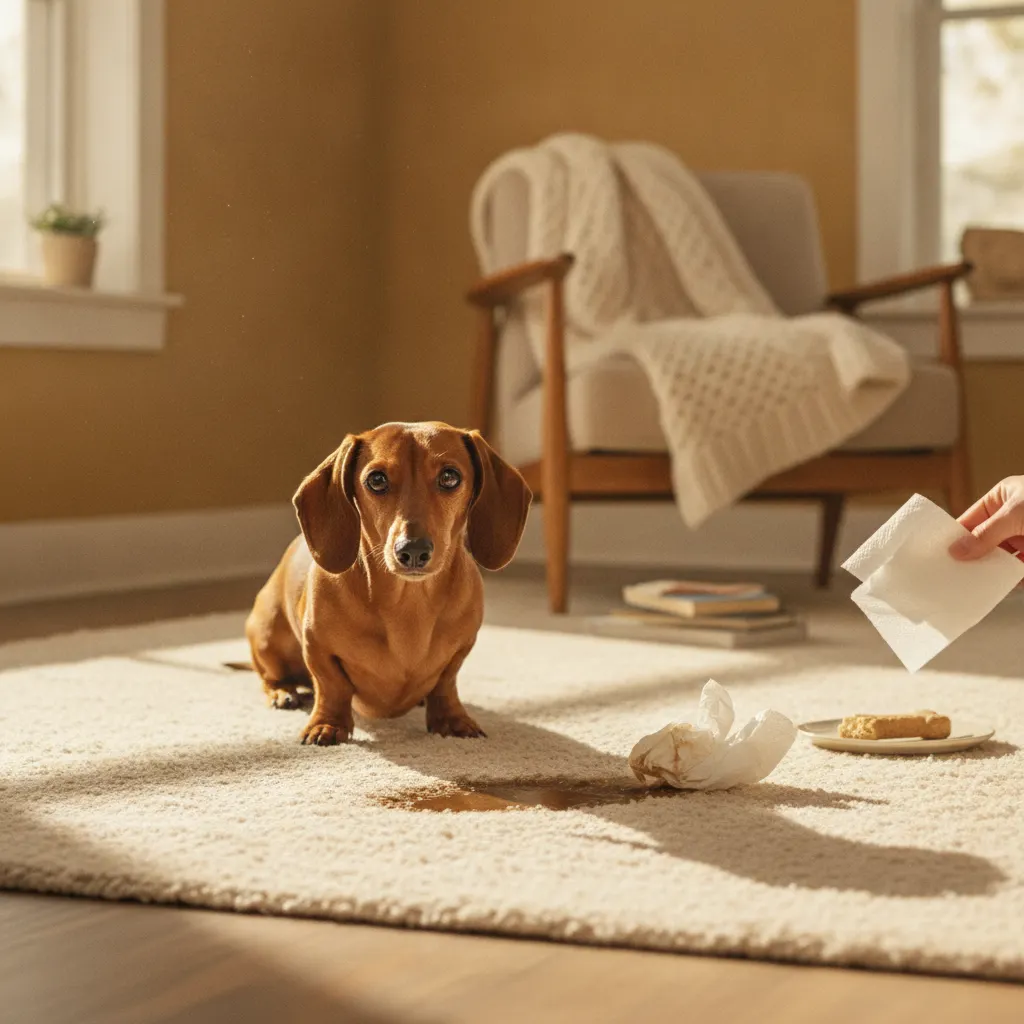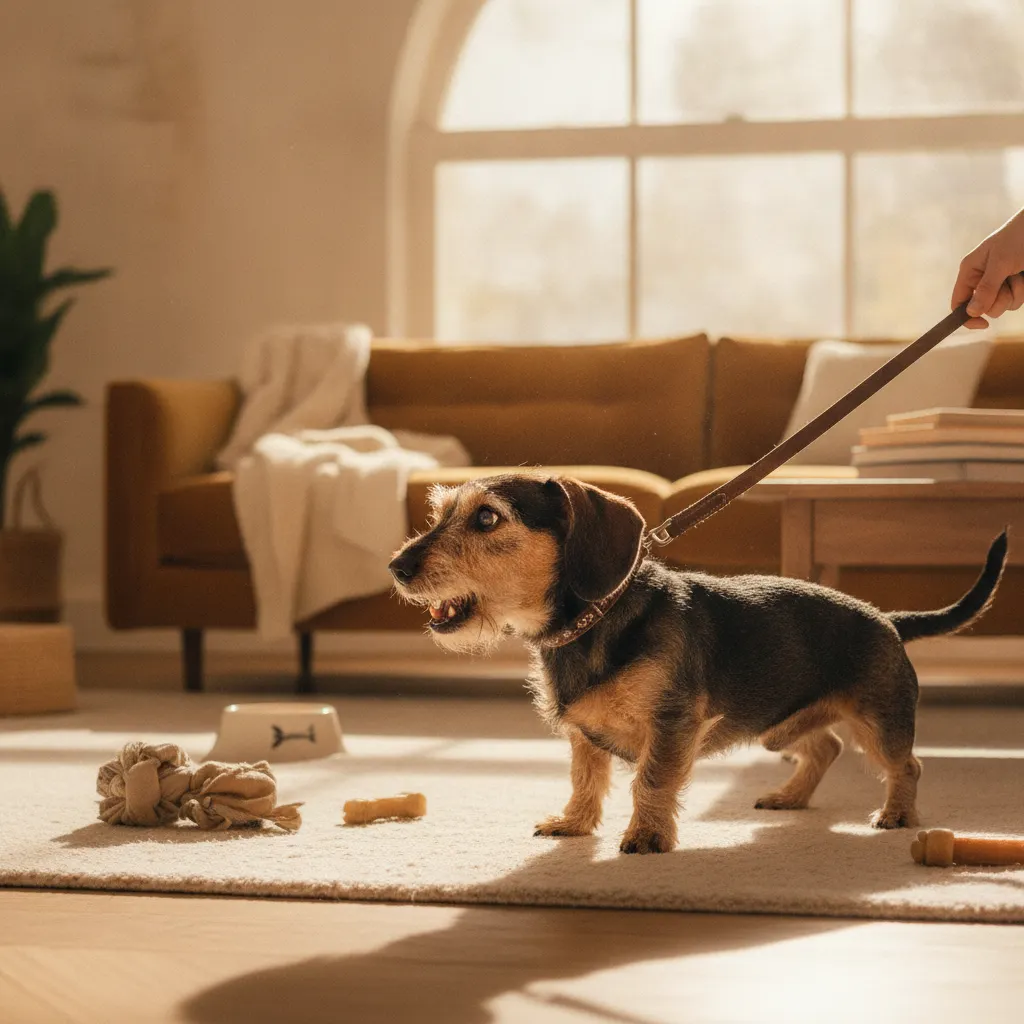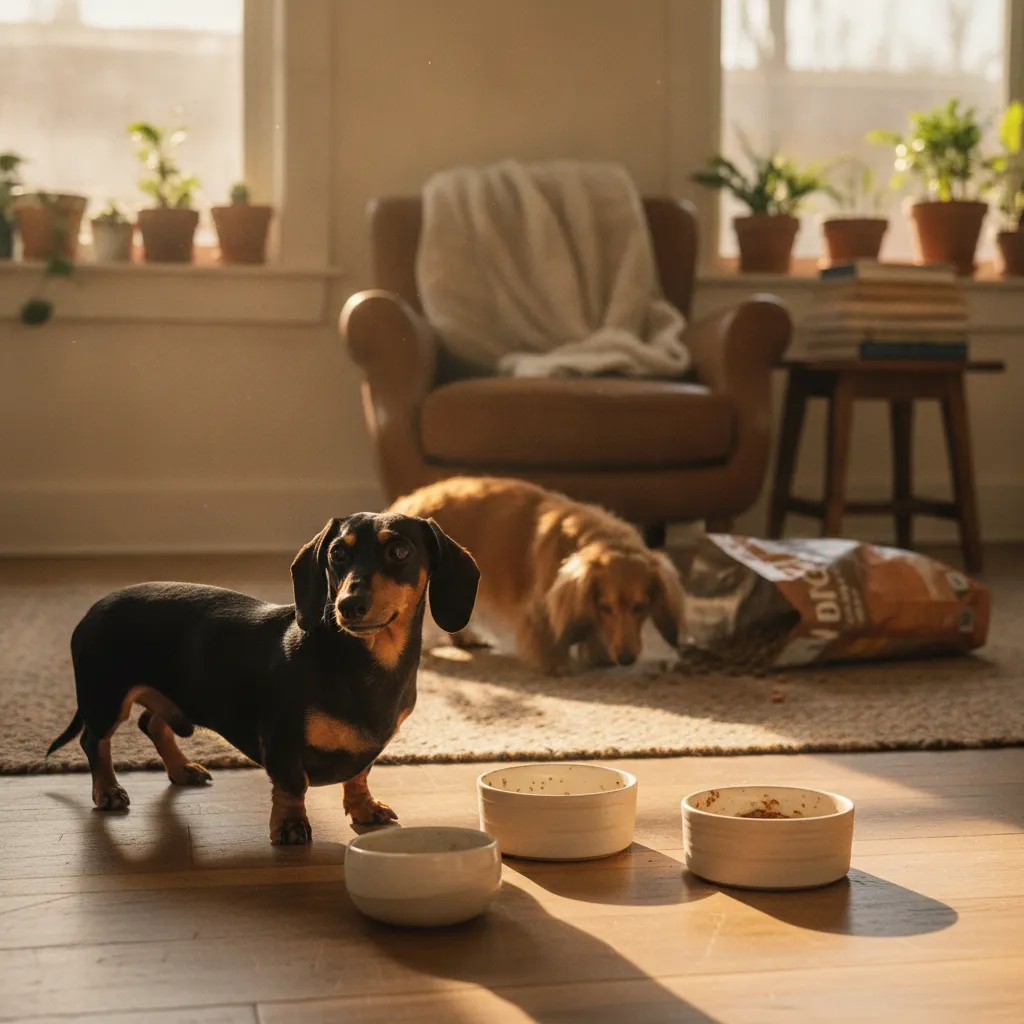
It’s the sound every multi-doxie owner knows. The dry, rattling cascade of kibble hitting two ceramic bowls. Before the last piece has even settled, the tension in the room skyrockets. It’s a silent, coiled-spring energy that feels one wrong move away from a snap. You place the bowls down, and the race begins. One dog inhales their food in twelve seconds flat, then immediately makes a beeline for their sibling’s bowl, who is now growling with a mouthful of food. Welcome to the Doxie Dinner Dash. If this sounds like your kitchen twice a day, I want you to take a deep breath. You are not a bad dog owner, and your dogs are not broken. You’re just accidentally hosting a nightly reenactment of ancient survival instincts in your kitchen.
The stress of managing a multi dachshund feeding routine is real. It’s that knot in your stomach as you scoop the food, the constant refereeing, the worry that one dog is getting bullied out of their dinner or the other is eating so fast they’ll make themselves sick. You love them both dearly, but for ten minutes every day, your home feels less like a cozy den and more like a gladiator arena where the prize is a scoop of chicken-flavored kibble. You might feel guilty, frustrated, or just plain exhausted by the constant vigilance required to make sure everyone eats safely. This isn’t the peaceful life you pictured with your pack of little sausage dogs.
Why Hasn't Anything I've Tried Worked?
If you're reading this, you've probably tried a few things already. You’ve stood between the bowls like a tiny, human wall, which only seems to make them eat faster. You’ve tried the firm “Leave it!” command, which your lightning-fast eater pretends not to hear as they snatch a stray kibble from their sibling's space. Maybe you bought those fancy slow-feeder bowls, hoping to level the playing field. And it worked, for a minute. Now, one dog has mastered the plastic maze and finishes just 30 seconds slower, while the other is still politely nudging food out of the first spiral. The core problem—the competition—is still there; it’s just noisier now.
These solutions fail because they only address the symptom: fast or competitive eating. They don’t address the root cause, which is a deeply ingrained part of the dachshund psyche. You’re trying to apply human rules of polite sharing to a situation that, in their minds, is about resource security. To a dachshund, a bowl of food isn't a polite meal; it’s a freshly caught badger. And when there’s another hunter nearby, you don’t savor the badger—you secure it. Fast. By trying to force them to eat nicely side-by-side, we’re ignoring 600 years of breeding and instinct. We’re asking them to deny the very wiring that makes them such tenacious, brilliant little dogs.
The Reframe: You're Not Managing Bad Dogs, You're Leading a Pack
Here’s the shift that will change everything: Stop trying to be a referee and start being a resource manager. The problem isn't food aggression; it's resource insecurity. Your doxies aren't being 'dominant' or 'mean' to each other. They are simply acting on a primal instinct that says, “This high-value resource might disappear if I don’t get it now, and that other dog is a potential competitor for it.” It’s not personal; it’s survival.
When you see it this way, the goal changes. Your job is not to force them to share or to teach them table manners. Your job is to create a system where each dog feels 100% secure that their food is theirs, that they have ample time to eat it, and that no one is going to challenge them for it. When you provide that security, the frantic eating, the guarding, and the tension melt away. You are not managing bad dogs; you are leading a tiny wolf pack and assuring them that the hunt was successful and there is enough for everyone. Peace at mealtimes doesn't come from correction; it comes from structure and the absolute certainty of safety.
Remember this core rule of dachshund life: Quirks are consistent; problems are a change. Competitive eating has likely always been there. But if one dog suddenly becomes aggressive at mealtime when they weren't before, or suddenly stops eating, that’s a signal. A sudden shift in behavior always warrants a call to your vet to rule out any underlying health issues. As always, this is educational content, and your veterinarian is the ultimate authority on your individual dog's health.
The Calm Kitchen Protocol: A Step-by-Step Guide to Peaceful Multi-Dachshund Feeding
Managing mealtimes in a multi-dachshund home isn't about finding the perfect bowl or the magic command. It's about creating a predictable, calm, and secure ritual. I call this the "Calm Kitchen Protocol." It’s what I’ve used with my own doxies, Marley and Mia, for years, and it turned our chaotic dinner dash into the most peaceful part of our day. It has four simple, non-negotiable steps.
Step 1: Separation is a Gift, Not a Punishment
This is the most important rule, and the one people resist the most. Your dachshunds must be fed in separate, secure spaces. This could mean separate rooms with the doors closed, in their own crates, or on opposite sides of a baby gate. The physical barrier is non-negotiable. Why? Because it completely removes the element of competition. There is no one to race against, no one to steal from, and no one to guard from.
Many owners feel guilty about this, as if they're punishing their dogs. I want you to completely reframe this. You are giving your dogs the gift of a private, peaceful dining experience. You are telling them, “This food is all yours. No one will bother you. Take your time. You are safe.” For an anxious or competitive eater, this is the ultimate relief. They can finally relax their posture, chew their food properly, and eat at a natural pace. If you're struggling with a dog who eats too fast, this step alone can make a huge difference, even more so than just a special bowl. For more tips on that specific issue, you might find our guide to slowing down a food-gobbling dachshund helpful.
Step 2: The Ritual of the Calm Wait
The meal doesn't begin when the food hits the bowl. It begins with a moment of calm. Before you even scoop the kibble, ask your dogs for a simple behavior. A “sit” is perfect. They don’t go to their separate feeding stations until you release them. The bowls don’t go down until they are sitting calmly in their spot. This isn't about old-school dominance; it's about establishing a clear, predictable sequence led by you.
This simple pause does two critical things. First, it breaks the frantic energy cycle. Instead of escalating into a frenzy as you prepare the food, they learn that calm behavior is what makes the food appear. Second, it reinforces to their pack-oriented brains that you are the one in control of this valuable resource. You are the calm, fair leader who will distribute it. This builds trust and reduces their anxiety about needing to fight for their share. It’s a foundational part of what we call The 'Polite Sausage' Project—teaching gentle household boundaries that make life better for everyone.
Step 3: The Order of Operations is All About Consistency
Who gets fed first? The answer is simpler than you think: it doesn't really matter who, as long as the order is the same every single time. In my house, Marley, my older male, always gets his bowl first. Then Mia gets hers. It’s not because he’s the “alpha” or because I love him more. It’s because that is The Rule. The Rule never changes. Tomorrow, Marley will be first. Next week, Marley will be first.
This consistency creates profound predictability. The dogs learn the sequence. Mia doesn't get anxious or jumpy while I'm putting Marley's bowl down, because she knows her turn is coming. She can trust the process. Whether you choose to feed the older dog first, the calmer dog first, or you just flip a coin once and stick with it forever, the key is unwavering consistency. This removes any ambiguity or need to jostle for position. The pack leader has a plan, and the plan is always the same.
Step 4: The Clean and Tidy Exit
The mealtime ritual doesn't end until the bowls are empty and picked up. As soon as a dog finishes eating and walks away from their bowl, pick it up. Don't let them linger and lick it for ten minutes, and absolutely do not let them wander over to the other dog's station to “pre-wash” their bowl. When the food is gone, the resource event is over.
Picking up the bowls promptly does a few things. It prevents the faster eater from going to bully the slower eater. It eliminates any post-meal guarding of an empty-but-still-valuable bowl. And it provides a clear, definitive end to the meal. The kitchen goes back to being a neutral space. This clean exit is crucial for maintaining a peaceful transition from mealtime back to regular household life. If you ever deal with growling over resources, even empty ones, understanding this concept of opening and closing a resource event is key. It's something we talk about in our guide to handling the 'Grumpy Couch Dragon'.
Proof That It Works: The Story of Marley and Mia
When Mia first came into our home as a puppy, mealtimes were a disaster. Marley, who had always been a leisurely eater, suddenly started inhaling his food and then shoving his entire head into her puppy bowl. She, in turn, learned to eat as if her life depended on it, sometimes choking and coughing because she was swallowing so fast. I tried everything—standing between them, feeding them in different corners, you name it. It was stressful for all three of us.
The day I implemented the Calm Kitchen Protocol was the day peace was restored. I started crating Mia for her meals and feeding Marley in the kitchen with the baby gate closed. The first time, Mia cried a little, and Marley seemed confused. But within three days, the transformation was incredible. I’d tell them “go to your spot,” and they’d trot to their respective places and wait. Marley started eating slowly again. Mia, safe in her crate, would actually leave kibble in her bowl and come back to it a minute later—something that would have been unthinkable before. There was no more growling, no more frantic energy. They learned to trust the system. They knew their resource was safe. It proved to me that the problem was never them; it was the environment I had created. By providing structure and security, I allowed their best, calmest selves to emerge.
Understanding the deep-seated instincts behind your dachshund's behavior is the key to a happier, calmer life together. Mealtime is just one piece of the puzzle. If you want to finally understand why your doxie burrows, barks at the mailman, or gives you that infamous side-eye, we've put all the answers in one place. Get the free Dachshund Behavior Decoder and become a more confident, connected doxie parent.
Frequently Asked Questions
What if my dachshunds have always eaten together without a problem? Should I still separate them?
If your current system truly works with no signs of stress—like rapid eating, staring, stiff body language, or moving away with food—then you may not need to change. However, this peaceful coexistence can change in an instant due to age, health issues, or other dynamics. Implementing a separate multi dachshund feeding routine is a preventative measure that guarantees safety and is often easier to start before a problem ever arises.
Is using crates for feeding cruel?
Not at all! When done correctly, a crate is a dog's private, safe den. Feeding them in their crate reinforces it as a positive place and gives them a guaranteed space free from interruption. It’s not a punishment; it's a private dining room that removes all social pressure and resource anxiety.
One of my dogs is a much slower eater. How do I manage that with this protocol?
The Calm Kitchen Protocol is perfect for this situation. By feeding them in separate, secure rooms or crates, the slow eater is protected. They no longer have to worry about the faster dog finishing and coming over to pressure them. They can take all the time they need without stress, which often leads to better digestion and a more enjoyable meal.
Will feeding them separately make my dachshunds dislike each other?
Quite the opposite. By removing a major point of conflict and resource competition from their daily lives, you are actually helping to improve their relationship. They are no longer rivals twice a day. This reduces overall stress and can lead to more harmonious interactions outside of mealtimes, as you are fostering cooperation over competition in your home.
I live in a small apartment. How can I manage separate feeding spaces?
You don't need a large house for this to work. Creativity is key! You can use a bathroom and a kitchen, two separate crates, or even a bedroom and a living room. A sturdy baby gate in a hallway can also create two distinct zones. The goal of a good multi dachshund feeding strategy is simply to break the line of sight and prevent physical access during the meal.
dachshund behavior · dog training · resource guarding · multi-dog household