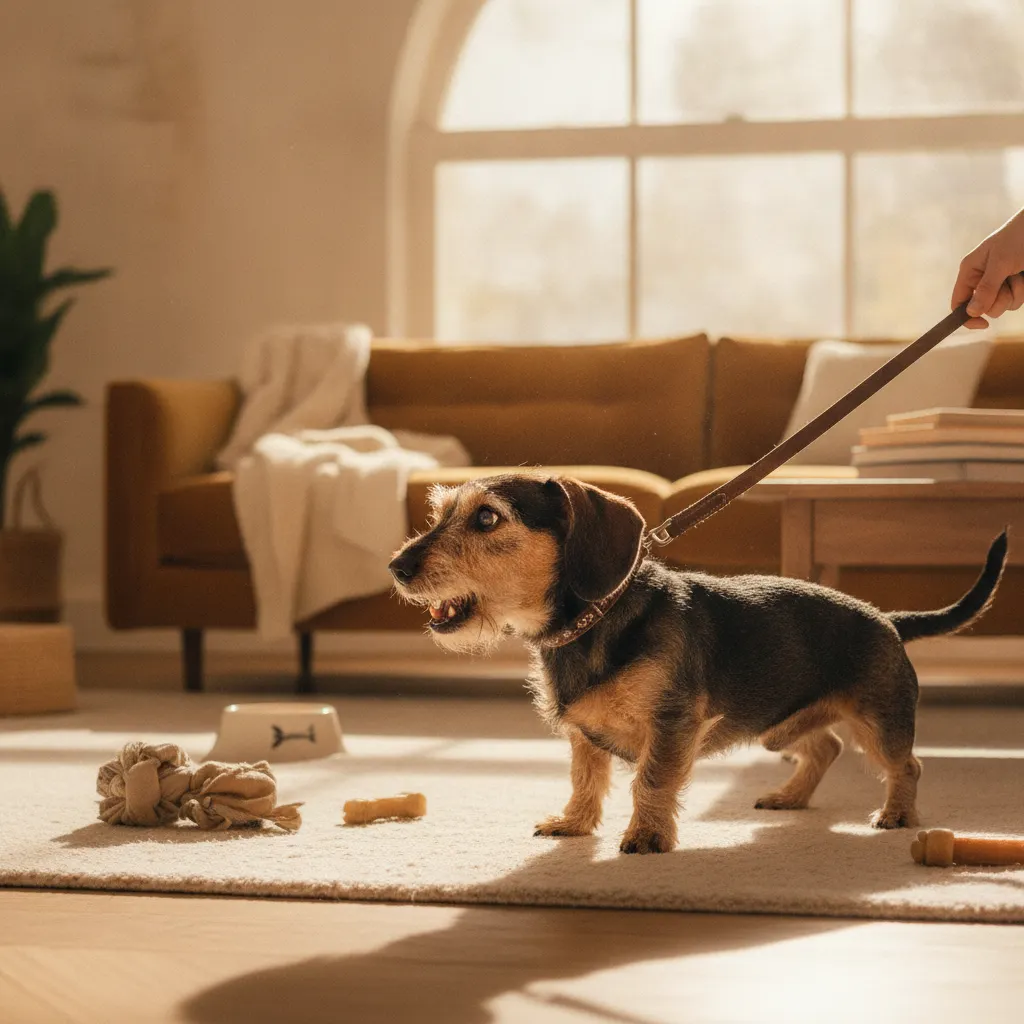
One minute, you’re enjoying a perfectly lovely stroll, sniffing interesting smells, sun on your face. The next, the leash in your hand goes taut, connected to a fifteen-pound creature of pure, vibrating rage. The barking is shrill enough to shatter glass. The lunging is so ferocious you worry about that long little back. And the object of this fury? A perfectly nice Golden Retriever ambling along a hundred feet away. Your sweet, cuddly sausage dog has turned into a tiny, furry land shark, and all you want is for the ground to open up and swallow you whole.
If this scene feels painfully familiar, you’re not alone. This is leash reactivity, and it’s one of the most stressful, embarrassing, and misunderstood behaviors in the dachshund world. It’s that heart-sinking feeling when you spot another dog, the quick scan for an escape route, the apologies you mumble to strangers as you drag your snarling doxie away. It makes you feel like a failure, like you have the only “bad dog” in the neighborhood.
Here’s the thing: you are not a bad dog owner. And your dachshund is not a bad dog. They’re just a dachshund, with 600 years of very specific programming, having a very big feeling in a very small body.
Why Has Everything I've Tried Made It Worse?
You’ve probably tried it all. The sharp “No!” The quick leash pop. Maybe you’ve tried holding a treat in front of their nose, a treat they completely ignore as they scream at the offending poodle across the street. Maybe you bought a new harness that promised a miracle cure. And yet, the behavior continues, or has even gotten worse.
Here’s why those common fixes often backfire:
- Punishment Increases Fear: When your doxie is already panicking, a leash jerk or a loud shout just adds another stressful element to the situation. In their mind, it confirms that the other dog’s presence *does* mean bad things happen. They think, “When that fluffy dog appears, my human gets tense and my neck hurts! That fluffy dog is definitely a threat!”
- Distraction Is a Band-Aid: Waving a piece of cheese in a frantic dog’s face is like trying to ask someone to do a math problem while their house is on fire. Their brain is flooded with cortisol and adrenaline. They are in fight-or-flight mode, and they are not capable of learning or focusing on a food lure.
- The Wrong Gear: Retractable leashes are a recipe for disaster. They teach your dog to pull and give you virtually no control when you need to create distance quickly. Choke chains or prong collars might suppress the barking out of fear, but they do absolutely nothing to change the underlying emotion. They just bottle up the anxiety until it explodes in another way.
The reason these solutions fail is that they all address the *symptom* (the barking and lunging) instead of the *cause* (the overwhelming anxiety). You’ve been trying to punish a panic attack, and that will never, ever work.
The Big Reframe: It's Not Aggression, It's Anxiety
This is the most important thing you will read in this entire article: Your Doxie isn't being a jerk; they're having a panic attack.
Leash reactivity is almost never true aggression. It is a fear-based response. Think about it from their perspective. Dachshunds were bred to be bold, independent hunters who went into dark tunnels to fight angry badgers. They are hardwired to be brave and make their own decisions. Now, put that brave, independent creature on a six-foot tether.
When they see another dog approaching, their instincts scream at them. “Threat! Potential danger!” An off-leash dog has options: they can approach cautiously, they can run away (flight), or they can stand their ground (fight). A leashed dog has only one of those options removed: flight. The leash takes away their ability to create distance and escape. They feel trapped, vulnerable, and helpless.
So what do they do? They choose “fight.” They put on a big, loud, scary display to make the other dog go away. The lunging, the barking, the snarling—it’s all a desperate attempt to create space. They are essentially shouting, “STAY AWAY! YOU ARE TOO CLOSE! I AM VERY SCARY, PLEASE LEAVE!” And from their perspective, it works! Every single time, the other dog eventually walks away. In your doxie’s mind, their ferocious display is what saved them.
Once you understand that you’re dealing with a scared dog, not a bad one, your entire approach will change. Your job is no longer to punish the behavior, but to help them feel safe.
How Do I Actually Fix Leash Reactivity in My Dachshund?
Fixing leash reactivity is a process of changing your dog’s emotional response, not just stopping the barking. It requires patience and a systematic approach. We’re going to stop putting them in situations where they feel the need to panic, and instead, we’re going to build their confidence and change their association with other dogs from “scary” to “boring” or even “good.”
Step 1: The Cortisol Vacation (Stop the Bleeding)
Before any training can happen, you have to lower your dog’s stress levels. Cortisol, the stress hormone, can take up to 72 hours to leave a dog’s system. If your doxie is having reactive episodes every day, they are living in a constant state of high alert. Their trigger threshold will be incredibly low.
For the next week, your new religion is Management. This means avoiding triggers at all costs. Your goal is to have zero reactive episodes.
- Walk at weird times: Go out super early in the morning or late at night when fewer dogs are out.
- Drive to quiet places: Find an empty office park, a cemetery, or a deserted field for your walks.
- Become a master of avoidance: See a dog? Immediately cross the street. Duck behind a parked car. Do a quick, cheerful U-turn and walk the other way. Do not “test” them to see if they’ll react. Assume they will, and avoid it.
This isn’t forever, but it’s a critical first step to give their brain a chance to reset.
Step 2: Change the Goal of the Walk
For a while, stop thinking of walks as a way to get from Point A to Point B. Think of them as “sniffaris.” Sniffing is a huge stress-reliever for dogs. It lowers their heart rate and is mentally enriching. Let your doxie lead the way and sniff every single blade of grass if they want to. A 20-minute sniff-heavy walk is more tiring and fulfilling for an anxious dog than a 45-minute forced march down a busy sidewalk.
Quirks are consistent; problems are a change. Leash reactivity that has been happening for years is a training challenge. A sudden onset of reactivity in a previously calm dog could be a sign of pain or a medical issue. When in doubt, your vet is always the authority on your individual dog.
Step 3: Play the “Look at That” Game (Counter-Conditioning)
This is where the real training begins. The goal is to change your dog's association with seeing another dog from fear to pleasant anticipation. You’ll need high-value treats—not their kibble. Think tiny pieces of boiled chicken, cheese, or hot dogs.
- Find the Threshold: Go to a place where you can see other dogs from a huge distance (e.g., the edge of a park). Find the distance at which your dachshund can see another dog but *not* react. This might be 50 feet, or it might be 300 feet. This is their “threshold.”
- Look and Mark: The moment your doxie looks at the other dog, before they have a chance to bark or lunge, say “Yes!” in a happy voice and immediately give them a treat.
- Turn Away: After they eat the treat, cheerfully call their name and move away from the trigger dog. Keep it short and successful.
- Repeat, Repeat, Repeat: Do this for just a few minutes at a time. The pattern is: See dog -> “Yes!” -> Treat -> Move away. Your doxie will start to learn that seeing a dog makes delicious chicken appear. They may even start looking at a dog and then looking back at you, as if to say, “Hey, did you see that? Where’s my chicken?” This is a massive win.
Slowly, over many sessions and many weeks, you can gradually decrease the distance. But if your dog ever reacts, it just means you got too close, too fast. Just increase the distance and try again next time. This is a dance: two steps forward, one step back.
Step 4: The Right Tools for the Job
While no gear will “fix” reactivity, the right tools can make managing it much safer and easier.
- A Front-Clip Harness: This is an incredibly helpful tool. When your dog pulls, the front clip gently turns them back toward you, redirecting their momentum without putting any pressure on their neck or back. It gives you much better control. This is crucial for protecting that long little back. Ensuring your whole home is safe, from walks to floors, is part of being a doxie parent. That's why considering things like the right rugs to prevent slipping is just as important as the right harness.
- A Standard 6-Foot Leash: Ditch the retractable leash. A simple, sturdy 6-foot leash gives you predictable control and keeps your dog close and safe.
- A Treat Pouch: You need to deliver that high-value reward within a second of marking the behavior. A treat pouch makes this possible. Fumbling in your pockets is too slow.
This isn't about finding a magic bullet, but about setting you and your dog up for success. The dynamic of a multi-dog household can also play a role; sometimes one dog's anxiety can feed off another's. Understanding these pack dynamics can be a big help, even on walks. If you have more than one sausage, learning how to handle their interactions is key, as we discuss in our guide to managing a multi-wiener household.
You Can Do This
I know how isolating and hopeless leash reactivity can feel. I’ve been there with my own doxies, standing on a street corner, flushed with embarrassment, feeling like the worst dog mom in the world. But I promise you, by shifting your perspective from seeing a “bad” dog to seeing a scared dog, you change everything.
You become their safe person. You become their advocate, the one who creates distance and doesn't force them into scary situations. You teach them, one piece of chicken at a time, that the world isn’t so scary after all.
It’s a long road, but every successful walk, every time you spot a dog and successfully turn away without an incident, is a victory. You’re not just managing barking; you’re building a deeper, more trusting bond with your little sausage. And that is worth everything.
If you want to understand the “why” behind this and other baffling doxie behaviors, it's the first step to becoming a more confident, less-stressed doxie parent. Get the free Dachshund Behavior Decoder and start learning their secret language today.
Frequently Asked Questions
Is leash reactivity the same as aggression?
Not usually. While it can look aggressive, leash reactivity is most often a fear-based behavior. The dog feels trapped by the leash and uses a big, loud display (barking, lunging) to try and make the scary thing (the other dog) go away and create space.
Will my dachshund ever be "cured" of leash reactivity?
It's better to think of it as management, not a cure. The goal is to reduce the frequency and intensity of the reactions and give you the tools to handle encounters calmly. Many dogs can make incredible progress and learn to walk past other dogs peacefully, but it will always be something you need to manage.
What if I live in a busy city with dogs everywhere?
This makes management harder, but not impossible. Focus on walking at off-peak hours (very early morning/late night), using visual barriers like parked cars, and practicing your emergency U-turn. You can also work on counter-conditioning inside your apartment by a window, rewarding your dog for calmly seeing other dogs on the street below.
Can a specific type of harness fix leash reactivity?
No single piece of gear can “fix” leash reactivity because it’s an emotional issue, not an equipment issue. However, a good front-clip harness can be an excellent management tool. It gives you better control without causing pain or choking, which helps prevent your dog from practicing the lunging behavior and keeps them safe.
How long does it take to see improvement?
This varies wildly depending on the dog, their history, and your consistency. The key is patience. You might see small improvements in a few weeks, but significant, lasting change can take many months of consistent training and management. Celebrate the small wins!
Should I use a prong collar, shock collar, or e-collar?
Absolutely not. These tools work by using pain and fear to suppress behavior. While they might stop the barking in the short term, they make the underlying anxiety much worse. This can lead to a dog who appears calm but is internally panicking, and can cause the reactivity to pop up in other, often more severe, ways.
leash reactivity · dog training · dachshund behavior · anxious dog