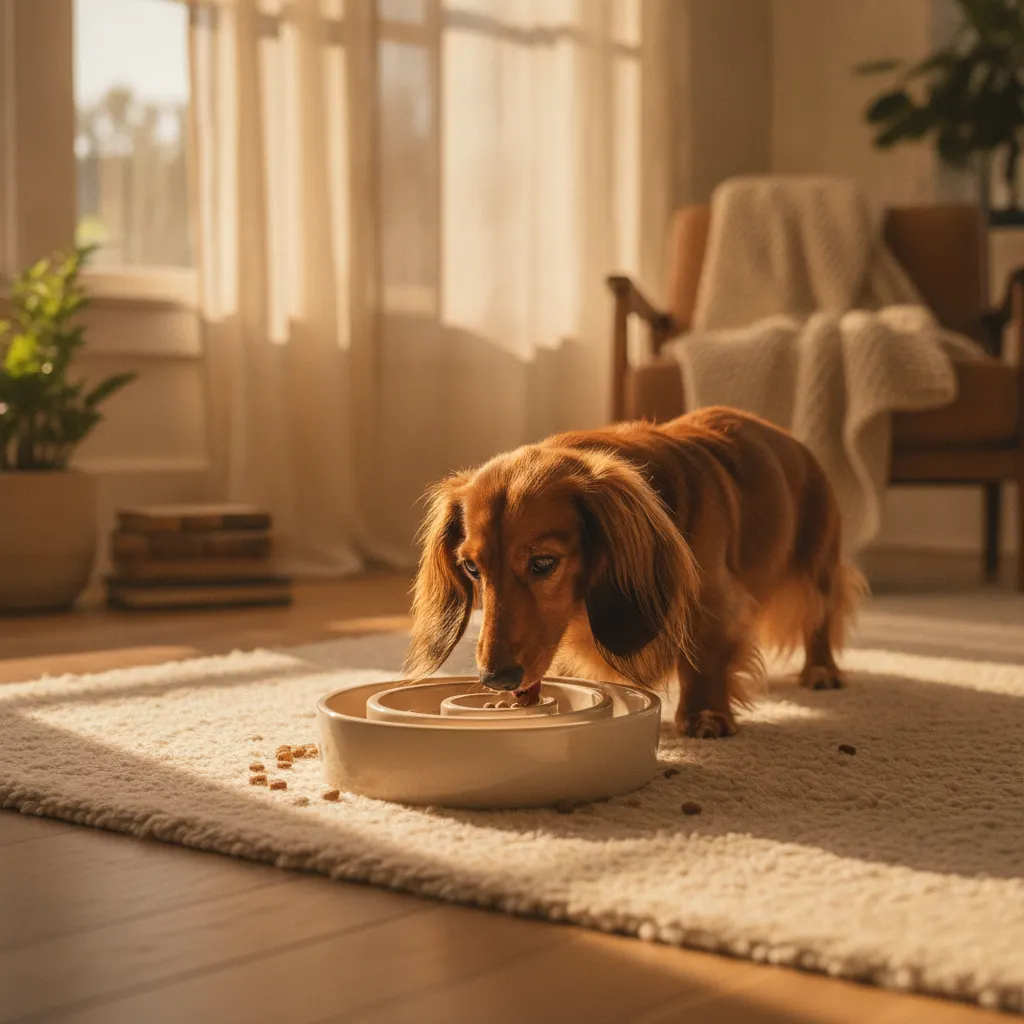
You know the sound. The rattle of kibble hitting the ceramic bowl, followed by what can only be described as a tiny, furry vacuum cleaner inhaling its contents in under ten seconds. Then, silence. Your dachshund looks up at you, eyes wide, with a look that clearly says, "Is that it? Was that a snack? Where is the real dinner?" If your dachshund eats too fast, you're not alone. It's a core experience of being a doxie parent, right up there with untangling them from a blanket and explaining to guests that yes, they really do need that many pillows.
But behind the funny, frantic eating is a little knot of worry. You've heard the warnings about bloat. You've cleaned up the dreaded "scarf and barf" more times than you can count. You worry they aren't even tasting their food, let alone digesting it properly. It feels like a problem you should be able to solve, but nothing seems to stick.
Why Hasn't Anything I've Tried Worked?
If you're like I was with my Marley, you've probably already been down the usual road of failed solutions. You tried putting a big, smooth rock in his bowl, only to hear the sound of teeth clanking against it. Then you switched to a tennis ball, which he promptly learned to just pop out with his nose before inhaling his meal at the same record-breaking speed.
Maybe you bought one of those generic plastic slow-feeder bowls from the pet superstore. It worked for about three days. Then, your brilliant little sausage dog, whose ancestors were bred to outsmart badgers in underground tunnels, treated it like a fun but ultimately simple-minded puzzle. He either figured out the pattern instantly or got so frustrated he tried to flip the whole bowl over.
You've tried spreading the kibble out on a mat, which just led to kibble dust in your grout and your dog chasing a single piece under the sofa for twenty minutes. You've tried just telling them to "slow down," which, as we all know, is about as effective as reasoning with a toddler about the necessity of bedtime. These solutions fail because they address the symptom—the speed of eating—without understanding the root cause.
The Reframe: You're Feeding a Hunter Like a Goldfish
Here’s the truth that changed everything for me and my doxies: Your dachshund isn't being greedy, and they're not broken. The problem isn't their speed; it's our method. We are feeding a highly intelligent hunting dog with a brain wired for complex problem-solving as if they're a goldfish getting flakes dropped into a bowl. We're giving them a paycheck without asking them to do any work.
For hundreds of years, every ounce of a dachshund's being was engineered for the hunt. The seeking, the sniffing, the digging, the problem-solving—that's the sequence their brain is built for. The food at the end is just the reward. When you just dump food in a bowl, you skip the entire neurological process that gives them satisfaction. Their brain gets the reward (food) without the fulfilling work (the hunt). That frantic, desperate eating is the symptom of a deeply bored brain. They eat fast because their instincts are screaming, "Get the calories now before another animal does!" but their life has given them no challenge, no hunt, no reason to feel secure in their resource.
When we understand this, the goal changes. We stop trying to *slow them down* and start trying to *engage their brain*. Mealtime shouldn't be a 10-second event. It should be a 10-minute activity.
The Foraging Framework: Turning Mealtime into a Mind Game
The solution is to throw out the food bowl. I know, it sounds dramatic. But for a dog that eats too fast, the bowl is the problem. It represents zero effort for maximum reward, and it's making your dog's brain antsy. Instead, we're going to make them work for their food, engaging their natural instincts to forage, sniff, and seek. This is what I call the Foraging Framework, and it has three simple levels.
Level 1: The Puzzle Upgrade
The easiest first step is to replace the bowl with a tool designed for enrichment. This isn't just a slow feeder; it's a game.
- Snuffle Mats: These are fabric mats with lots of strips and pockets where you can hide kibble. Your doxie has to use their powerful nose to sniff out every last piece. It forces them to slow down, but more importantly, it satisfies that powerful sniffing instinct. It's incredibly calming for them.
- Puzzle Feeders: These come in all shapes and sizes, from balls they have to roll around to release kibble, to complex boards with sliders and compartments. The key is to start easy and help them learn the game. This taps into their problem-solving skills. For a great overview of different toy types, including puzzles, check out our guide on the five types of toys every dachshund needs.
The goal here is to introduce the concept that food no longer just appears. It must be found. This simple switch can have a massive impact on their state of mind.
Level 2: The Indoor Scatter Hunt
You don't even need to buy anything to start. The most natural way for a dog to eat is to forage. You can simulate this right in your living room. Start by taking a handful of their kibble and scattering it in a small, contained, and safe area.
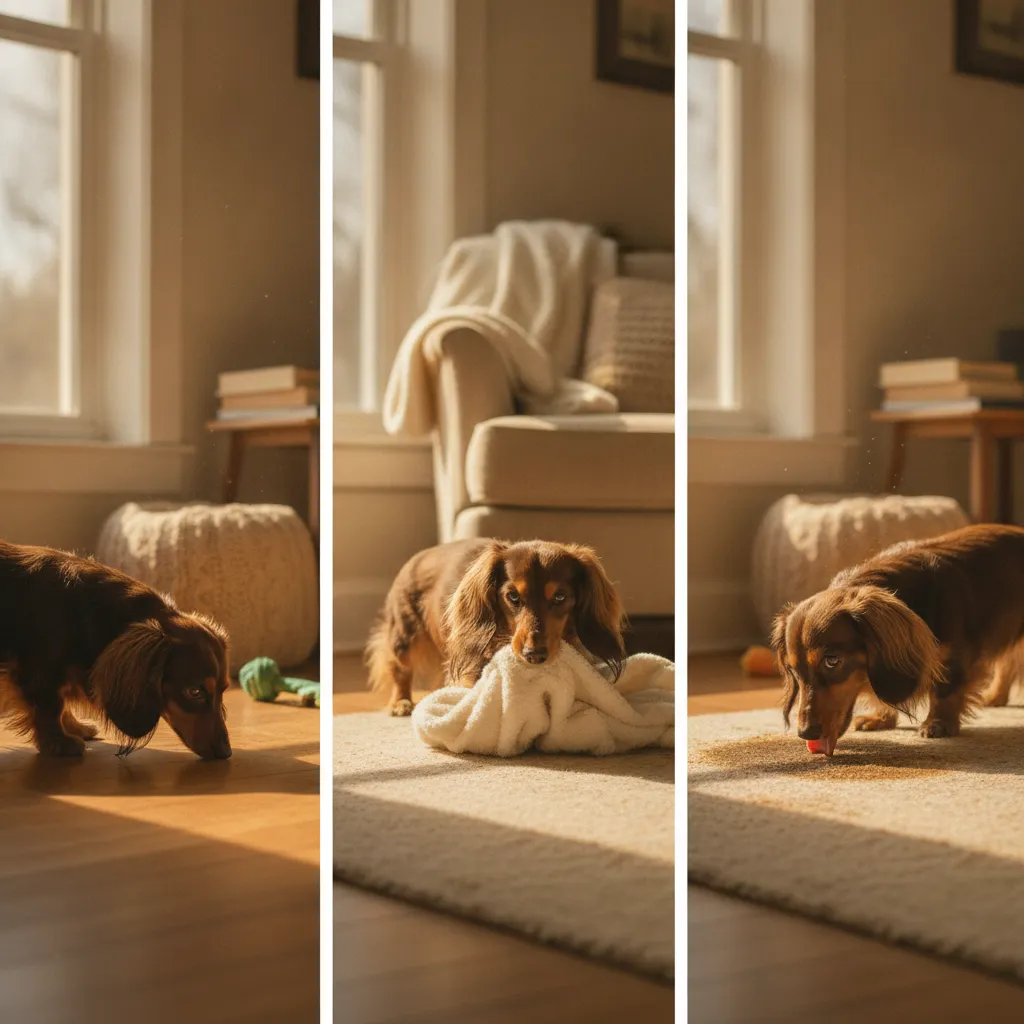
A low-pile rug is a great place to start. This encourages them to use their nose and move around, eating one piece at a time. Make sure the surface is clean and free of anything they shouldn't ingest. Using non-slip rugs can provide a safe and stable surface for this activity, protecting their long little backs while they hunt for their dinner. As they get better at it, you can make the area larger or the scatter a bit wider. You are literally recreating a miniature hunt for them, and their brains love it.
Level 3: DIY Enrichment
Once you see how much your doxie loves the challenge, you can get creative and make your own food puzzles for free. This is where you can really have fun and rotate activities to keep things interesting.
- The Muffin Tin Game: Take a standard muffin tin, drop a few pieces of kibble in each cup, and then cover the cups with toys, tennis balls, or balled-up socks. They have to figure out how to remove the obstacle to get to the food.
- The Towel Burrito: Lay an old towel flat on the floor. Sprinkle some kibble on it. Roll it up tightly. Your doxie then has to use their nose and paws to unroll the towel to reveal the food.
- The Cardboard Box Forager: Take a small cardboard box and fill it with dog-safe packing paper, old t-shirts, or toilet paper rolls. Sprinkle their meal inside and let them dig and forage through the materials to find their food. Just be sure to supervise so they don't eat the cardboard!
These methods do more than just solve the problem of a dachshund that eats too fast. They build confidence, reduce anxiety, and provide crucial mental stimulation. A 10-minute session with a snuffle mat can be more tiring and satisfying for your dog than a 30-minute walk. It's a workout for their most important organ: their brain.
Proof It Works: The Story of Mia's Mealtime Makeover
When my Mia was a puppy, she was the absolute queen of the scarf-and-barf. Food was in her bowl for maybe five seconds before it was gone, and half the time, it came right back up a minute later. I was worried and frustrated. I tried all the cheap plastic slow feeders, and she treated them like a personal insult, flipping them over in disgust.
The day I threw out her food bowl was the day everything changed. I bought a simple snuffle mat and hid her first meal in it. I'll never forget watching her. Instead of that frantic, gulping energy, she was quiet. Focused. Her little nose was working, her tail was giving these soft, happy wags. It took her almost 15 minutes to finish her meal. And when she was done, she didn't look at me for more. She trotted over to her bed, curled up, and let out a huge, contented sigh.
She wasn't just full; she was satisfied. We never went back to a bowl. Now, at nine years old, her meals are still served in a rotation of puzzles, snuffle mats, and scatter hunts. It has become a cherished ritual for both of us. It's not just about slowing her down anymore; it's about honoring the brilliant little hunting dog she is.
Your dachshund isn't being rude when they eat fast; their brain is just bored. Turning mealtime into a game is the kindest thing you can do for them.
This journey isn't about correcting a "bad" behavior. It's about meeting a deep, instinctual need. It's a shift from seeing your dog as a pet to be fed to seeing them as a partner to be enriched. While some of us are trying to slow our eaters down, others might be dealing with the opposite issue. If that's you, you might find our guide for when your stubborn sausage refuses to eat helpful for a different perspective.
Understanding this one instinct—the need to work for their food—is a huge piece of the puzzle. But it's just one of many instincts that make our dachshunds so uniquely quirky and lovable. If you've ever wondered why they burrow, why they bark at everything, or why they give you that famous side-eye, it all comes back to their breeding and their wiring. To finally understand the "why" behind all their funny little habits and become a more confident doxie parent, I'd love for you to have this resource I made. Get the free Dachshund Behavior Decoder.
Frequently Asked Questions
Why does my dachshund eat so fast in the first place?
Dachshunds eat fast due to a combination of instinct and history. Their ancestors needed to eat quickly before competitors or larger predators could steal their food. This 'scarcity mindset' is hardwired into them, even if their next meal is guaranteed.
Is a slow feeder bowl enough to stop my dachshund from eating too fast?
A slow feeder bowl is a good start and certainly better than a regular bowl for a dachshund that eats too fast. However, methods like snuffle mats and puzzle toys are even better because they engage your doxie's brain and satisfy their natural instinct to forage and hunt, providing mental enrichment along with slowing them down.
Could my dachshund eating too fast be a sign of a medical problem?
While fast eating is common, a sudden *change* in eating habits can be a red flag. If your dog suddenly starts eating ravenously when they didn't before, it's worth a vet visit to rule out issues like parasites, diabetes, or nutrient absorption problems. Always remember our rule: quirks are consistent, a change is the signal to call your vet.
What if my dachshund gets frustrated with puzzle toys?
Frustration is common at first! Start with the easiest puzzle you can find (Level 1) and show them how it works. You can use a few high-value treats mixed with their kibble to keep them motivated. The key is to build their confidence with quick wins before moving on to more difficult challenges.
My dachshund just flips over the puzzle feeder. What should I do?
This is a classic stubborn doxie move! Look for puzzle feeders that are heavier or have non-slip bottoms. You can also place the puzzle on a non-slip mat. Most importantly, supervise them during puzzle time, gently correcting them if they try to cheat by flipping it over and redirecting them to solve it the right way.
Can I use these slow-feeding methods with wet or raw food?
Absolutely! While scattering isn't ideal for wet food, products like LickiMats are perfect. These are textured silicone mats where you can spread their food, forcing them to lick it off, which slows them down and is also a very calming activity for dogs.
dachshund feeding · slow feeder · canine enrichment · dog behavior