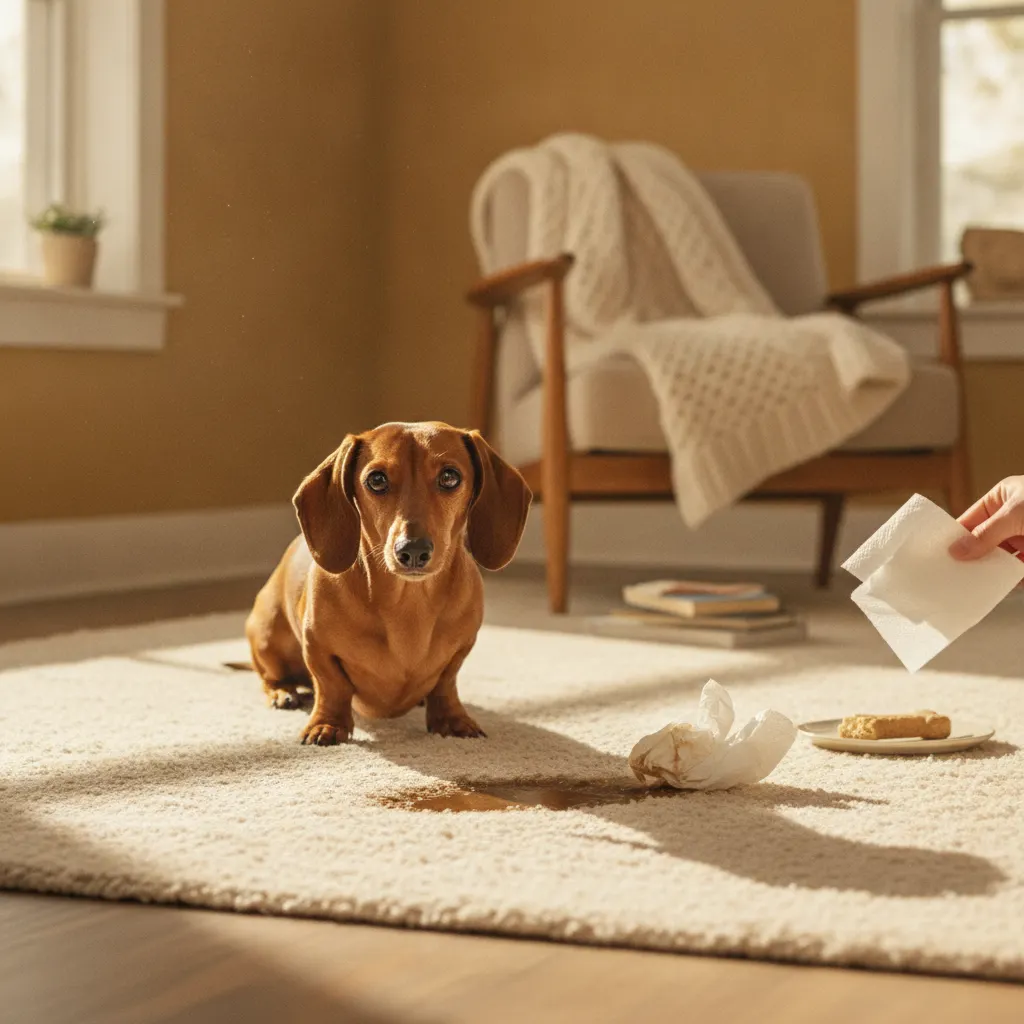
You feel it before you see it. That damp spot on the rug, discovered in your socks on the way to the coffee maker. Your heart sinks. You look over at your dachshund, who is either staring at you with a look of profound, unearned innocence or hiding under a blanket, knowing the gig is up. And the first thought that screams through your head is, “But you KNOW better!”
It’s one of the most frustrating moments as a doxie parent. You did the work. You survived the puppy puddles, you celebrated the first full week of no accidents, you finally trusted them with the good rug. And now, out of nowhere, it feels like you’re back at square one. This sudden potty training regression feels like a personal betrayal. Is he mad at you? Is she being stubborn? Are you a failure as a dog parent? Take a deep breath. It’s almost never about any of those things.
The truth is, an accident from a house-trained dachshund isn’t an act of rebellion. It’s a message. It’s one of the only ways they have to send up a flare signal that something isn’t right in their world. Our job isn’t to be the disciplinarian; it’s to be the detective. And once you learn how to read the clues, you can solve the real problem, not just clean up the symptom.
Why Has My Dachshund Started Having Accidents Again?
Before we become detectives, let’s talk about what most of us do first—the things that feel right but almost never work. When faced with a sudden puddle, our human instincts kick in. We might scold the dog, point at the spot, and use a firm “No!” We might resolve to take them outside more often, opening the door every hour on the hour. We might even dig out the old puppy pads, sighing with defeat.
Here’s why those gut reactions often fail with a dachshund. Scolding them after the fact is useless. A dog’s brain doesn’t connect your anger now with the puddle they made ten minutes or an hour ago. All they learn is that you are suddenly scary and unpredictable, which can actually create more anxiety and—you guessed it—more accidents. They might just get better at hiding them from you.
Simply opening the back door more often also misses the point. Your doxie might trot outside, sniff a leaf for ten minutes, and come right back in, mission unaccomplished. Dachshunds are not golden retrievers, content to just “be” outside. They were bred for a purpose, and that purposefulness extends to everything, including potty breaks. If they don’t feel the urge right then, or if something outside is more interesting or scary, they’ll just hold it until they’re back on their favorite cozy rug.
These failed solutions all stem from the same misunderstanding: they treat the accident as a training failure. But it’s not. A potty training regression in an adult dachshund is a communication breakdown. They are trying to tell you something, and scolding them is like shouting over them while they’re trying to speak.
What Is My Dachshund *Really* Trying to Tell Me?
This is the single most important shift in perspective you can make. The accident is not the problem; it is a symptom of the problem. Your long little dog isn’t being “bad.” They are using the clearest signal they have to tell you one of four things:
- “My body doesn’t feel right.” (A medical issue)
- “My world has changed and it’s stressing me out.” (An environmental issue)
- “My heart is anxious or I’m not getting what I need.” (An emotional issue)
- “The rules have gotten a little fuzzy and I need a reminder.” (A training drift)
Your job is to figure out which message they’re sending. Stop seeing a puddle to be cleaned and start seeing a clue to be investigated. When you switch from frustrated owner to curious detective, the entire dynamic changes. You’re no longer in conflict with your dog; you’re working together to solve a mystery. This is the foundation of a trusting relationship, and it’s far more effective than any punishment could ever be.
Your doxie isn't being bad; they are sending you a message. The accident isn't the problem, it's a symptom.
I remember this with my own Marley. He was perfectly house-trained for years, and then suddenly started having small accidents right by the door. I was baffled and annoyed. But when I stopped being annoyed and started watching, I noticed it only happened after our other dog, Mia, had barked ferociously at a delivery truck. The message wasn't, “I forgot where to pee.” The message was, “That loud noise scared me so much that I couldn’t control my bladder.” The problem wasn't his training; it was his anxiety. We worked on his noise sensitivity, and the accidents vanished.
How to Be a 'Potty Problem' Detective: A 4-Step Investigation
Ready to put on your detective hat? Here is the systematic approach to figuring out what’s really going on when your potty-trained doxie starts having accidents. Work through these steps in order.
Step 1: Rule Out the Urgent (The Medical Exam)
This is the non-negotiable first step. A sudden change in behavior is always a potential health red flag. Quirks are consistent; problems are a change. Before you assume it's behavioral, you must rule out a medical cause. Schedule a visit with your vet.
Common medical culprits for new accidents include:
- Urinary Tract Infections (UTIs): These are common and create a frequent, urgent need to urinate, often in small amounts. Your dog physically can’t hold it.
- Bladder Stones or Crystals: These can cause irritation, blockage, and pain, leading to accidents and straining.
- Kidney Disease: As kidney function declines, a dog will drink more water and need to urinate much more frequently.
- Cushing's Disease or Diabetes: Both of these conditions cause excessive thirst and, consequently, excessive urination that can overwhelm even a well-trained dog.
- Back Pain (IVDD): This is a big one for dachshunds. Nerve damage from a bulging or ruptured disc can interfere with bladder control. Sometimes, it’s even painful for them to get into the “potty stance.”
- Age-Related Incontinence: In senior doxies, the sphincter muscles that control the bladder can weaken, leading to leaks, especially when they are sleeping or relaxed.
Be prepared to tell your vet exactly when the accidents started, where they happen, and if you’ve noticed any other changes in your dog's eating, drinking, or general energy levels. This is critical information. For more on this, our guide on when to call the vet can help you prepare for that conversation.
Step 2: Investigate the Environment (The Scene of the Crime)
If your vet gives your doxie a clean bill of health, your investigation moves to their environment. Dachshunds are incredibly sensitive to their surroundings. A change that seems minor to you can feel like an earthquake to them. Think like a doxie: what is different in your home?
- New Things: Have you gotten a new rug? A new couch? Even a new brand of floor cleaner with a strong smell can be unsettling and prompt a dog to “over-mark” the territory with their own scent to feel more secure.
- Schedule Changes: Are you suddenly working from home less, or more? Has your daily walk schedule shifted? A disruption to their predictable routine can cause anxiety that manifests as accidents.
- Visitors: Have you had houseguests? A new baby? Even a new boyfriend or girlfriend who stays over? A new person in their space is a major event.
- Outside Stressors: Is there construction happening next door? A new, loud dog in the neighborhood? An increase in delivery trucks? If something outside makes them feel unsafe, they may be reluctant to go out and will choose to eliminate inside where they feel secure.
Look for patterns. Does the accident always happen in the same spot? On a particular type of surface? This can give you clues. Peeing on a new rug is often about marking new territory. Peeing by the front door might be about anxiety related to you leaving or to things they hear outside.
Step 3: Analyze the Emotional Climate (The Feeling Factor)
Dachshunds are emotional sponges. They are deeply bonded to their people and are highly attuned to the emotional state of the home. If medical and environmental causes are ruled out, it’s time to think about feelings.
- Your Own Stress: Have you been more stressed, anxious, or sad lately? Your doxie feels that. They don't understand the source of your stress, but they know their pack leader is unsettled, which makes them unsettled, too. Sometimes, they have accidents because their whole world feels off-kilter.
- Separation Anxiety: Do the accidents only happen when you’re gone? This is a classic sign of separation anxiety, not spite. The peeing is a physical manifestation of their panic. This is a complex issue, but recognizing it as anxiety is the first step. Our guide to managing your own anxiety when leaving your doxie can be a surprisingly helpful place to start.
- Boredom or Lack of Attention: Is your doxie getting enough mental and physical stimulation? A bored dachshund is a mischievous dachshund. While less common, sometimes an accident can be an attention-seeking behavior if they’ve learned it gets a big reaction from you.
- Household Conflict: Is there tension between pets in the home? A new dog or cat? A subtle power struggle could lead to one dog marking territory to assert themselves.
Step 4: Go Back to Basics (The Training Tune-Up)
After you have thoroughly investigated and ruled out medical, environmental, and major emotional triggers, it's time for a simple training tune-up. Don’t think of this as starting over; think of it as reinforcing the rules and rebuilding your doxie's confidence. This is where you address that fourth potential message: “The rules have gotten a little fuzzy.”
- Leashed Potty Breaks: No more just opening the door. Take your dachshund out on a leash every single time, even in a fenced yard. This keeps them focused on the task at hand and ensures you see them actually go.
- Frequent, Scheduled Trips: Increase the frequency. Go back to taking them out first thing in the morning, last thing at night, and after every meal, nap, and playtime. Set a timer if you have to.
- Throw a Potty Party: When they successfully potty outside, make it the best event of the day. Use a super high-value treat (bits of chicken or cheese, not their regular kibble) and shower them with praise the second they finish. Re-establish that going outside is the most rewarding thing they can do.
- Clean Thoroughly: You must use an enzymatic cleaner specifically designed for pet urine. Regular cleaners won't eliminate the odor molecules that tell your dog, “This is an approved potty spot.” If they can still smell it, they will go there again.
- Manage the Space: When you can't be supervising them directly, limit their freedom. Use a crate (if they are crate-trained), baby gates, or keep them on a leash with you. This prevents them from wandering off to have a secret accident and helps them practice holding it. This isn't a punishment; it's a management tool to set them up for success. Re-establishing boundaries can be a kind and effective way to rebuild good habits, a concept we explore in The 'Polite Sausage' Project.
This four-step process turns a frustrating problem into a manageable investigation. It respects your dachshund's intelligence and honors the bond you share. You’re not just fixing a behavior; you’re listening to what your dog needs.
Understanding the “why” behind your dachshund’s actions is the key to being a more confident and connected doxie parent. It’s not always simple, but it’s always worth it. If you want to get fluent in your dachshund's unique language and decode their quirky behaviors, from potty problems to playful growls, the next step is to understand their core motivations.
That’s why I created a free guide to help you do just that. Get the free Dachshund Behavior Decoder and start turning confusion into connection.
Frequently Asked Questions
Why is my potty-trained dachshund suddenly peeing in the house at night?
Nighttime accidents in a previously trained dog are a significant red flag for a medical issue. It could be related to kidney problems, a UTI, diabetes, or age-related incontinence where they can't hold it while asleep. Your first call should always be to your veterinarian to rule out a health problem.
Could my dachshund's potty training regression be a sign of IVDD?
Yes, absolutely. Intervertebral Disc Disease (IVDD) can cause nerve damage that affects bladder control. If the accidents are paired with any reluctance to move, jump, a wobbly walk, or signs of pain, it's crucial to seek immediate veterinary attention. Don't dismiss a potty training regression as just behavior if other physical symptoms are present.
Does punishing my dachshund for an accident help stop it?
No, it almost always makes things worse. Your dog won't connect the punishment to the act of peeing that happened earlier. They will only learn that you are a source of fear and anxiety, which can lead to more stress-related accidents or cause them to hide from you when they have to go.
How long does a potty training regression typically last?
The duration depends entirely on the underlying cause. If it's a medical issue like a UTI, it can resolve quickly with treatment. If it's due to an environmental or emotional stressor, it will last until that stressor is removed or the dog has been helped to cope with it. A training tune-up can show results in as little as a week or two with consistency.
My dachshund only has accidents when I'm gone. Is this spite?
It's almost never spite; it's a classic sign of separation anxiety. The accidents are a physical symptom of their panic and distress at being left alone. Spite is a complex human emotion that dogs don't really experience; interpreting it as such will only damage your relationship with your dog. Focus on addressing the underlying anxiety instead.
Should I go back to using puppy pads during a regression?
This can be a double-edged sword. While they can protect your floors, they can also send a mixed message to your dog that it's sometimes okay to potty inside. It's generally better to focus on the 'Back to Basics' training protocol: more frequent leashed trips outside and managing their space indoors to prevent accidents from happening in the first place.
potty training · dachshund behavior · dog training · house soiling