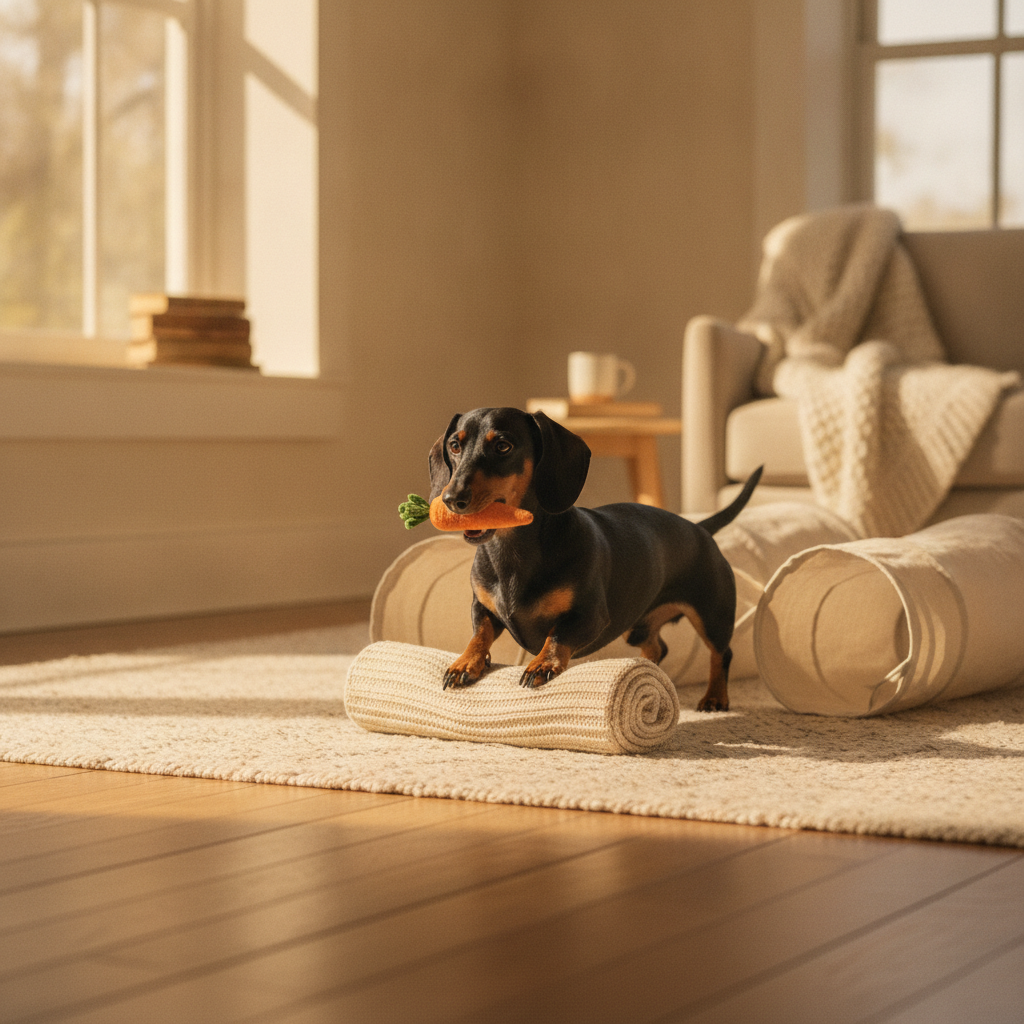
You feel it before you see it. That sudden tautness in the leash as your dachshund lunges—with the full, unholy force of their entire 15-pound body—at a squirrel that is, by all accounts, mocking them from across the street. Your heart does a little flip-flop. It’s not the lunge itself. It’s the sharp little *ack* sound they make, the pressure of the collar against their throat, and the image that flashes through your mind of that force traveling right down their long, precious, and incredibly fragile spine.
This is the moment every doxie parent knows. The walk that was supposed to be a relaxing stroll turns into a low-grade anxiety attack. You’re constantly scanning for triggers, shortening the leash, and bracing for impact. The great dachshund harness vs collar debate isn't about fashion. It's about that heart-in-your-throat feeling and the desperate desire to protect that long little back from harm.
The Real Problem: A Design Flaw We Can't Ignore
Here’s the thing we all live with: our beloved sausage dogs are anatomical marvels of questionable engineering. They have the soul of a lion, the courage of a badger-hunter, and the spine of, well, something that shouldn't be attached to a creature with the soul of a lion. The central conflict of dachshund ownership is loving a dog bred for fearless tenacity, housed in a body that needs to be handled like a priceless antique vase.
The pain you feel isn't just about the fear of a catastrophic injury like Intervertebral Disc Disease (IVDD). It’s the daily, nagging worry. Is this walk hurting them? Is that little cough after they pull a sign of something serious? Am I being a good enough doxie parent? You’re trying to do the right thing, but the information out there is a confusing mess.
You’ve probably been down this road. You started with a standard collar because that’s just what dogs wear, right? But the choking and gagging when your doxie pulls is awful. It feels wrong. So, you switched to a harness you grabbed at the pet store. Maybe it was one of those 'no-pull' ones that just seemed to squeeze them uncomfortably, or a flimsy one that they learned to back out of in approximately seven seconds flat, leaving you holding an empty leash while they trot triumphantly toward a busy road. Nothing seems to fit their unique, elongated body quite right, and you're left feeling more confused and worried than when you started.
Why We Need to Rethink Leash Attachment Entirely
Let's reframe the entire conversation. This isn't about finding a magic tool to stop a dachshund from pulling. Let’s be honest with ourselves: you are not going to train 600 years of hunting instinct out of them. As I've said before, your dachshund isn't stubborn, he's a badger hunter. He was bred to charge headfirst into dark tunnels after formidable opponents. A squirrel is a Tuesday morning warm-up.
The real goal is not to eliminate pulling, but to redirect the force of that pull away from their two most vulnerable areas: their delicate trachea and their long spinal column.
A collar fails this test spectacularly. When your doxie pulls on a leash attached to a collar, all of that force is concentrated on a tiny, fragile area of their neck. This can lead to two major problems:
- Tracheal Damage: The trachea, or windpipe, is a flexible tube made of cartilage rings. It's surprisingly delicate. Repeated pressure or a sudden, hard jerk on a collar can cause those rings to weaken or even collapse. This is painful and can lead to a chronic, honking cough and breathing difficulties.
- Spinal Strain: Imagine your doxie’s spine as a long, linked chain. When you yank one end (the neck), a shockwave of force travels down the entire length of that chain. For a dog with a disproportionately long back and short legs, this jarring force puts immense stress on the cushioning discs between their vertebrae. It’s like repeatedly bending a paperclip in the same spot. Eventually, it weakens and breaks. This is the mechanism that can contribute to a disc herniation, the cause of IVDD.
The debate over a dachshund harness vs collar ends here for me. A collar is for one thing and one thing only: holding ID tags. It is not, and should never be, the point of contact for a leash.
What Makes a Harness a “Dachshund-Safe” Harness?
Okay, so we're all in on harnesses. But just grabbing any old harness off the shelf is like buying a car seat without checking the safety rating. Many harnesses are designed for dogs with completely different body shapes and can still cause problems for our low-riders. So, what should you look for?
The Anatomy of a Doxie-Approved Harness
After nearly two decades with Marley and Mia, and countless walks, I’ve learned that the right harness has a few non-negotiable features. It’s all about pressure distribution and allowing for natural movement.
- A Y-Shaped Front: This is the single most important feature. Look at the harness from the front. It should form a 'Y' shape. The straps should come down the shoulders and meet on the breastbone (sternum), well below the throat. This design ensures that any pulling force is distributed across the strong, bony chest, completely bypassing the delicate neck and trachea. Avoid harnesses with a horizontal strap that goes straight across the chest or neck.
- Wide, Padded Straps: Think of it like a backpack. A heavy bag with thin, stringy straps digs into your shoulders. One with wide, padded straps is much more comfortable. The same principle applies here. Wide straps spread the pressure over a larger surface area, preventing chafing and digging in, especially under their front legs.
- A Back-Clip Leash Attachment: This is crucial. The leash should clip to a ring on the harness that sits over your dachshund’s back. When they pull, this design keeps the force aligned with their spine, pulling them forward. Many 'no-pull' harnesses have a front clip on the chest. While this can discourage pulling by turning the dog, it can also twist their torso and spine in an unnatural way. For a breed already predisposed to back issues, we want to avoid any unnecessary twisting.
- An Adjustable, Snug Fit: A good harness will have multiple points of adjustment (around the neck and chest) to get a custom fit for your doxie’s unique barrel chest and slim waist. The rule of thumb is that you should be able to fit two fingers snugly between the harness and your dog’s body. Any looser, and they might perform their famous Houdini escape. Any tighter, and it could restrict movement or cause chafing.
A quick but important note: This is educational content based on my own experience and research. It is never a substitute for professional veterinary advice. Quirks are consistent; problems are a change. A behavior your doxie has always had is almost never an emergency, but a sudden shift is. When in doubt, your vet is always the ultimate authority on your individual dog's health.
Real-World Proof: The Marley Story
I wasn't always this dogmatic about harnesses. When Marley was a puppy, we used a cute little collar. On our walks, he’d lunge at leaves, butterflies, and his own shadow. And every lunge was followed by that awful gagging cough. My vet explained the risk of tracheal collapse, and we switched to a harness immediately. But our first harness was a cheap, step-in model with thin straps. It stopped the choking, but after a long walk, he’d have red, raw marks under his front legs.
It took trial and error, but finding a well-padded, Y-front, back-clip harness was a revelation. The pulling didn't stop—he's still Marley, after all—but the *impact* of the pulling did. The force was clearly being absorbed by his strong little chest. Our walks became more relaxed. I wasn't constantly worried, and he was clearly more comfortable. It’s a small change that makes a world of difference in protecting that long little back and giving you peace of mind.
Protecting their backs isn't just about walks. It's about creating a safe environment, which includes things like ramps for furniture and engaging in back-friendly games and activities that strengthen their core without risky jumping.
The choice in the dachshund harness vs collar discussion is one of the easiest and most impactful decisions you can make for their long-term health. It’s a fundamental part of responsible dachshund ownership, right up there with managing their weight and preventing them from leaping off the couch like tiny, misguided superheroes.
Understanding their physical needs is just one piece of the puzzle. To truly be a confident doxie parent, you also need to understand the 'why' behind their quirky behaviors. Knowing why they pull, bark, or burrow helps you meet their needs and build an even stronger bond. It's about seeing the world from their short-legged perspective.
To help you do just that, I've put together a guide on their most common behaviors and what they mean. You can learn the 'why' behind their funny little habits and become an even more confident doxie parent. Get the free Dachshund Behavior Decoder and start understanding the brilliant little mind inside your sausage dog.
Frequently Asked Questions
Can my dachshund wear a collar at all?
Absolutely. A collar is essential for carrying identification and registration tags. Just think of it as jewelry, not functional equipment. It should be lightweight and worn loosely enough for safety, but it should never have a leash attached to it for walks.
What is the best type of harness for a dachshund?
The safest choice is a harness with a Y-shaped front that rests on the breastbone, not the throat. Look for wide, padded straps to distribute pressure evenly and a leash clip on the back to keep their spine in a neutral alignment when they pull.
How do I know if my dachshund's harness fits correctly?
The 'two-finger rule' is a great guide. You should be able to slide two fingers comfortably between the harness and your dog at any point. It should be snug enough that they can't back out of it, but not so tight that it chafes or restricts their movement.
My dachshund squirms and hates wearing a harness. What should I do?
Patience and positive association are key. Introduce the harness slowly. Let them sniff it, and give them a treat. Put it on for just a few minutes at a time inside the house, paired with lots of praise and more treats. Gradually increase the time until they associate the harness with good things, like walks and fun.
In the dachshund harness vs collar debate, does a harness actually prevent IVDD?
While no single product can guarantee prevention of a complex condition like IVDD, using a harness is a critical part of a comprehensive risk-reduction strategy. By taking all leash pressure off the neck and spine, a harness helps minimize the daily micro-traumas that can contribute to disc degeneration over time.
Should I use a front-clip or back-clip harness for my dachshund?
For a dachshund, a back-clip harness is almost always the safer option. Front-clip harnesses are designed to stop pulling by turning the dog, which can cause unnatural twisting of their long spine. A back clip keeps the leash force aligned with their body, which is much safer for their delicate anatomy.
dachshund health · IVDD prevention · dog harness · dog collar