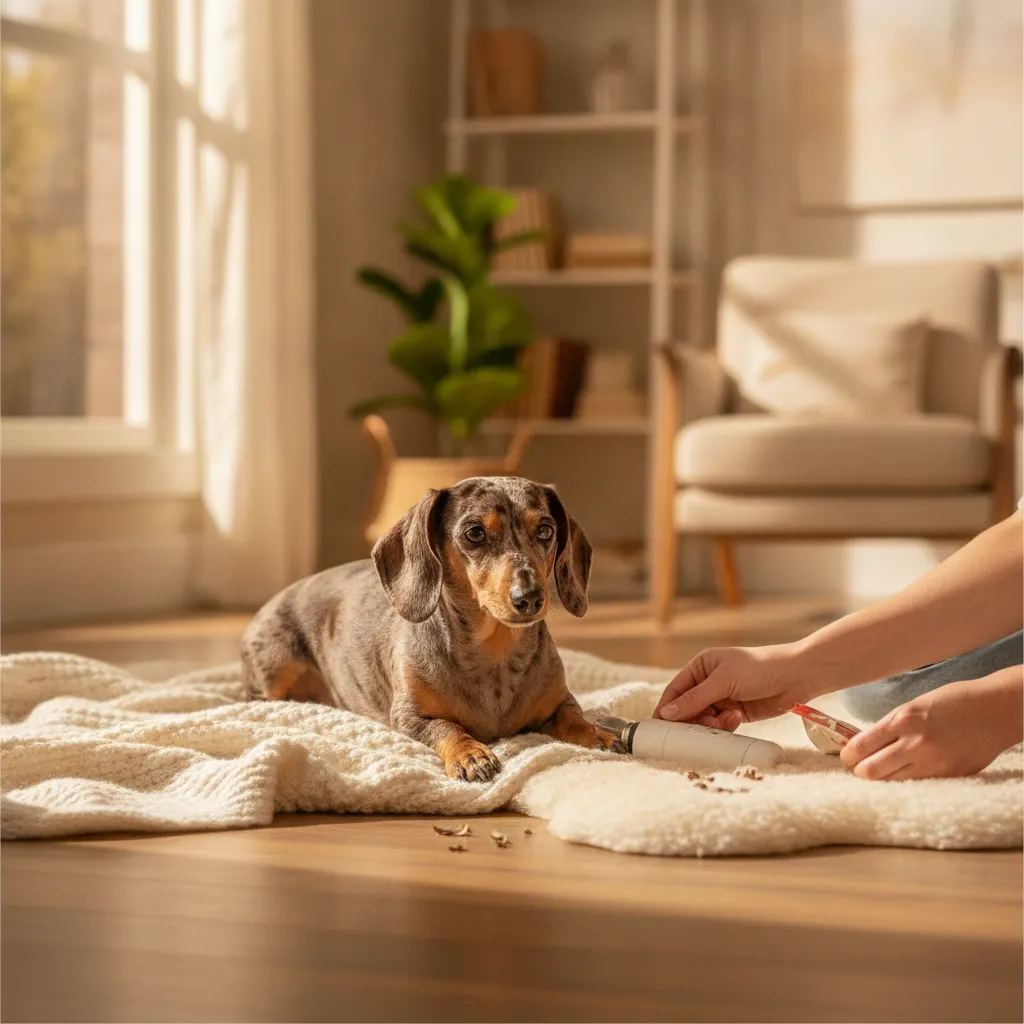
The car ride home is silent, except for the soft panting from the crate in the back. You glance in the rearview mirror at two wide, uncertain eyes staring back. This is it. The “gotcha day” photo is already planned, the new bed is waiting, and your heart is about to explode with love for this little soul you’ve just saved. You open the front door, unlatch the crate, and wait for the joyful explosion of gratitude. Instead, the dog either bolts under the nearest piece of furniture or stands frozen in the middle of the room, trembling. This isn’t the Instagram moment you pictured. This is the quiet, uncertain, and profoundly real beginning of life with a rescue dachshund.
If you're feeling a knot of anxiety in your stomach right now, you’re not alone. You expected an instant bond, a dog who understood you were their hero. Instead, you have a housemate who won't eat, who pees on the rug the second you turn your back, and who flinches when you reach for them. You start to question everything. Did I make a mistake? Am I the wrong person for this dog? Why don’t they love me? It feels like you’re failing, and the guilt is crushing.
So you do what any loving new parent would do: you try to fix it. You shower them with squeaky toys they ignore. You follow them around, cooing and trying to pet them, which only makes them retreat further. You get frustrated when they don't seem to understand what “outside” means, even though you’ve said it fifty times. You’re trying to pour love into a cup that seems to have a hole in the bottom, and both you and the dog are getting more stressed by the day. The generic advice online about “giving them love” feels hollow because it’s not working.
Here’s the thing you need to hear, and I want you to take a deep breath and let it sink in: You did not adopt a blank slate; you adopted a whole life. Your new dachshund had a world of experiences, routines, and relationships before you came along. Their world was just turned upside down. They lost their home, their people, their smells—everything they knew. They aren't being ungrateful; they are grieving and overwhelmed. The problem isn't their behavior. The problem is our expectation that they should arrive fully formed and ready to fit into our lives. Your first job isn’t to train them or even to love them. Your first job is to make them feel safe. That’s it. Everything else comes after.
The Doxie Decompression Protocol: A Three-Phase Guide to Safety and Trust
Over my nearly 20 years with dachshunds, including fostering and helping rehome several, I've learned that they experience change more deeply than many other breeds. Their loyalty is fierce, which means the loss of a previous bond can be a profound loss. They are also creatures of habit with long memories. That's why we need to move slower and be more intentional than we think. Forget everything you know about raising a puppy from scratch. We’re not building from the ground up; we’re carefully renovating a beautiful, historic home that needs its foundation secured first.
You may have heard of the 3-3-3 rule for rescue dogs: 3 days to decompress, 3 weeks to learn the routine, and 3 months to feel at home. It’s a great starting point, but for our sensitive sausage dogs, I like to think of it less as a timeline and more as a series of phases. Your dog sets the pace.
Phase 1: The First 72 Hours – The Silent Sanctuary
The goal for the first three days is one thing: absolute, total, boring predictability. Your home is not a fun new playground; it's a loud, strange, overwhelming planet. Your job is to shrink their world down to a manageable size.
- Create a Den: Before they even arrive, set up a crate in a quiet corner of your main living area. Drape a blanket over the top and sides to make it feel like a safe, dark cave. Put a soft bed and maybe one of your old t-shirts inside. Keep the crate door open. This is not a punishment place; it is their private apartment where no one will bother them.
- Limit the Space: Close off extra bedrooms and use baby gates to limit your new doxie to just one or two rooms (like the living room and kitchen). A whole house is overwhelming. They need to learn the map of a very small territory first.
- No Visitors, No Adventures: As tempting as it is to show off your new family member, the first week is not the time. No friends over, no trips to the pet store, no long walks in a busy neighborhood. Their world should be you, your home, and the designated potty spot. That’s it.
- Let Them Hide: If your doxie dives under the couch and stays there for six hours, let them. They are not rejecting you; they are seeking security. Prying them out will only confirm that the giant new human is unpredictable and unsafe. Sit on the floor across the room, read a book, and let your calm presence be the invitation.
- Potty Breaks on a Leash: Even if you have a fenced yard, take them out on a leash every 2-3 hours. This does two things: it prevents them from finding a corner of the yard to hide in, and it reinforces the connection between you, the leash, and the act of going potty. Use the same door every time and go to the same spot.
Your mantra for the first 72 hours is: “I am a calm, predictable, and safe piece of furniture.” You provide food, water, and access to the potty. You expect nothing in return.
Phase 2: The Next Three Weeks – Building Predictable Rhythms
Once the initial shock has worn off, your rescue doxie will start to cautiously observe. They’re a little scientist, gathering data about this new environment. Is the food bowl always filled at the same time? Does the tall person always make that loud noise with the coffee machine in the morning? Your job is to make your data as consistent as possible.
- The Power of Routine: Wake up, go out, eat, have a quiet chew time, nap, go out, eat, have a short walk, sleep. Do the same things in the same order at the same times every single day. This predictability is what builds trust. It’s the single most important thing you can do.
- Let Them Initiate: Continue to let them make the first move. Sit on the floor and let them approach, sniff, and retreat. Don't reach for them. When they do come close, don't immediately pet their head (which can be intimidating). Instead, offer a closed fist for them to sniff, and maybe give a gentle scratch on the chest or side of the neck.
- Observe, Don't Judge: Now is the time to become a detective of doxie body language. What does their tail do when you pick up the leash? What do their ears do when the dishwasher starts? These are the clues to their past and their personality. You’ll start to see what scares them and what piques their interest. This is the foundation for understanding their unique needs. If you’re struggling to figure out what their little quirks mean, it's the perfect time to understand the 'why' behind their behavior. Being able to decode their signals is the fastest way to build that bond.
- Introduce One New Thing: After the first week, you can start introducing new things, but only one at a time. A new toy. A five-minute visit from one calm friend. A short walk down a different street. Watch their reaction. If they seem overwhelmed, retreat and try again in a few days. For enrichment, try some simple brain games for dachshunds that are low-pressure and build confidence.
Phase 3: The Next Three Months (and Beyond) – Unpacking the Baggage
Sometime between the three-week and three-month mark, you’ll see the real dog start to emerge. This is an incredible moment. You’ll get your first real tail wag, the first time they choose to nap on your lap, the first playful bow. But with the good stuff also comes the baggage. This is when behavioral issues rooted in their past life may surface.
- Separation Anxiety: This is huge for rescue dogs. They’ve already been abandoned at least once. Their greatest fear is that you will leave and never come back. Start practicing departures *very* slowly. Pick up your keys and put them down. Walk to the door and come back. Step outside for 10 seconds. Build up duration gradually.
- Resource Guarding: A dog who may have had to compete for food, toys, or attention might become possessive. If you see stiffening, growling, or snapping when you approach their food bowl or a favorite toy, do not punish them. This is a fear-based behavior. Work with a professional positive-reinforcement trainer to trade up (offering a high-value treat for the guarded item) and build trust.
- House-Training Setbacks: Assume your rescue dachshund is not house-trained, no matter what you were told. Go back to basics: frequent leash-walks, high-value rewards for pottying outside, and managing the environment to prevent accidents. If accidents persist, a vet visit is crucial to rule out a UTI or other medical issues. Remember our core rule: quirks are consistent, a change is a problem. But with a rescue, you don't have a baseline, so a vet checkup is non-negotiable.
- Fear and Reactivity: Your doxie might be deeply fearful of men in hats, plastic bags, or other dogs. This is data from their past. Don't force them into stressful situations. Instead, work on creating distance and pairing the stressful thing with something amazing (like chicken). This process, called counter-conditioning, takes time and patience. For fears around the house, some of the same principles in our guide to helping an anxious dachshund can be applied.
What a Rescue Doxie Really Needs From You
I remember a little long-haired rescue I fostered named Penny. For two solid weeks, she lived behind my couch. She would only come out late at night to eat and drink. I just let her be. I’d sit on the floor, talk to my own dogs, Marley and Mia, and completely ignore her. Then one evening, I was watching TV and felt a tiny, tentative nose touch my elbow. I didn't move a muscle. She stood there for a full minute, then slowly, carefully, she curled up at the far end of the couch. It wasn't a cuddle. It was a truce. And it was one of the most beautiful moments I’ve ever experienced. That was the beginning.
Bringing home a rescue dachshund is a masterclass in patience. You are not just getting a dog; you are earning one. You are peeling back layers of fear and uncertainty to find the incredible, loving, stubborn, hilarious personality underneath. It will not happen overnight. But when that dog finally looks at you, lets out a deep sigh, and melts into your side, you’ll know that every quiet, patient moment was worth it. You didn’t just save them; you created a space where they could save themselves.
Understanding their past is impossible, but understanding their behavior right now is your superpower. It’s how you turn an uncertain housemate into a devoted family member. If you want to become fluent in the language of doxie, to know why they burrow, why they bark at the mailman, and what that little ear flick *really* means, it's time to become a true student of the breed.
To help you on this journey, I’ve put together a guide that explains the 'why' behind their most common (and confusing) behaviors. It’s about building a bond based on understanding, not just love. You can Get the free Dachshund Behavior Decoder and start building that deeper connection today.
Frequently Asked Questions
How long does it really take for a rescue dachshund to settle in?
While the 3-3-3 rule (3 days, 3 weeks, 3 months) is a good guideline, every dog is an individual. A confident dog with a stable past might feel at home in a month, while a timid dog from a difficult situation could take a year or more to truly show their full personality. The key is patience and letting the dog set the pace.
What are the most common behavioral issues in a rescue dachshund?
Separation anxiety, house-soiling, and fear-based reactivity (like barking at strangers or other dogs) are very common. Many rescue dachshunds may also exhibit resource guarding with food or toys. These issues often stem from the instability and potential trauma of their past experiences.
Should I get a second dog to keep my new rescue company?
It's best to wait at least six months to a year before considering another dog. Your new rescue needs time to bond with you and feel secure in their new environment without the added social pressure of another animal. Introducing a second dog too soon can increase stress for everyone involved.
My rescue dachshund seems fearful of everything. What can I do?
Focus on building confidence through predictability and positive experiences. Don't force them into stressful situations. Use high-value treats to create positive associations with things they fear from a distance. Simple brain games and predictable routines can make their world feel much safer.
Is it true that rescue dachshunds are harder to potty train?
They can be, but it's not impossible. You don't know their history, so it's best to assume they have no prior training. Go back to basics with frequent, leashed potty breaks, enthusiastic praise, and high-value rewards. Consistency is far more important than any previous habits.
What health problems should I look out for in a rescue doxie?
Beyond the obvious back issues (IVDD), be sure to have a vet check their teeth, as dental disease is very common. Also, watch for signs of skin allergies, ear infections, and any vision or hearing loss, especially in older dogs. Our guide covers some of these common dachshund health issues in more detail.
dachshund adoption · rescue dogs · dog behavior · new dog owner