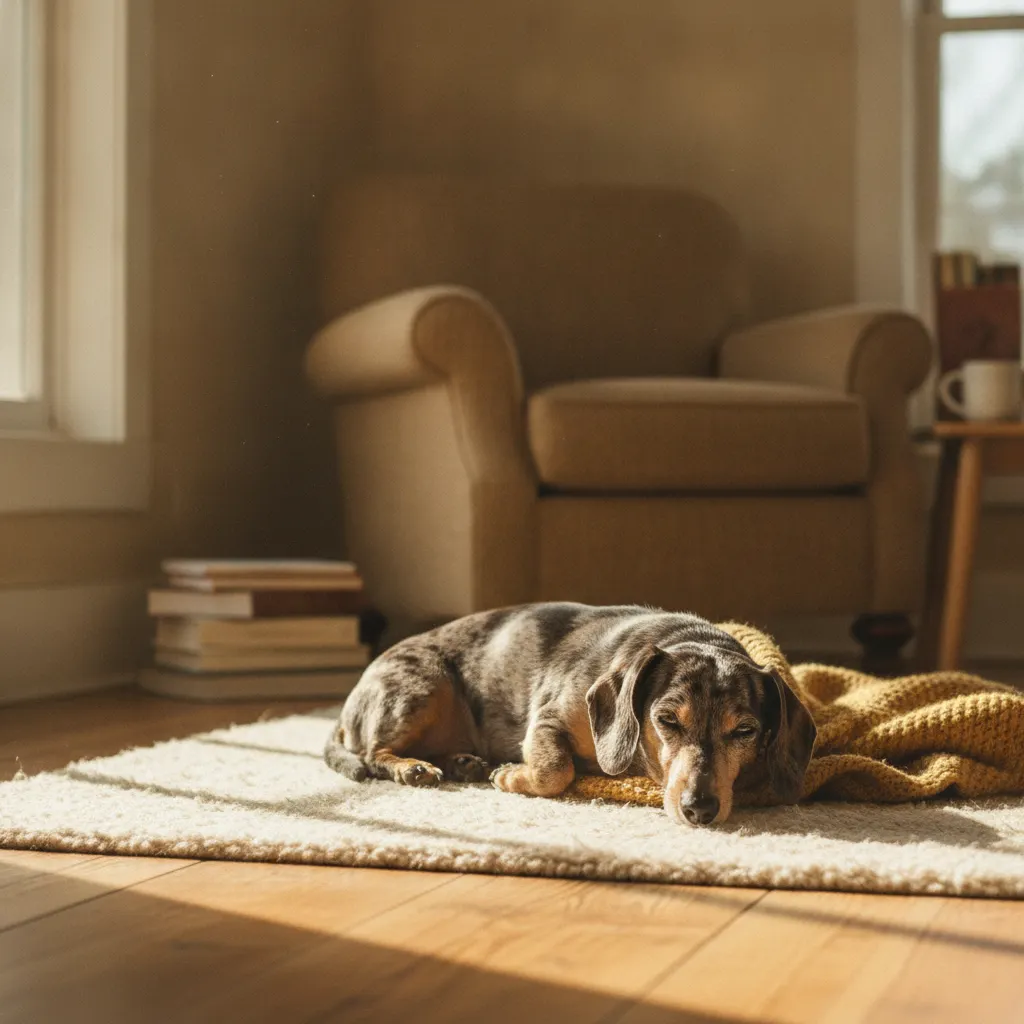
That sound. The frantic tick-tick-scraaaabble of tiny nails on a slick floor, followed by that clumsy, splay-legged fish-tail that stops your heart for a second. You watch them recover, shake it off, and trot away as if nothing happened. But your own heart is still hammering in your chest. Every single time it happens, a little voice in your head whispers, “Was that the one? The one that twists something?”
This is the low-grade, humming anxiety that comes with loving a dachshund. Your beautiful hardwood, laminate, or tile floors—the ones you picked out and loved—suddenly feel less like a design choice and more like a minefield. You find yourself tensing up every time your doxie gets the zoomies, calculating the trajectory from the hallway to the kitchen. It’s exhausting. And it’s a feeling that can slowly chip away at the simple joy of watching your dog be a dog. This constant worry has a name, and if you’re a doxie parent, you know it well: the IVDD Dread.
Why Your Quick Fixes Aren't Working
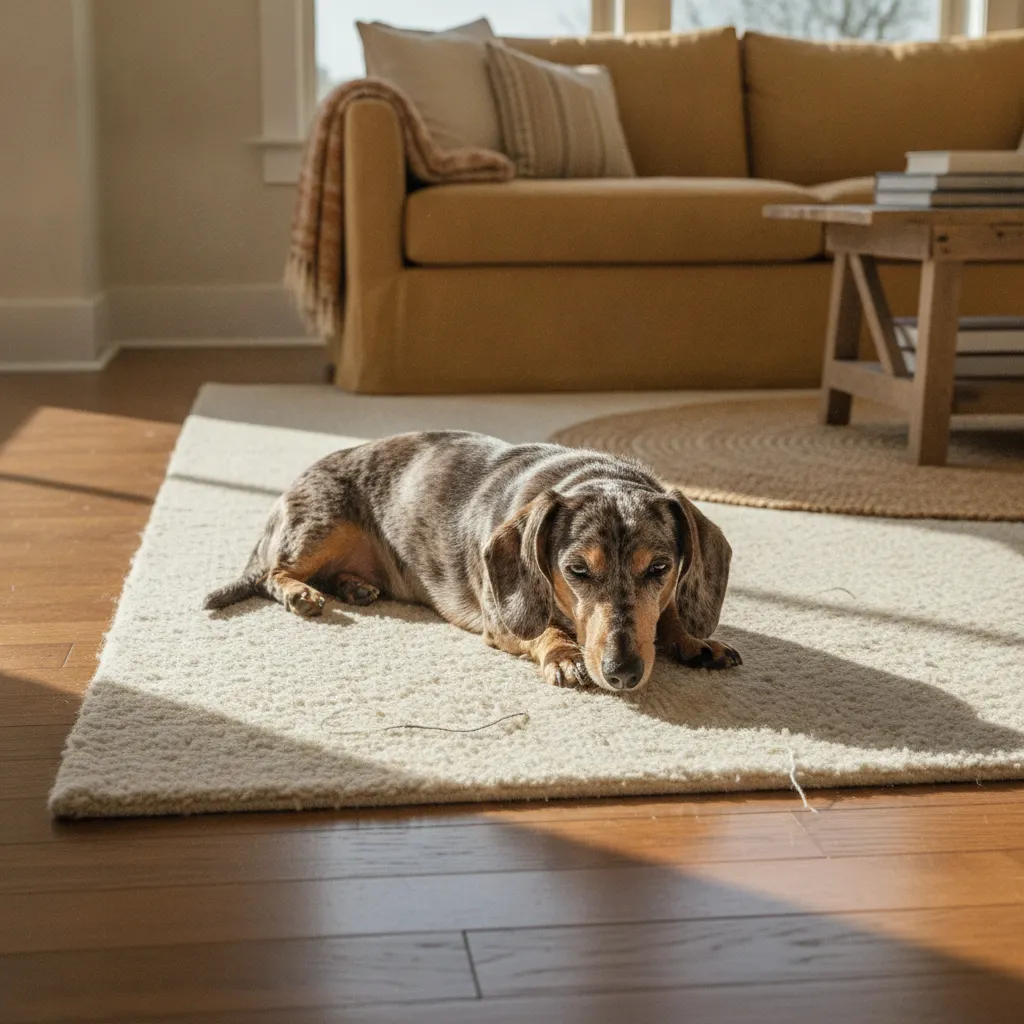
So, what do we do? We try to fix it. We go out and buy a cute, fluffy little rug and place it in the middle of the living room. It looks nice, but your doxie treats it like an island of lava, carefully walking around it. Or worse, they hit it at full speed and the whole thing slides, turning a small slip into a full-on toboggan ride into the coffee table. Now you have two problems.
Maybe you’ve tried the little grippy socks. You spend twenty minutes wrestling them onto four tiny, uncooperative paws, only for your dachshund to either freeze in place like a statue or spend the next hour furiously chewing them off one by one. Or perhaps you’ve tried paw wax, which works for about five minutes until they’ve licked it all off or tracked it all over the couch.
These solutions fail because they’re trying to solve the wrong problem. They are based on the idea that the dog is the issue, that we need to add something *to the dog* to make them compatible with the floor. It’s like trying to fix a bumpy road by putting better shocks on a single car. It’s inefficient, frustrating, and ultimately, it doesn’t work. The road is still bumpy.
The Reframe: Stop Fixing the Dog, Start Fixing the Floor
Here is the single most important shift in perspective you can have about dachshund-proofing your home: The problem isn’t your dog’s clumsiness. The problem is the environment. Your dachshund was bred to dig through earth and underbrush, not to navigate a surface with all the traction of a freshly Zamboni'd ice rink. Their long body and short legs make them uniquely vulnerable to the physics of a low-friction surface.
So, let’s stop trying to fix the dog. Let’s fix the floor. The goal isn’t to dot your home with a few “safe zones.” The goal is to build a complete, connected, and secure highway system for your dachshund. Think of yourself not as a dog owner, but as a tiny civil engineer. Your job is to create safe, reliable roadways that connect all the places your doxie needs and wants to go. When you start thinking in terms of traffic flow and infrastructure, the solution becomes clear, simple, and incredibly effective. This is the core principle of creating the best possible flooring for dachshunds: it's not about replacing your floors, but augmenting them with intelligence and love.
The 'Safe Highway System': A Step-by-Step Guide to Doxie-Proof Rugs
Building this system isn’t about spending a fortune or sacrificing your home’s style. It’s about being strategic. It’s about creating a network of traction that gives your doxie freedom and you peace of mind.
Step 1: Map Your Doxie's Daily Commute
Before you buy a single thing, grab a notepad and spend a day just observing. Where does your dachshund *actually* walk? Don’t guess. Watch them. Their most common routes will probably be:
- Their bed or crate to the water bowl.
- The water bowl to the back door for potty breaks.
- The living room couch to the kitchen (especially when they hear the fridge open).
- The main hallway that connects the rooms they use most.
- The area right at the bottom of any stairs or furniture they are allowed on.
These are your main arteries. These are the paths that absolutely must be paved with traction. You’ll quickly see that one 5x7 rug in the center of the room doesn’t cover any of these critical paths. You need to think in lines, not squares. This is where runners become your absolute best friend.
Step 2: Choose Your 'Paving' Material (The Anatomy of a Doxie-Safe Rug)
Not all rugs are created equal. For a dachshund home, some features are non-negotiable, while others are just nice to have. This is the most crucial part of selecting the right flooring for dachshunds.
The Pile: Low and Tight is RightThe “pile” is the height of the rug’s fibers. For doxies, you want a low-pile, tightly woven rug. Think commercial-grade carpet or a flatweave style. Here’s why:
- High-Pile/Shag Rugs: These can be problematic. A dachshund’s little claws can easily get snagged in the long fibers, causing a nail to get torn or, worse, causing a trip and a tumble that could injure their back. They are also impossible to clean.
- Looped Rugs (like some Berber): Similar to shag, the loops are perfect little claw-catchers. Avoid any rug where you can easily stick your finger through a loop in the fabric.
- The Winner: Low-Pile/Flatweave: These provide a smooth but grippy surface. Their nails won’t get caught, it’s easy for them to get traction for takeoff and landing, and they are infinitely easier to clean when the inevitable accident happens.
If you remember nothing else, remember this: a rug that slides is more dangerous than no rug at all. The backing is what prevents this. You have a few options:
- Rubber Backing: This is the gold standard. A solid, integrated rubber backing will grip the floor and stay put. Many washable runners and kitchen mats have this built-in. It’s your best, most reliable choice.
- Woven/Jute/Felt Backing: Most traditional area rugs have this. On its own, it’s like putting a sheet of paper on ice. If you fall in love with a rug that has this kind of backing, you MUST pair it with a high-quality, non-slip rug pad underneath. Not the cheap waffle-weave kind that disintegrates, but a solid felt-and-rubber combination pad. Cut it just slightly smaller than the rug itself.
Dachshunds are low to the ground. They bring in dirt, they have accidents, they spill things. A rug that can’t be easily and thoroughly cleaned will not last long.
- Synthetics (Polypropylene, Nylon, Olefin): These are your workhorses. They are durable, stain-resistant, and relatively inexpensive. Many machine-washable rugs are made from these materials. They are a fantastic, practical choice for high-traffic doxie highways.
- Natural Fibers (Wool, Cotton): Wool is naturally durable and stain-resistant but can be more difficult and expensive to clean. Cotton is soft and often washable, but can wear out faster. They can be great options, but check the cleaning instructions carefully.
Step 3: Build and Secure Your Highways
Now it’s time to lay the pavement. The goal is continuous, connected paths. You want your doxie to be able to get from the couch to the water bowl without ever having to touch the slippery floor. This means using multiple runners to create an L-shape or T-shape where needed. Don't be afraid to have them overlap slightly to ensure there are no gaps.
Even with a good backing, you might want extra security. For high-traffic areas or corners where your doxie likes to bank at high speed, consider using double-sided carpet tape. It’s a cheap and easy way to make absolutely sure that nothing is going to budge. A secure floor gives your dog confidence. You'll notice they run and play more freely when they know their footing is sure. This isn't just about preventing catastrophic injury; it's about improving their daily quality of life and protecting their long-term joint health, which goes far beyond just the back.
Proof is in the Peace of Mind
I learned this the hard way. With my first doxie, Marley, I had beautiful dark hardwood floors throughout my house. I did the classic “one big area rug” solution. And I spent years with my heart in my throat, watching him slip and slide on the surrounding floor. It wasn't until I brought Mia home, a tiny, rambunctious puppy, that I realized my approach was all wrong. I was constantly yelling “Be careful!” at a dog who just wanted to play.
That’s when I became a tiny civil engineer. I sat on the floor and watched where they ran. I bought a set of inexpensive, machine-washable, rubber-backed runners and laid them out, creating a continuous path from their crate in the living room, down the hall, and into the kitchen. The change was immediate. The frantic scrabbling stopped. They played with more confidence. They could zoom around the corner without their back end sliding out from under them.
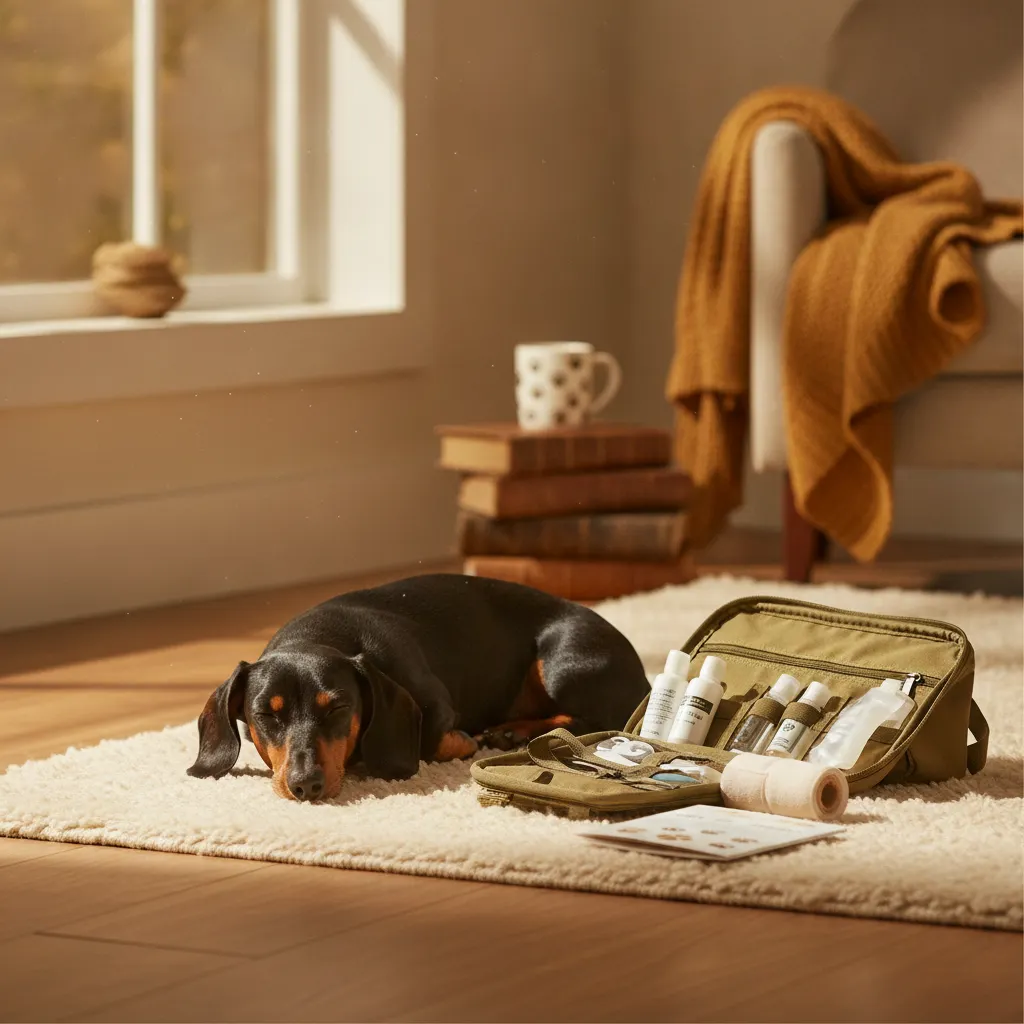
But the biggest change was in me. The constant, low-level anxiety just... dissolved. I could finally relax and enjoy them, knowing I had engineered their environment to be as safe as possible. I didn't have to be the “fun police” anymore. I had done the work ahead of time, much like preparing a back-ready first-aid kit gives you peace of mind for emergencies. I had built them a safer world.
Your Home, Their Sanctuary
Your home should be a sanctuary for your dachshund, not an obstacle course. By shifting your thinking from correcting the dog to correcting the floor, you can eliminate one of the biggest daily risks to their spinal health. Creating a “Safe Highway System” with the right kind of rugs and runners is one of the most loving and impactful things you can do for your long little dog.
It’s a project you can tackle in a single weekend, and it will pay dividends for the rest of your life together—in fewer heart-stopping moments, in the confidence you see in your dog’s happy trot, and in the profound peace of mind that comes from knowing you’ve done everything you can to protect that long little back.
Once you’ve made their physical world safer, you can go even deeper into understanding their quirky little minds. Knowing *why* they do the funny things they do is the key to being a more confident and connected doxie parent. To learn the reasons behind their stubbornness, their burrowing, and their surprisingly complex social cues, you can start by understanding their core instincts. Get the free Dachshund Behavior Decoder and start speaking their language today.
Frequently Asked Questions
Are hardwood or tile floors always bad for dachshunds?
They aren't inherently "bad," but they are a high-risk factor. These surfaces offer zero traction, which can lead to slips and falls that cause micro-traumas or a single serious injury to their spine. The best approach to flooring for dachshunds is not necessarily replacement, but strategic coverage with non-slip rugs and runners in all high-traffic areas.
What about paw wax or adhesive paw grips? Are they a good alternative?
While they can provide some temporary traction, they are not a reliable long-term solution. Many dachshunds dislike the feeling and will lick or chew them off, and they require constant reapplication. It's far more effective and less stressful for the dog to modify the environment (the floor) rather than constantly trying to modify the dog.
My dachshund loves to chew on the corners of rugs. What should I do?
This is common! Opt for very low-pile, durable rugs that don't have tempting tassels or loose edges. When you introduce a new rug, supervise them closely and redirect any chewing to an appropriate chew toy. A bitter-tasting spray made for dogs can also be applied to the corners to deter them.
How do I keep all these runners and rugs clean with a dachshund in the house?
Washability is key. Look specifically for runners that are labeled as machine-washable. For larger rugs, a small spot cleaner or carpet shampooer can be a lifesaver for dealing with inevitable accidents. Regular vacuuming with a good quality vacuum will handle the constant shedding.
Can I just use a bunch of small, rubber-backed bath mats?
While better than nothing, this can create its own problem. A series of small, disconnected mats can become tripping hazards for both you and your dog. It's much safer to use longer runners to create a continuous, uninterrupted path of traction, which is the ideal flooring for dachshunds from a safety perspective.
IVDD · back safety · home safety · dachshund care