You see a video online: a sleek Border Collie flying over jumps, weaving through poles like water. Then you look down at your own long, low-to-the-ground sausage dog, currently tangled in a blanket, and you laugh. Agility? For this dog? It sounds like a recipe for a panicked trip to the vet. The very idea of all that jumping and twisting probably makes your heart leap into your throat. But what if I told you that not only can dachshunds do agility, but a special, modified version might be one of the best things you ever do for their confidence, their boredom, and your bond? The secret isn't forcing a wiener dog to be a Border Collie; it's about making the sport of dachshund agility work for their unique, adorable build.
The Big Question: Is Agility Safe for a Dachshund's Back?
Let's just name the elephant in the room: Intervertebral Disc Disease (IVDD). It's the shadow that follows every doxie parent. We arrange our entire homes to protect that precious spine, from ramps on the furniture to stern looks when they get the zoomies. So, when someone mentions a sport that involves jumping, weaving, and climbing, our internal alarm bells don't just ring—they scream.
You want to give your doxie a rich, fulfilling life. You know they're smart and energetic. You see that little spark in their eye that tells you a walk around the block just isn't cutting it. But every potential activity is filtered through one critical question: "Is this safe for their back?"
Maybe you've tried just buying more puzzle toys, but they solve them in five minutes and go back to barking at squirrels. Perhaps you considered a standard agility class, only to be politely told that your dog's conformation isn't "ideal" for the sport. It's frustrating. You feel stuck between wanting to challenge your brilliant little hunter and the paralyzing fear of causing an injury. That fear is valid, and it comes from a place of deep love.
The Real Problem Isn't the Sport, It's the Rules
Here’s the shift in perspective that changes everything: The danger isn't in the concept of agility. The danger is in trying to make a dachshund play by rules designed for a completely different kind of dog. Standard agility, with its regulated jump heights and tight weave pole spacing, was created with long-legged, flexible breeds in mind.
Forcing a dachshund into that world is like asking a weightlifter to run a marathon. They're both athletes, but their bodies are built for different tasks. The real problem isn't the running, weaving, or tunneling—it's the high-impact jumping and abrupt, spine-torquing turns of competitive agility.
So, we're not going to do that. We're going to throw the rulebook out the window and create our own sport. Welcome to the world of "Doxie-gility." The goal isn't speed or blue ribbons. The goal is confidence, coordination, teamwork, and pure, unadulterated fun, all while keeping that long little back safe and sound.
Your Guide to Back-Safe Dachshund Agility
Creating a Doxie-gility course is less about buying official equipment and more about using your imagination. It’s about adapting the world to your dachshund, which, as a doxie parent, you're already an expert at. Here are the core principles and how to build your own fun-zone at home or in the yard.
The Golden Rules of Doxie-gility
Before you lay out a single cone, commit these rules to heart. They are your non-negotiable safety net.
- The Ground is Your Friend: All obstacles should be low to the ground or on the ground itself. Height is not our goal.
- No High-Impact Landings: Jumping down from things is the arch-nemesis of a dachshund spine. We eliminate it completely.
- Gentle Curves, No Sharp Twists: Think sweeping turns, not hairpin bends. We want to avoid any movement that puts torque on the spine.
- It's a Game, Not a Race: The point is joyful engagement. If your doxie is stressed, tired, or just not into it, the game is over for the day. Fun is the only finish line.
Building Your Back-Safe Course
You don't need a thousand dollars of professional gear. In fact, you probably have everything you need right in your house. It's all about creative repurposing.
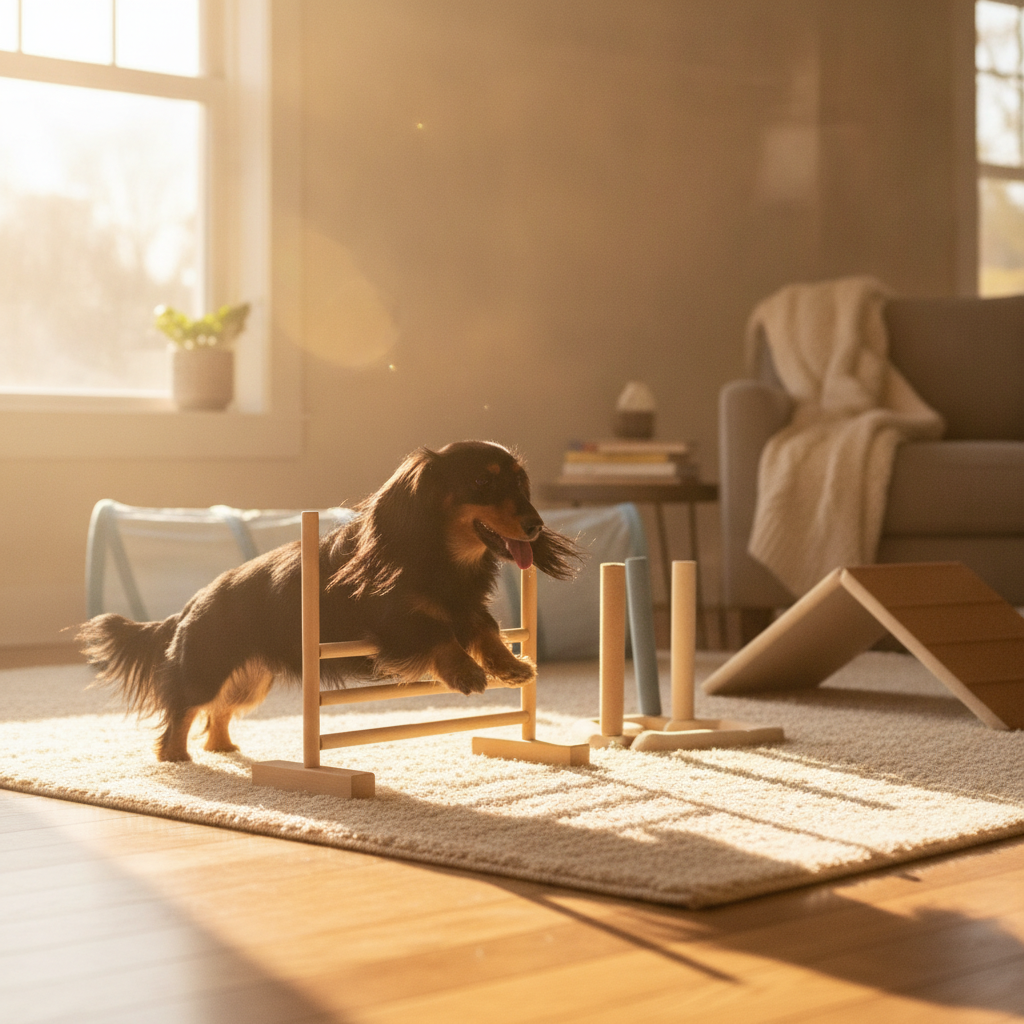
The Tunnel: A Doxie's DreamThis is the one piece of agility equipment that feels like it was invented specifically for dachshunds. It taps directly into their 600-year-old instinct to burrow into badger dens. A simple child's play tunnel is perfect. They are inexpensive, collapsible, and the right size for both miniature and standard doxies. Start with a short, straight tunnel and you'll likely find your doxie takes to it instantly. It's a dark, exciting tube that needs investigating—it's in their DNA!
The Weave Poles (Doxie Edition)Forget the tight, rapid-fire weaving you see on TV. For a dachshund, that's a recipe for a spinal twist. Our weave poles are more of a gentle slalom. You can use anything: shoes lined up, toilet paper rolls, or even plastic water bottles. The key is to space them far apart—at least two dachshund-lengths—so your dog is making a gentle, snake-like motion rather than a sharp, jerky one.
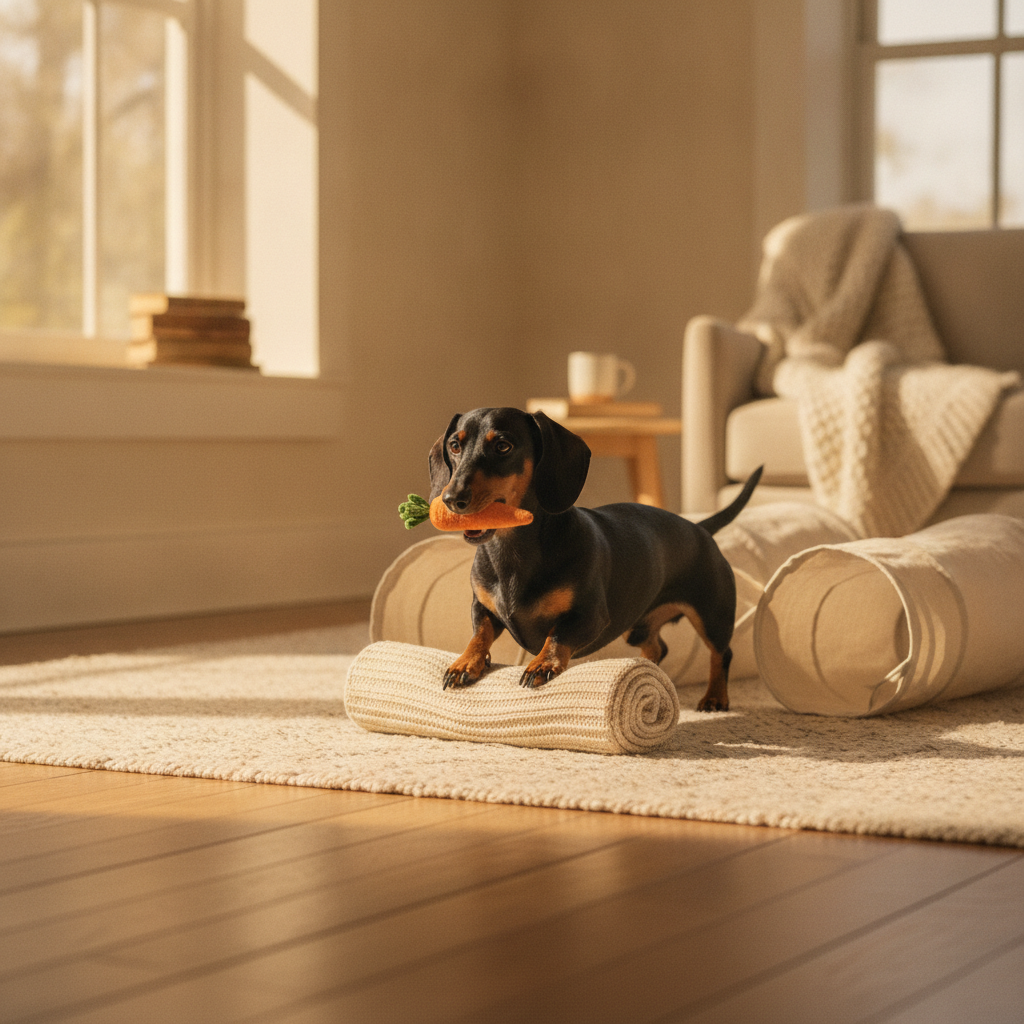
The "Jumps" (Or, as We Call Them, "Step-Overs")We are officially banning the word "jump." In Doxie-gility, we have "step-overs." The goal is to get your dog to lift their feet deliberately, which is great for body awareness and coordination, without ever leaving the ground. Lay a broomstick, a pool noodle, or even a rolled-up towel on the floor. That's it. That's the obstacle. Celebrate them for stepping over it neatly. You can gradually increase the challenge by lining up a few in a row, but never raise the height.
The Pause TableThis is a fantastic exercise for teaching impulse control—something every dachshund owner knows is a work in progress. The "table" doesn't need to be a table at all. It can be a low, stable ottoman, a sturdy cushion, or even just a designated bath mat on the floor. The goal is to have them get onto the platform and wait for your release command. It's a moment of calm focus amidst the excitement of the course.
The A-Frame Reimagined: The Gentle RampA steep A-frame is a definite no. But a very low, wide ramp is a wonderful tool for building confidence and rear-end strength. If you already have a ramp for your couch or bed, you're halfway there! You can practice having them walk up and down it on command. As I've said before, ramp training is all about patience, and turning it into a game is a brilliant way to reinforce this life-saving skill.
Training Tips for Your Stubborn Sausage
Remember, you're working with a dog bred for independent thought. They need to believe this is their idea.
- Short and Sweet: Keep training sessions to 5-10 minutes. End on a high note while they're still engaged and having fun. This leaves them wanting more next time.
- High-Value Treats: This is the time to break out the good stuff. Tiny pieces of cheese, boiled chicken, or their absolute favorite treat will make them very interested in your new game.
- One Thing at a Time: Introduce one obstacle per session. Let them sniff it, explore it, and get comfortable with it before asking them to engage. Lure them through the tunnel or over the step-over with a treat.
- Massive Praise: Over-the-top cheering, petting, and excitement from you is the real reward. They feed off your energy.
Remember the golden rule of dachshund care: quirks are consistent; problems are a change. A sudden reluctance to play, yelping, or a change in their posture is a signal to stop immediately and consult your vet. This is educational fun, not a replacement for professional veterinary advice.
My Own Doxie-gility Stars: Marley and Mia
I can tell you from my own experience, this stuff works. My Mia is a little powerhouse, always looking for a job to do. A simple course of a tunnel and some step-overs in the living room completely channels her energy. It satisfies that deep-seated need to have a task, which is something every bored hunter needs. She zips through the tunnel with a look of pure joy on her face.
Marley, on the other hand, is my more cautious soul. The Doxie-gility course has been an incredible confidence builder for him. At first, he was suspicious of the tunnel. But with patience and lots of encouragement, the first time he trotted through it, he came out the other side with his tail held high, so proud of himself. It wasn't about speed; it was about overcoming a challenge. It's just one of many fun and safe activities we've found to enrich their lives without putting them at risk.
This modified sport strengthened our bond because it became a language we both understood. It's a partnership, a game we play together. And that is the true prize.
Want to know why your doxie loves burrowing in tunnels and 'hunting' the squeaker out of a toy? It's all part of their unique wiring. To become a more confident doxie parent by finally understanding the 'why' behind all their funny, stubborn, and lovable quirks, Get the free Dachshund Behavior Decoder.
Frequently Asked Questions
Is dachshund agility safe for their backs?
Yes, but only if it's heavily modified. Traditional agility with high jumps and tight turns is not safe. A "Doxie-gility" approach focusing on ground-level, low-impact obstacles like tunnels and step-overs makes it a fun and safe activity that protects their spine.
At what age can my dachshund start agility training?
It's best to wait until your dachshund is at least 12 to 18 months old, after their growth plates have closed. Starting strenuous activity too early can be harmful. As always, consult your veterinarian before beginning any new physical activity with your dog.
Can my dachshund compete in agility competitions?
It's very unlikely they could safely compete in standard, sanctioned competitions due to the required jump heights. However, some local clubs offer "fun runs" or beginner-level classes with very low or on-the-ground obstacles. The goal for dachshund agility should always be fun and enrichment, not formal competition.
What are the best agility obstacles for a dachshund?
Tunnels are fantastic as they play into a dachshund's natural burrowing instincts. Wide-spaced weave poles (for a gentle slalom) and ground-level step-overs (like a broomstick on the floor) are also excellent. Always avoid high-impact equipment like standard jumps, the teeter-totter, and the dog walk.
My dachshund is a senior. Is agility still an option?
Absolutely! A very gentle, modified course can be wonderful for a senior dog's mental and physical health. Think of it as physical therapy. Simple exercises like walking through a tunnel or over a single step-over can help with body awareness and keep their mind sharp. Just be sure to clear it with your vet first.
What if my dachshund seems scared of an obstacle?
Never, ever force them. The goal is to build confidence, not create fear. If they are scared of the tunnel, for example, try scrunching it up so it's very short and toss a high-value treat just inside. Celebrate any interaction, even just a sniff. Keep it positive and go at their pace.
dachshund training · dog agility · IVDD prevention · canine enrichment