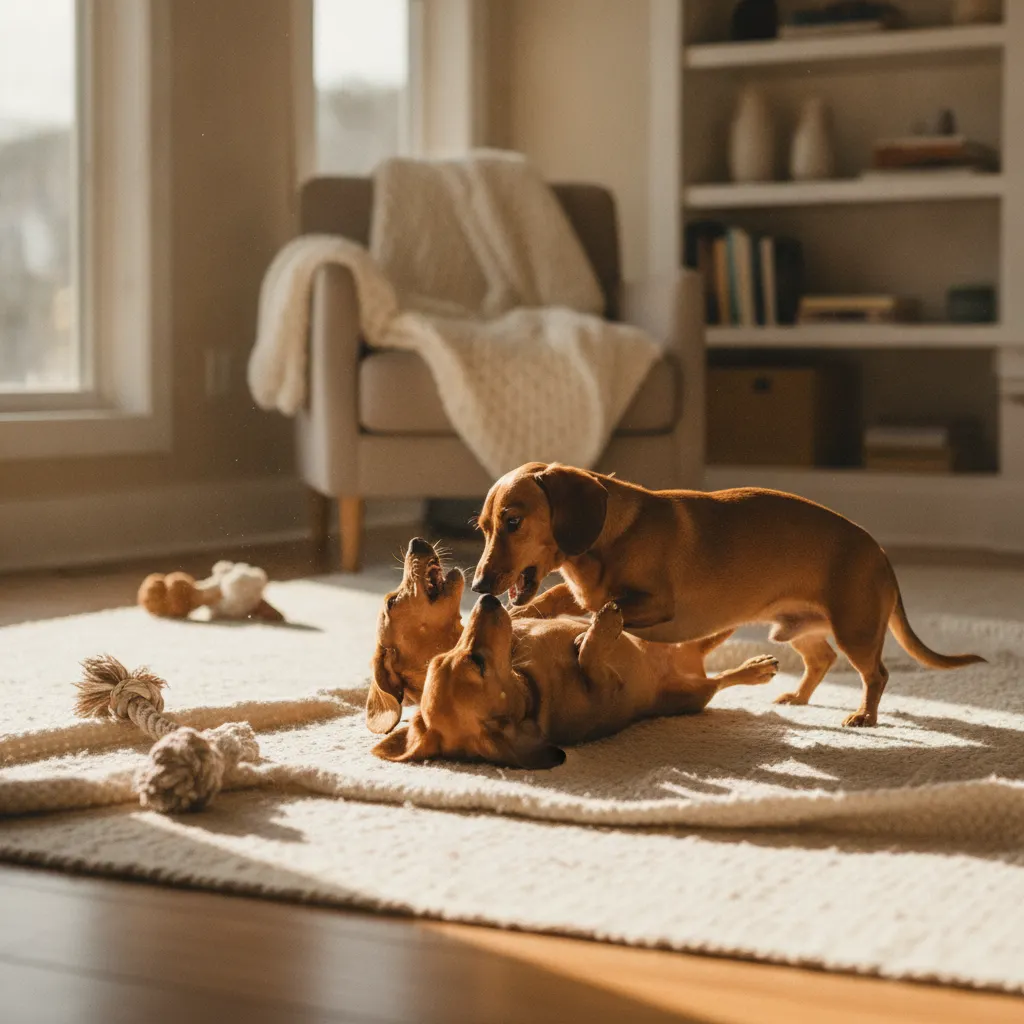
You’re sitting on the couch, enjoying a rare moment of peace. Suddenly, it happens. A brown-and-tan blur torpedoes across the living room, launching itself with the force of a tiny cannonball into your other dachshund. What follows is a chaotic whirlwind of growls, snarls, and a game I affectionately call “bitey-face.” It looks and sounds absolutely brutal. If you were a new doxie parent, you’d be forgiven for thinking you’ve accidentally adopted a pair of tiny, furry gladiators who are about to fight to the death on your favorite rug.
This is the moment every dachshund owner has. You watch this display, your heart thumping, and you think, “Is this normal? Are they trying to hurt each other? Did I do something wrong?” You see videos of Golden Retrievers gently playing fetch, and then you look at your own little hellions trying to chew each other’s faces off. The worry is real. You’re not just a dog owner; you’re the referee for the Wiener Dog Wrestling Federation, and you’re not even sure of the rules. This raw, intense dachshund play style can be deeply unsettling if you don’t understand what’s behind it.
So what do we do? We clap our hands and say, “Be nice!” We separate them when the growling gets too loud. We might even buy them softer, gentler toys, hoping to inspire a more civilized form of entertainment. And what happens? They ignore the plush toy and go right back to body-slamming each other behind the ottoman. These solutions fail because they’re based on a fundamental misunderstanding of who our dogs are. You’re trying to apply Labrador rules to a dachshund game, and it just doesn’t work. You’re asking a tiny, stubborn badger hunter to play like a water-retrieving bird dog, and they’re looking at you like you’re crazy.
Your Doxie Isn't Being Bad — They're Being a Dachshund
Here’s the reframe that changed everything for me: Your dachshund’s play isn’t about aggression. It’s a rehearsal. For 600 years, these dogs were bred for one specific, terrifying job: to go underground, into a dark, narrow tunnel, and fight a badger. A badger is a formidable, ferocious opponent with sharp claws and a nasty disposition. To survive that encounter, a dachshund needed to be bold, relentless, and an expert in close-quarters combat.
Their play is a direct reflection of that ancestry. They aren't trying to hurt each other; they are practicing ancient skills hardwired into their DNA. The body slam, the jaw sparring, the dramatic growls—it’s all a dress rehearsal for a badger fight they’ll never actually have. Once you see their play through this lens, it stops being scary and starts being fascinating. You’re not watching aggression; you’re watching history come to life in your living room.
Your dachshund isn't being aggressive; they're rehearsing for a fight they'll never have.
Understanding this is the key. It allows you to stop worrying and start appreciating the incredible instincts that make our little sausage dogs so unique. You can become a better play-supervisor when you know what you’re actually looking at.
Decoding the Moves: A Guide to the Dachshund Play Style
So, what are these signature moves, and what do they really mean? Let's break down the main events of the Dachshund Olympics. By understanding the “why” behind each move, you can confidently tell the difference between healthy play and a potential problem.
The Body Slam: A Tactic of Leverage
This is often the opening move. One doxie lowers their shoulder and slams into the other, sometimes knocking them right off their feet. It looks rough, but it’s a brilliant hunting tactic. In a narrow badger tunnel, you can’t outrun your opponent. You have to unbalance them, gain a position of leverage, and take control of the situation. The body slam is a way to practice creating that opening. It’s not about causing pain; it’s about strategic positioning. My Marley is the master of this. He’ll use the couch as a backboard to launch himself at Mia, who has learned to brace for impact. It’s their version of a friendly shoulder check in hockey.
Bitey-Face: The Art of Jaw Sparring
This is the one that worries owners the most. It involves open mouths, lots of teeth, and what looks like an attempt to bite the other dog’s entire head. But if you watch closely, you’ll see it’s incredibly controlled. This is called bite inhibition. They are practicing how to use their most powerful weapon—their jaw—without actually causing damage. They are measuring each other's strength, testing boundaries, and communicating. Healthy bitey-face is accompanied by bouncy, loose body language, play sneezes (a signal that “this is just a game!”), and taking turns being the “aggressor.” It’s a beautifully intricate dance, not a street fight.
The Growl and the Snarl: A Vocal Performance
Dachshunds are famously vocal, and their playtime is no exception. The growls can sound guttural and terrifying, like something out of a horror movie. However, in the context of play, these sounds are just part of the performance. It’s communication. A play growl is often higher-pitched and more variable than a true, aggressive growl. It’s their way of saying, “Ooh, this is getting exciting!” or “You got me that time!” Think of it less as a threat and more as the color commentary for their wrestling match. When I first got Mia, her high-pitched play-yaps during games with Marley sounded like she was being murdered. But years later, I know it’s just her “I’m having the best time ever” voice.
The 'Squeak-and-Destroy' Alligator Roll
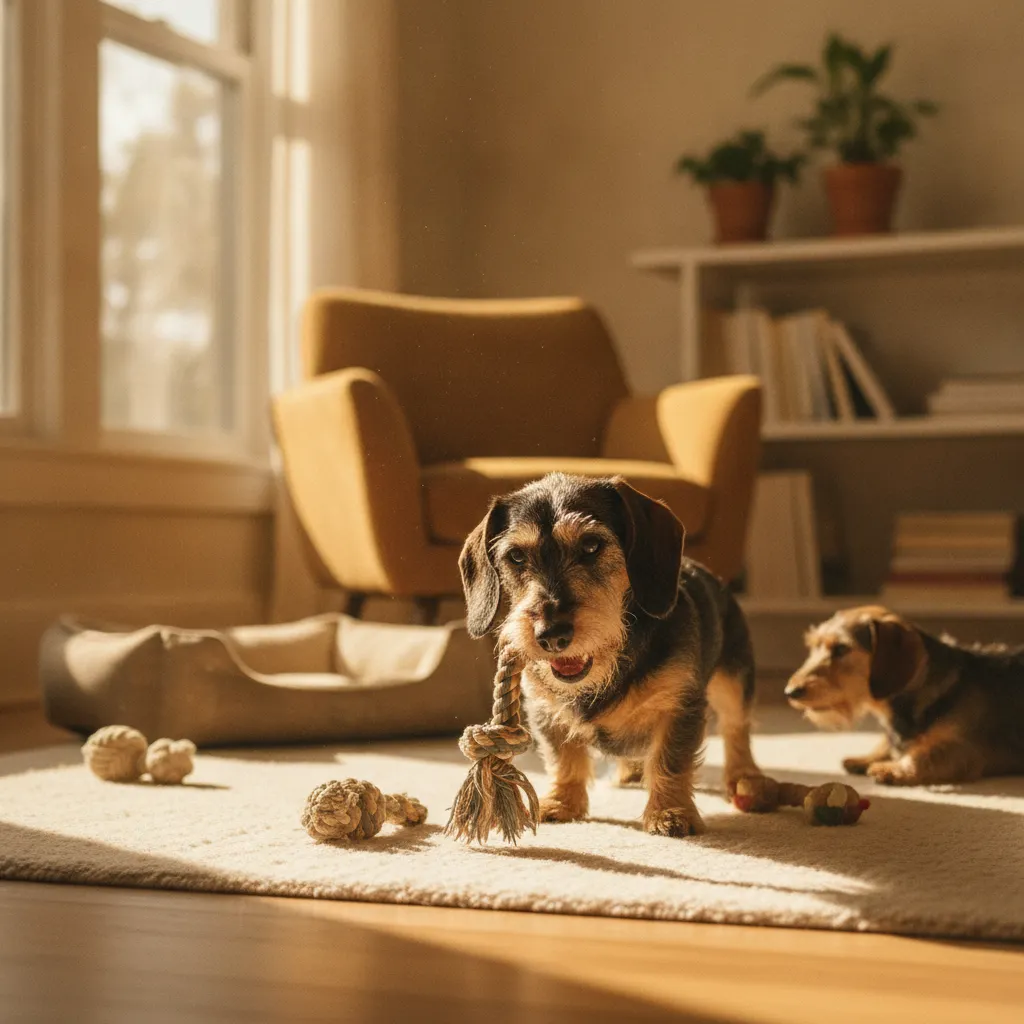
When a dachshund gets a toy, especially a squeaky one, you’ll often see them grab it, plant their feet, and shake their head back and forth with incredible violence. This is the “alligator roll,” and it’s a pure, unadulterated instinct to dispatch prey. The squeak mimics a small animal, triggering that ancient hunter wiring. This is a fantastic outlet for their energy and a vital part of the typical dachshund play style. It’s why having the right toys is so important; you need something that can stand up to this instinctual thrashing. If you’re tired of replacing toys every week, it’s worth checking out a guide to the five types of toys every dachshund needs, from durable chewers to brainy puzzles.
How to Be a Good Referee for the Wiener Dog Wrestling Federation
Even though their play is normal, it’s still our job to make sure everyone stays safe and happy. You don’t need to stop them, but you do need to supervise. Knowing what to look for will give you the confidence to let them be dachshunds.
Know the Signs of Healthy Play
Look for the “meta-signals” of play—the signs dogs use to tell each other “I’m just kidding!”
- The Play Bow: The classic “front end down, butt in the air” invitation to play.
- Bouncy, Inefficient Movement: Play is often exaggerated and goofy. Aggression is stiff, tense, and efficient.
- Taking Turns: Watch to see if they switch roles. One dog chases, then the other. One is on top, then they switch. If one dog is always the victim, it may be time for a break.
- Play Sneezing: A quick sneeze is a dog's way of saying, “This is fun! We’re not serious!”
- A Loose, Wiggly Body: Happy, playing dogs are like noodles. Tense, aggressive dogs are like statues.
Know When to Call a Time-Out
Sometimes, play can escalate. One dog might get over-aroused, or the other might get tired and cranky. It’s time to intervene if you see:
- A Stiff Body and Tail: A high, stiff, vibrating tail is a major warning sign.
- Lip Curling and Hard Stares: A relaxed, open mouth is play. A curled lip showing all the teeth, combined with a hard, unblinking stare, is a threat.
- One Dog Constantly Trying to Disengage: If one dog is trying to hide, get away, or yelps and doesn’t immediately return to the game, the fun is over for them. Step in and give them space.
- Raised Hackles: The hair standing up on their back is a sign of arousal that can tip from excitement into aggression.
When you see these signs, don’t yell. Simply step in calmly, separate them, and give them something else to do for a few minutes. A great technique is to have a “settle” command or to redirect them to their own chew toys. If you have two doxies, learning to manage their dynamic is a skill all its own. For more on that, our guide to managing a multi-wiener household can be a lifesaver.
The Most Important Rule of All
Here is the one rule that will save you a hundred panicked Google searches: Quirks are consistent; problems are a change. If your dogs have always played this rough, it's almost certainly just their normal dachshund play style. A sudden shift—like a dog who used to love bitey-face now snapping viciously—is the real signal that something might be wrong, whether it's pain, fear, or a medical issue. And as always, this is just educational content. Your own vet is the ultimate authority on your individual dog's health and behavior. Never hesitate to call them if you're truly concerned.
Watching Marley and Mia play has been one of the great joys of my nearly 20 years with this breed. It’s a window into their wild little souls. Once I learned to stop worrying and just appreciate the spectacle, I felt so much more connected to them. I wasn’t just their mom; I was a spectator to a 600-year-old tradition unfolding on my living room floor.
Understanding this wild play style is a huge piece of the puzzle, but it's just one part of their wonderfully weird world. If you’ve ever wondered why they burrow, why they bark at everything, or why they give you that signature side-eye, it’s all connected. To become a more confident doxie parent and truly understand the “why” behind their behavior, I’d love for you to join our pack. You can start by getting the guide that decodes it all: Get the free Dachshund Behavior Decoder.
Frequently Asked Questions
Why does my dachshund growl so much when playing?
Growling is a normal part of dachshund play and a form of communication. A play growl is usually higher-pitched and more varied than an aggressive growl. It's their way of expressing excitement and engagement in the game, not a sign of true aggression.
Is my dachshund playing or fighting with my other dog?
Look for key body language cues. Play involves bouncy movements, taking turns, play bows, and sneezing. Fighting is characterized by stiff, tense bodies, raised hackles, hard stares, and one dog consistently trying to escape or yelping without returning to play.
How can I encourage a safer dachshund play style?
While their rough style is normal, you can ensure it stays safe by always supervising play. Teach a “take a break” command to interrupt things if they get too intense. Providing other outlets for their energy, like puzzle toys and sturdy chew toys, can also help moderate the intensity of their wrestling.
My dachshund plays too rough with other, non-dachshund dogs. What should I do?
This is common, as the unique dachshund play style can be misinterpreted by other breeds. It’s best to choose playmates of a similar size and play style. Always advocate for your dog and be ready to remove them from a situation if the other dog is clearly not enjoying the rough-and-tumble game.
Why does my dachshund bite my hands and feet when we play?
This is often a case of misdirected playfulness. They are trying to engage you in their natural jaw-sparring game. The best solution is to immediately redirect their mouth onto an appropriate toy every single time they try to bite your skin, teaching them what is and isn't okay to chew on.
Can a solo dachshund be happy without another dog to play rough with?
Absolutely! A solo dachshund can be perfectly happy as long as you, their owner, engage them in play that satisfies their instincts. Games of tug-of-war (let them win!), chasing a flirt pole, or working on puzzle toys can provide the mental and physical stimulation they need to thrive.
dachshund behavior · dog play · dachshund training · dog body language