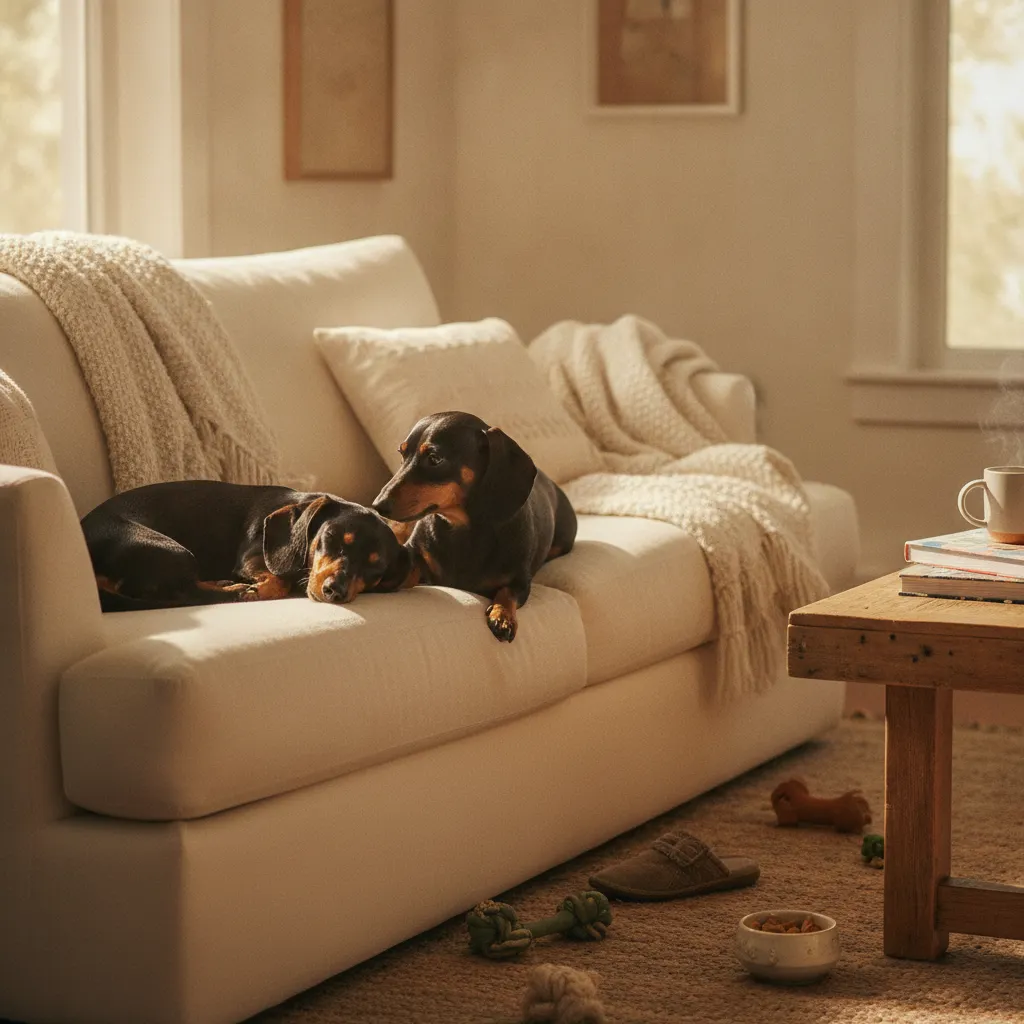
You hear it before you see it. A low grumble from the direction of the dog bed, escalating into a series of snarls that sound like a tiny, furry chainsaw trying to start. You rush in to find one of your dachshunds has a squeaky toy, and the other has decided that this particular toy is the most valuable object on planet Earth. The standoff is tense, the air is thick with wiener-dog indignation, and you’re about to spend the next five minutes playing hostage negotiator over a worn-out plush hedgehog. Welcome to the reality of a multi-dachshund household. It’s not always the cuddly pile of sausages you see on Instagram, is it?
The Heart of the Problem: You're Not a Referee, You're a Resource
If you're constantly breaking up spats, feeling anxious when they play, or wondering if you made a huge mistake bringing a second (or third) doxie home, you’re not alone. The stress is real. You love them both dearly, but the constant tension can wear you down. You feel like a failure when a fight breaks out, wondering what you’re doing wrong. Your home, which was supposed to be a haven, now has pockets of drama that can erupt at any moment.
Many of us try the obvious things first. We scold them, which only seems to add our own stressed-out energy to the mix. We buy two of every toy, only to discover that the only toy that matters is the one their sibling has. We separate them, but that just feels like a temporary ceasefire in an ongoing cold war. These solutions fail because they address the symptom—the squabble—without understanding the root cause. You’re trying to apply generic dog logic to a creature that operates on a completely different, 600-year-old operating system. You’re not dealing with two dogs; you’re managing a tiny, stubborn, brilliant pack with its own complex social rules.
The Reframe: It's Not Aggression, It's Negotiation
Here’s the shift that changes everything: Your dachshunds aren’t being “bad.” They aren’t being mean or aggressive for the sake of it. They are negotiating. They are constantly communicating their status, their claims to resources, and their place in the pack hierarchy. That snarl over the toy isn't just a snarl; it's a sentence. It's saying, “This is mine, and my possession of it reinforces my standing.” The other dog's challenge is their reply. This drama is their version of a board meeting, and it’s happening on your living room rug.
For nearly two decades with my own doxies, Marley and Mia, I thought my job was to be the peacekeeper. To rush in and stop every argument. But I was just another player in their game. The real breakthrough came when I stopped being the referee and started being the benevolent owner of the entire stadium. I wasn't there to judge the plays; I was there to set the rules of the game itself. When you realize their squabbles are about resources—toys, food, your lap, the best sunbeam—you stop seeing it as a behavioral problem and start seeing it as an economic one. And you, my friend, control the entire economy.
A Simple Framework for a More Peaceful Pack
Managing a multi-dachshund household isn’t about finding a magic command that stops fights. It’s about creating an environment where there are fewer things to fight about. It’s about structure, leadership, and understanding their deep-seated instincts. Here’s the framework that brought peace to my home and can do the same for yours.
Principle 1: You Are the Source of All Good Things
Your dachshunds need to see you not as an alpha to be challenged, but as the calm, consistent leader who provides everything. This isn't about dominance; it's about making their world predictable and safe. When they know the good things come from you, and only you, they compete less with each other. You control the food, the toys, the treats, and the affection. Nothing is a free-for-all.
This means toys don’t just live in a basket on the floor. Playtime is something you initiate and end. High-value chews or special toys only come out when you can supervise. This simple shift from “the toys are on the floor” to “the toys come from my hands” fundamentally changes their dynamic. They start looking to you, not each other, for the next fun thing. For doxies, who have a strong instinct to claim and guard, removing the need to guard from each other is a massive relief for them. To learn more about what makes their brains tick, check out our guide on the five types of toys every dachshund needs.
Principle 2: Separate and Secure Mealtimes
If there is one non-negotiable rule in a multi-dachshund household, it’s this: feed them separately. Always. This is the single biggest source of conflict, and it’s the easiest one to solve. Feeding them in separate rooms, in their crates, or on opposite sides of a baby gate removes the tension and guarding that is almost guaranteed to happen around food bowls. It’s not about trust; it’s about removing the instinct to compete for the most vital resource of all. This one change can lower the overall stress level in your home by half.
Principle 3: Master the Art of Individual Attention
Dachshunds form incredibly strong bonds with their people. In a multi-dog home, they can become competitive for your attention. It’s crucial to carve out small pockets of one-on-one time for each dog, every single day. It doesn’t have to be a long, elaborate affair. It can be five minutes of cuddling with one while the other is outside. It can be a short training session with one while the other is in their crate with a chew. These small deposits in their individual emotional bank accounts reassure them of their special place with you. It reminds them that your love isn’t a finite resource they have to battle for.
Principle 4: Become a Student of Doxie Body Language
Most dachshund fights don’t start with the snarl. They start long before, with a stiff body, a hard stare, a “whale eye” (where you see the whites of their eyes), or a slight lip curl. These are the quiet questions being asked before the loud answers are given. Your job is to learn to spot this silent conversation and intervene before it escalates. Intervention doesn’t mean yelling. It means calmly redirecting. Call one of the dogs to you for a quick trick and a treat. Toss a toy in a different direction. Block their line of sight by simply walking between them. By de-escalating the *tension*, you prevent the fight. This is proactive, not reactive, pack management.
Remember this critical rule: quirks are consistent, but problems are a change. If your dogs have always had minor squabbles, that's their normal. But if a previously peaceful dog suddenly becomes reactive, or the intensity of the fights changes overnight, it's time for a vet visit. A sudden behavioral shift is often the first and only sign of pain or illness.
From My War Zone to (Mostly) Peaceful Coexistence
I speak from experience. When Mia, my younger doxie, entered her sassy adolescent phase, my home with Marley turned into a constant power struggle. It was exhausting. I was always on edge, waiting for the next eruption. The turning point was accepting that I couldn't stop them from being dachshunds. I couldn't erase 600 years of breeding that made them tenacious, opinionated, and resource-driven. What I could do was change the environment. I started managing the resources with intention. I separated them for meals without fail. I learned to read Mia’s subtle "I'm about to start something" stare and Marley's stiff-legged "don't you dare" posture. I became the calm director of our little three-member pack, not a frantic referee.
Did the drama disappear entirely? Of course not. They are still dachshunds. There are still occasional, operatic disagreements over who gets to burrow into a specific blanket. But the high-stakes fights are gone. The tension is gone. Our home is now a place of peace, punctuated by brief moments of hilarious, over-the-top sausage dog melodrama. And that’s a balance I can happily live with. Your home can be that way, too. It takes consistency and a willingness to see the world through their long, low-to-the-ground perspective.
Understanding the deep-seated 'why' behind their behavior is the key to being a more confident, less-stressed doxie parent. If you're ready to stop guessing and start understanding the secret language your dachshunds are speaking, the next step is right here. Get the free Dachshund Behavior Decoder and learn what’s really going on in that stubborn, clever little head.
Frequently Asked Questions
Is it better to get two dachshunds at the same time?
While it seems sweet, it can often be more challenging. Puppies raised together can sometimes develop “littermate syndrome,” where they bond so intensely with each other that they have a harder time bonding with you. Staggering their arrivals by at least a year or two often makes training and bonding easier for everyone.
Should I get a male and a female, or two of the same sex?
Generally, a male-female pairing tends to have the least friction, but this is not a hard and fast rule. Two females can sometimes compete more intensely, but individual personality is a far bigger factor than gender. The most important thing for harmony in any multi-dachshund household is ensuring all dogs are spayed or neutered.
My dachshunds used to get along, but now they are fighting. What happened?
This is a major red flag that requires your immediate attention. A sudden change in your multi-dachshund household dynamic is often a sign of a hidden medical issue. One of the dogs could be in pain, which makes them irritable and less tolerant. Your very first step should be a thorough check-up with your veterinarian to rule out any underlying health problems.
How do I introduce a new dachshund to my resident doxie?
Slowly and carefully. The first meeting should happen on neutral ground, like a park or a neighbor's yard, not in your home where your current dog feels territorial. Keep the initial meetings short, positive, and on-leash. For the first few weeks, manage all resources like toys, food, and your attention very carefully to prevent jealousy.
Will my dachshunds ever stop fighting completely?
The goal is management and reduction, not total elimination. Dachshunds are opinionated dogs with big personalities. Using the framework in this guide will dramatically reduce the frequency and intensity of spats, turning major fights into minor, manageable squabbles. A peaceful home is the goal, not a silent one.
What are the signs that a dachshund fight is serious and not just noise?
Most doxie squabbles are loud and dramatic but cause no real harm. A fight is serious if it results in puncture wounds, if one dog won't disengage even when the other is trying to retreat, or if it becomes a silent, focused attack instead of noisy chaos. If you see this level of aggression, it's time to separate the dogs and consult a professional veterinary behaviorist.
dachshund behavior · multiple dogs · dog fighting · pack dynamics