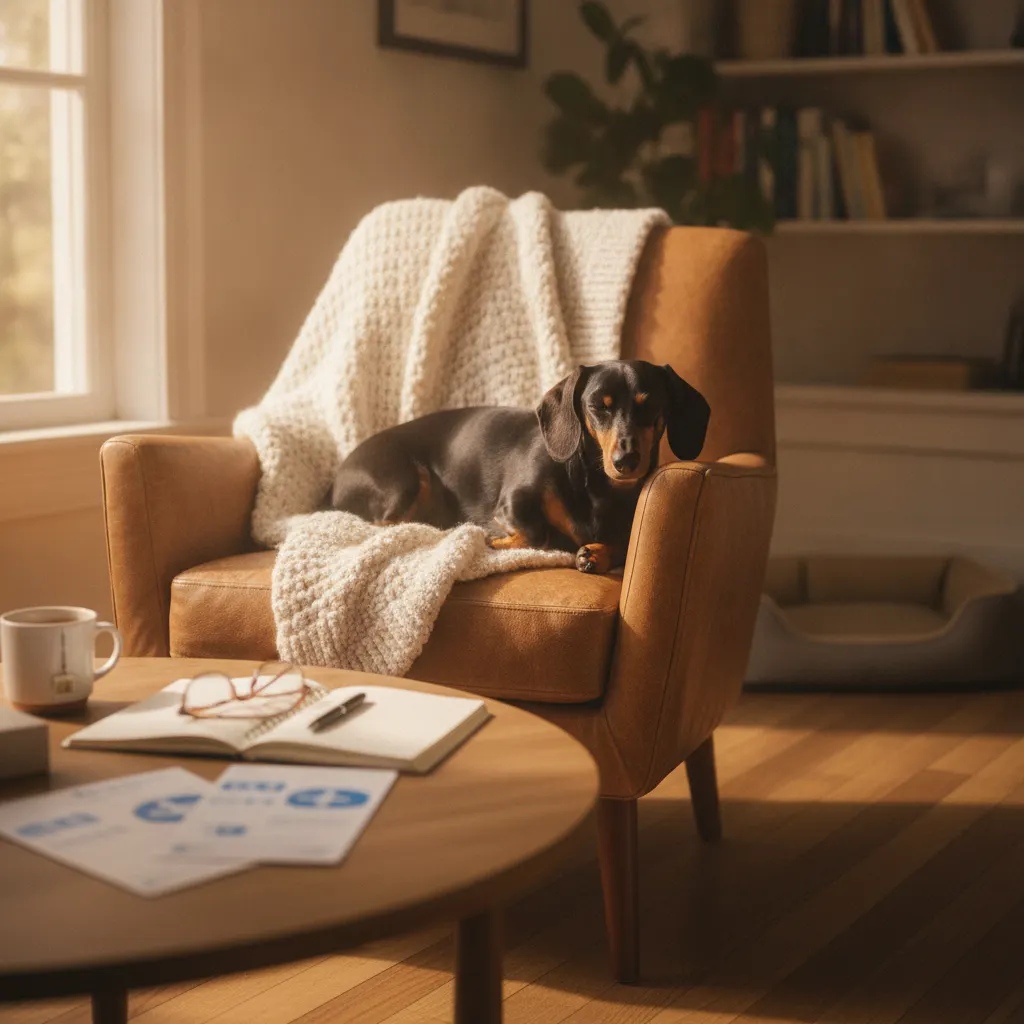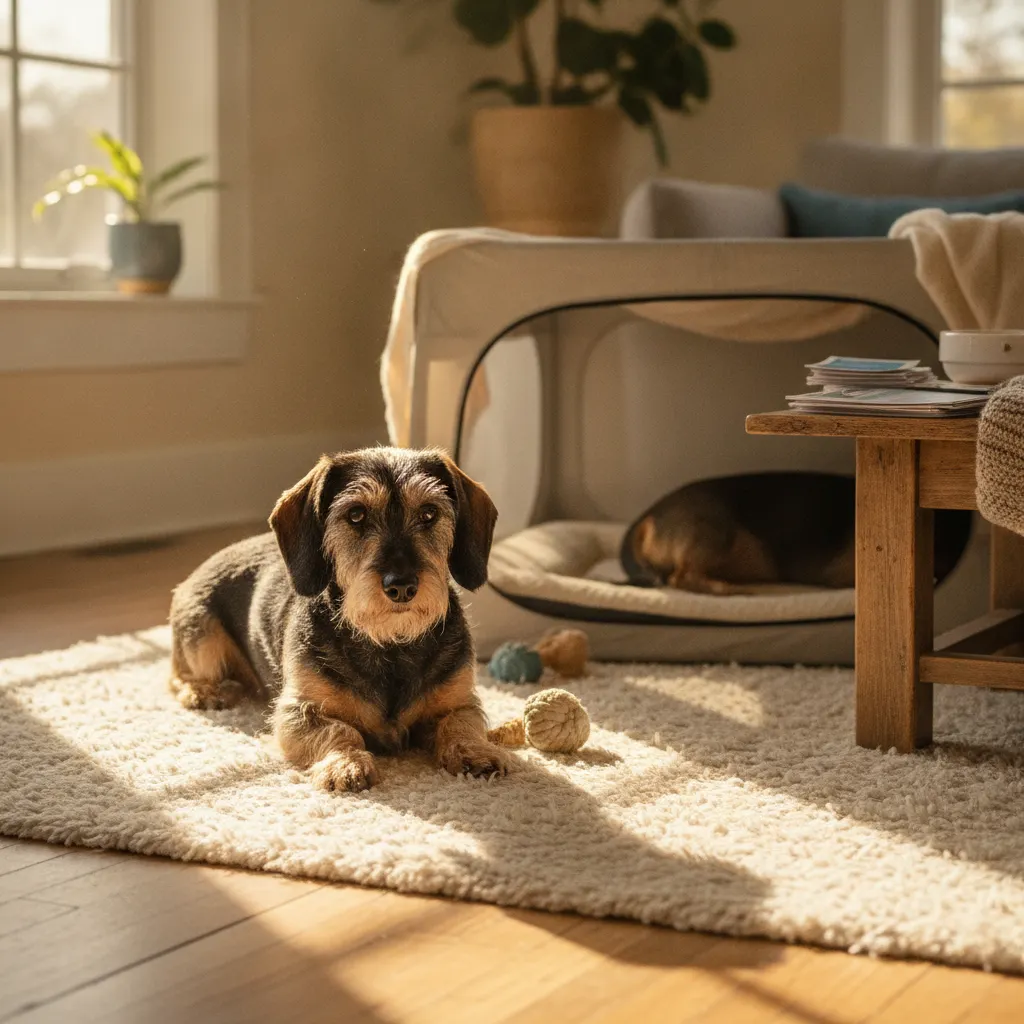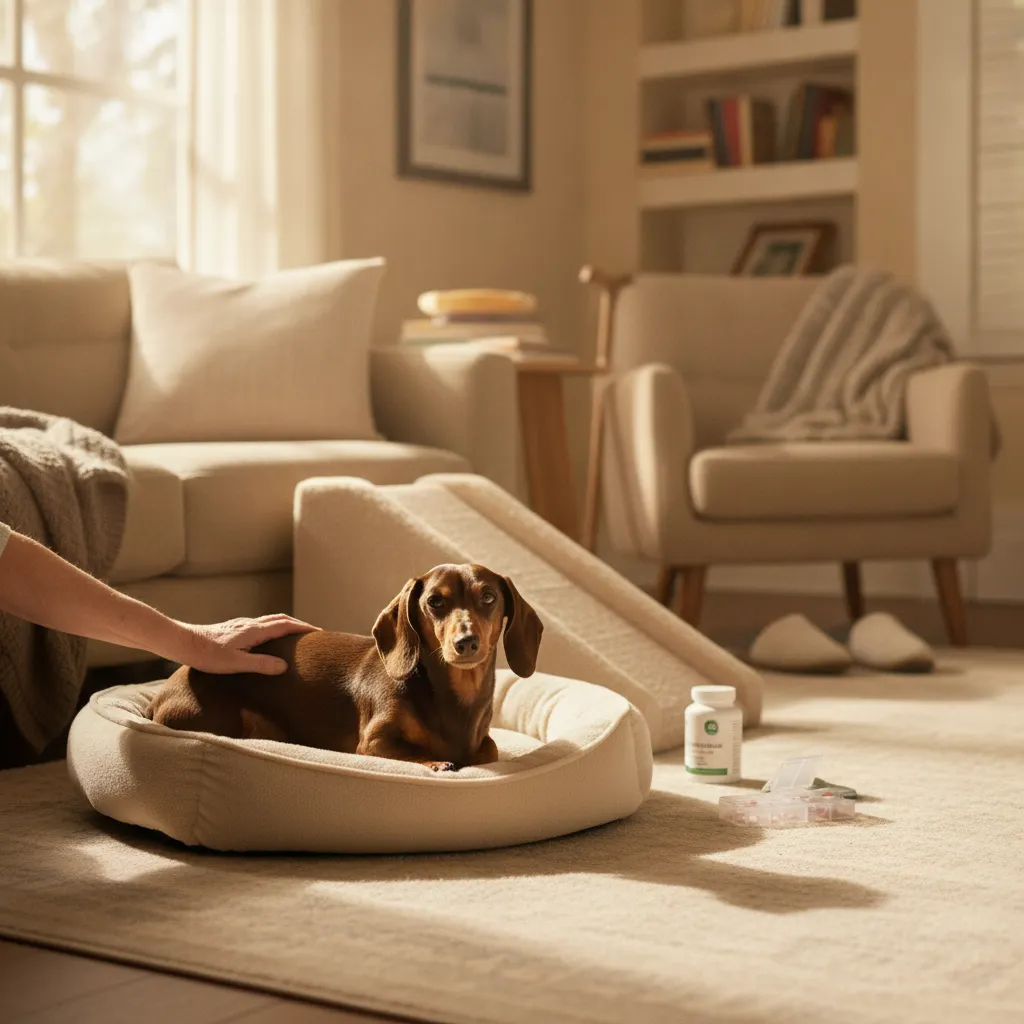
You hear a familiar grunt. It’s not your dachshund this time; it’s you. You’re bending over—just a little—to pick up a toy, and your lower back sends a sharp, fiery signal that says, “Absolutely not.” You freeze, hand hovering over the squeaky squirrel, and in that moment, a wave of anxiety washes over you. It’s not just about your own pain. It’s the sudden, anxious thought: What if I can’t pick him up when he needs me? The irony is almost cruel. You spend your days obsessing over protecting that long little back, but you’ve completely neglected your own. The reality of **caring for a dog with a bad back**—or preventing one—is that it puts a tremendous strain on yours.
This is the secret pain of so many doxie parents. We build our lives around these little dogs. We arrange our furniture for them, we cut our walks short if they seem tired, and we hold our breath every time they take a running leap. We are their guardians, their protectors, their personal elevator service. But what happens when the elevator is out of order? The guilt is immense. You feel like you’re failing them if a flare-up in your sciatica means you can’t lift them into the car. You feel a surge of anxiety when they’re snoozing on the couch and you know moving them means a careful, painful bend that might leave you stiff for hours.
Why Hasn't Standard Advice Helped Your Back?
If you've mentioned this struggle to anyone, you’ve probably heard the same tired advice. “Just lift with your knees!” they chirp, as if you’ve never heard that before. It’s great advice in a perfect world, but a wiggling, 15-pound sausage dog is not a perfect, symmetrical box. One sudden twist from them, and your perfect form is gone, along with your hopes of a pain-free afternoon.
Then there’s the “Get a ramp!” chorus. Ramps are fantastic tools, but they aren't a magic wand. I’ve spent weeks trying to convince a stubborn Marley that the ramp is, in fact, a brilliant invention and not a suspicious portal to another dimension. Sometimes they just refuse. Or they’ll use it 90% of the time, and that one time they don’t is the one that sends your heart into your throat.
The most frustrating advice is often, “Just don’t let them on the furniture.” This well-meaning but clueless suggestion completely misses the point of living with a dachshund. These dogs are burrowing, comfort-seeking, pack-oriented creatures. Denying them access to the couch—the family hub—is like telling a toddler they can no longer have cuddles. It creates a different kind of stress for both of you. These “solutions” fail because they treat the problem as one of brute force and simple compliance, ignoring the reality of your body and your dachshund’s very big personality.
The Reframe: Stop Being a Crane, Start Being an Architect
Here’s the shift that changed everything for me. The problem isn’t that your back isn’t strong enough. The problem is that your environment is demanding you act like a human crane, performing dozens of awkward, stressful lifts every single day. You’re trying to solve a systems problem with sheer physical effort, and your body is paying the price.
Your physical limits are not a personal failure; they are a critical design constraint for your home. When you accept this, you can stop blaming yourself and start solving the real problem.
Think of yourself as an architect. Your job is to redesign your home and routines to engineer the need for dangerous lifting right out of your daily life. This approach isn’t just about protecting your doxie’s back; it’s about preserving your own physical ability to care for them for years to come. Your well-being is not a luxury—it’s a prerequisite for their well-being.
The Two-Back System: A Practical Guide to a Safer Home
I developed this system after one particularly bad week. My own back was a mess from some weekend gardening, and at the same time, Mia took a small tumble off a single step. I could barely bend down to check on her, my own pain making me slow and clumsy. That’s when it hit me: my physical state was a direct risk factor for my dogs. I had to change the entire equation. The Two-Back System is about modifying your world so that safety is the default for everyone.
Part 1: The Environmental Audit
Grab a notepad and walk through your home, room by room. Your goal is to identify every “lift point” and “jump point” and neutralize it.
- The Living Room: The Epicenter of Jumps. This is usually ground zero. If you have a high, modern sofa, it’s a constant hazard. Consider a lower-profile couch for your next upgrade. In the meantime, use what you have. Sturdy ottomans, poufs, or even firm cushions can be arranged to create a “staircase” effect. The key is consistency. Also, look at your floors. Hardwood is like a slip-n-slide for little paws. Strategically placed runners and area rugs provide crucial traction, reducing the chance of a slip that could injure their back or cause you to twist awkwardly trying to catch them. We have a whole guide on choosing the right rugs for a dachshund that covers this in detail.
- The Bedroom: The Nightly Ascent. The bed is often the highest peak your doxie will try to scale. This is where a high-quality ramp is non-negotiable. Look for one with a gentle incline and a high-traction surface like carpet, not slick plastic. It will take time and a lot of high-value treats to train them to use it every single time, but it’s worth the effort. Place it where they naturally try to jump up, and for the first few weeks, block off all other access points.
- The Feeding Station: The Daily Bend. Bending over twice a day to place food and water bowls on the floor adds up. A slightly elevated feeding station can make a huge difference for your back and hips. It doesn't need to be high—just enough to let you place the bowls with a slight stoop instead of a full, back-straining bend.
Part 2: Smarter Handling & Lifting
Even in the most perfectly designed home, you will still need to lift your dog. But you can do it in a way that protects both of you. The goal is to make every lift intentional and safe.
- Master the “Scoop and Cradle.” Never, ever lift a dachshund by their front legs or just under their armpits. This puts immense pressure on their spine. Instead, put one arm under their chest, just behind the front legs. Use your other arm to scoop their hindquarters, supporting their entire body weight evenly. Hold them close to your chest to keep the center of gravity stable. Bend your knees, keep your back straight, and lift. It’s a single, smooth motion.
- Make the Floor Your Friend. We spend so much time bending down to our dogs. Flip the script. Instead of bending over for cuddles, grooming, or putting on a harness, make it a habit to sit on the floor with them. It might feel strange at first, but it completely eliminates dozens of micro-strains on your back throughout the day. I keep a firm cushion in the living room specifically for this purpose.
- Emergency Preparedness. The worst time to figure out how to lift your dog is when they are hurt and in pain. A pained dog might snap or squirm unexpectedly. Have an emergency plan. This could be a soft carrier, a firm-bottomed tote bag, or a dedicated pet sling. Keep it somewhere accessible. If your doxie ever shows signs of a back injury, your first step should be to confine them to a crate to prevent further movement, and your second is to call the vet. Knowing exactly how you will transport them safely removes a massive layer of stress and uncertainty. If you’re ever unsure about symptoms, our guide on when to call the vet for your dachshund can help you make a calm decision.
Part 3: The Human Factor: You Are Part of the System
This whole system falls apart if you don’t take care of yourself. Your health is not separate from your dog's; it’s intertwined. **Caring for a dog with a bad back** is a marathon, not a sprint, and you need to be fit for the journey.
- Incorporate “Doxie Owner Stretches.” Simple stretches that target your lower back, hamstrings, and hips can make a world of difference. A gentle cat-cow stretch in the morning, a hamstring stretch before you take them for a walk, or a child’s pose at the end of the day can help counteract the physical toll of pet ownership.
- Acknowledge the Mental Load. The constant low-grade worry about your doxie’s back is exhausting. The beauty of building a system is that it frees up mental energy. When your environment is doing the heavy lifting (pun intended), you don’t have to be on high alert 24/7. You can relax and enjoy your dog, knowing you’ve stacked the deck in favor of safety.
By shifting your perspective from being a lifter to being an architect, you change the game. You create a world where safety is the default, not a constant effort. It protects your long little dog, but just as importantly, it protects you—the person they depend on for everything. Your back matters because you matter to them.
Understanding your dachshund's behavior is a huge piece of this puzzle. Knowing *why* they insist on that flying leap off the couch helps you redirect the behavior with more patience and success. To be a more confident doxie parent and learn the 'why' behind their quirky habits, check out our free guide. It will help you work smarter, not harder, saving both your backs in the process.
Get the free Dachshund Behavior Decoder
Frequently Asked Questions
What if my dachshund absolutely refuses to use ramps or stairs?
Patience and high-value treats are key. Make the ramp the only way to get to their favorite spot, and reward every tiny step with praise and a tiny piece of chicken or cheese. Never force them. If they still refuse after consistent effort, you may need to re-evaluate your furniture setup to reduce heights altogether.
My back pain is chronic. Is caring for a dog with a bad back even feasible for me?
Yes, but it requires a commitment to the architectural approach. By systematically removing the need for lifting and bending from your daily routine, you can absolutely provide excellent care. Being proactive about environmental safety is even more critical when you have physical limitations, as it makes **caring for a dog with a bad back** a matter of strategy, not strength.
I live in a small apartment. How can I make it back-safe without adding a ton of clutter?
Focus on multi-functional pieces. An ottoman with storage can serve as a step up to the couch. Choose a ramp that can be folded and stored when not in use. Use runners instead of large area rugs. The goal is to integrate safety into your existing space, not to fill it with bulky equipment.
What are the most important tools for a doxie owner with back pain?
A good, sturdy ramp for the bed or couch is number one. Number two is a comfortable, supportive carrier or sling for vet visits or emergencies. And number three, which is often overlooked, is a long-handled dustpan and brush for cleaning up messes without bending all the way to the floor.
How do I handle grooming or bath time without hurting my back?
Avoid bending over a tub. For nail trims and brushing, sit on the floor with your dog. For baths, consider a grooming table if you have space, or use a walk-in shower with a non-slip mat and a handheld sprayer, allowing you to sit on a shower stool while you wash them. This is much safer for your back than leaning over a bathtub.
Is it ever okay to just quickly pick up my dachshund?
Quick, unplanned lifts are where injuries—to both of you—happen. While life isn't perfect, the goal is to make intentional, safe lifting your default habit. Using the 'Scoop and Cradle' technique every time builds muscle memory, so even in a hurry, you're more likely to lift correctly. Reducing the overall number of lifts per day is the most effective strategy for **caring for a dog with a bad back** and protecting your own.
IVDD · dachshund back health · dog owner health · pet care ergonomics