You see them trotting down the street: the tiny, 9-pound miniature dachshund who thinks he’s the boss of the entire block, and the sturdy, 30-pound standard who carries himself with the quiet dignity of a seasoned hunter. You’d think a 20-pound difference would create two completely different dogs. But here’s the secret every seasoned doxie parent knows: deep down, under all that sausage, a dachshund is a dachshund.
The real struggle begins when you’re trying to choose. You’re scrolling through pictures of adorable puppies, but your mind is racing with questions. Is a standard too much dog for my apartment? Are minis more fragile or yappy? Does one have more health problems than the other? The debate of miniature vs standard dachshund can feel overwhelming, leaving you worried you’ll make the wrong choice for your family and your future best friend.
You’ve probably tried to solve this by reading the dry, clinical breed standards that just list weights and measurements. Maybe you’ve fallen down a rabbit hole of online forums where one person swears their mini is a quiet angel and the next says their standard is a couch potato. Relying on these one-off stories is like trying to understand an entire country by talking to one tourist. It’s confusing and often contradictory, leaving you more uncertain than when you started.
Here’s the perspective shift you need: stop asking “Which size is better?” and start asking, “Which size is a better fit for my life?” The core of a dachshund—their stubbornness, their intelligence, their fierce loyalty, and their hilarious antics—is packed into every single one, regardless of what the scale says. The differences are in the details, the subtle nuances of daily life that can make one size a slightly smoother fit for your specific world.
So, What's the Official Difference, Anyway?
Before we get into personality and health, let’s clear up the technical side. According to kennel clubs like the AKC, the distinction between a miniature and a standard dachshund is all about weight and, to some extent, height. It’s not a separate breed; it’s a size classification within the same breed.
- Standard Dachshund: Typically weighs between 16 and 32 pounds at one year of age. They are the original size, bred for flushing badgers from their dens.
- Miniature Dachshund: Typically weighs 11 pounds or under at one year of age. They were bred down from the standards, likely to hunt smaller prey like rabbits.
You’ll also hear people talk about “tweenies.” This isn’t an official category, but it’s a loving term for dachshunds who fall in that gray area between 11 and 16 pounds. Many dachshunds, including my own, are happy little tweenies! The size classifications can feel rigid, but in reality, there's a whole spectrum of sausage. For more on all the sizes and coat types, you can check out our simple guide to dachshund sizes.
Does a Dachshund's Personality Change with its Size?
This is the million-dollar question. The honest answer? Not fundamentally. Every dachshund, from the tiniest mini to the most robust standard, is convinced it’s a giant dog trapped in a short body. That legendary courage, independence, and sometimes comical bossiness are standard-issue features. They were bred to think for themselves in a dark tunnel, and that trait doesn't shrink with their body.
However, owners often report subtle tendencies that might be linked to size. Some feel that standards can be a bit more mellow and laid-back, perhaps because they don’t have the same “small dog” energy. Minis, on the other hand, are sometimes perceived as being a bit more feisty or prone to barking. But I believe a lot of this comes down to “Small Dog Syndrome”—not in the dog, but in the owner! We tend to baby smaller dogs, carrying them everywhere and letting them get away with behaviors we wouldn’t tolerate in a larger dog. A poorly socialized mini is going to be yappy, just as a poorly socialized standard would be.
In my nearly 20 years with this breed, I’ve found that individual personality, genetics, training, and socialization have a far greater impact on behavior than weight. You can have a placid standard and a hyper mini, or vice versa. The key is to remember you're raising a mighty hunter, no matter the size, and to embrace their inner 'big dog' attitude with consistent, loving guidance.
Miniature vs Standard Dachshund: A Look at Health and Lifespan
When it comes to health, the conversation always, and rightly, turns to their backs. Intervertebral Disc Disease (IVDD) is the single biggest health concern for the breed. It’s a genetic condition linked to their long spine and short legs (a trait called chondrodystrophy) and it affects both sizes. The risk is baked into the breed's very structure.
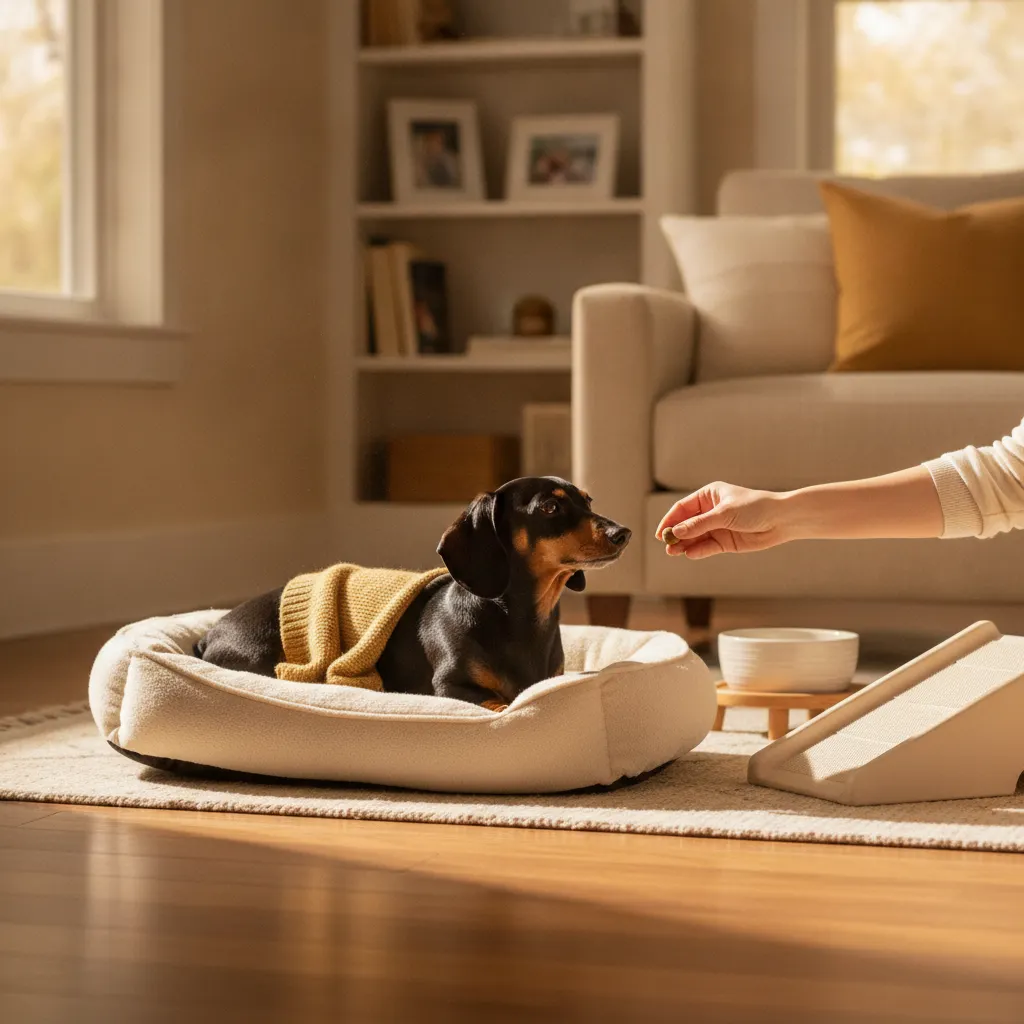
While some studies might show slight variations in prevalence between the sizes, the reality on the ground is that any dachshund can be affected. The most important thing you can do, whether you have a mini or a standard, is be proactive about back health. This means using ramps, discouraging jumping off furniture, keeping them at a healthy weight, and building core strength with safe activities. Their long little back is their one vulnerability, and it's our job to protect it.
Beyond their backs, there are a few other size-related considerations:
- Dental Issues: Miniatures can be more prone to dental problems. They have the same number of teeth as a standard, but they're crammed into a much smaller jaw, which can lead to overcrowding and a faster buildup of plaque and tartar.
- Obesity: A few extra pounds on a 30-pound standard is a concern; a few extra pounds on a 9-pound miniature is a crisis. It puts immense strain on their spine and joints. Diligence with diet is critical for minis.
- Heart Conditions: Some forms of heart disease, like mitral valve disease, can be more common in smaller breeds, including the mini dachshund.
Despite these points, both sizes enjoy a wonderfully long lifespan, typically 12 to 16 years. Good breeding, preventative care, and a healthy lifestyle are the true keys to longevity, far more than their classification as miniature or standard. For a broader look at breed-specific health, our guide on dachshund health quirks beyond the back is a great resource.
Lifestyle Fit: Which Wiener is Right for You?
This is where the comparison of miniature vs standard dachshund becomes truly useful. It’s not about which dog is superior, but which dog’s needs and characteristics slot more easily into your life.
Life with a Miniature Dachshund:
Minis are fantastic for those living in smaller spaces like apartments or condos. Their exercise needs can often be met with vigorous indoor play and a couple of good daily walks. They are easier and cheaper to travel with, fitting comfortably in an airline-approved carrier. Food and medication costs are also lower. On the flip side, their small size can make them more fragile. You need to be more careful about them being underfoot, and interactions with large, boisterous dogs or very young children need careful supervision.
Life with a Standard Dachshund:
Standards are more robust and can feel less delicate, which can be a plus for active families. While they are still not built for marathon running, they can often handle slightly longer hikes and more rugged play. They are still perfectly happy in an apartment as long as their exercise needs are met, but they do take up more space on the couch! Their food bills will be higher, and they are a more substantial armful to carry if needed. They are a powerful dog in a small package, with a surprisingly deep and loud bark that reflects their larger size.
Ultimately, the choice is deeply personal. Both sizes will fill your home with an immense amount of love, laughter, and stubbornness. They will both try to burrow under the covers, both give you the side-eye when you displease them, and both be fiercely loyal companions.
Whether you choose a tiny mini or a sturdy standard, you're getting 100% pure dachshund. Understanding the ancient instincts packed into that long body is the key to a happy life together. To get fluent in their quirky language and learn the 'why' behind their hilarious behavior, you'll want to be part of our pack. Get the free Dachshund Behavior Decoder and start understanding your doxie like never before.
Frequently Asked Questions
Are miniature dachshunds more aggressive?
No, miniature dachshunds are not inherently more aggressive. They can sometimes be perceived as “yappier” or more reactive, but this is often due to a lack of proper socialization or training—something owners might neglect with a smaller dog. A well-socialized doxie of any size will have a confident, brave temperament.
Do standard dachshunds need more exercise than minis?
Generally, yes, but only slightly. A standard dachshund is a more substantial dog and may benefit from slightly longer walks or more vigorous play sessions. However, both sizes are moderate-energy dogs; neither requires the intense exercise of a sporting breed. The most important thing for both is consistent, back-safe activity.
Is it true that minis have more back problems?
This is a common misconception. The risk of IVDD (Intervertebral Disc Disease) is high across the entire dachshund breed due to their genetic makeup. While some statistics vary, the difference in risk between a miniature vs standard dachshund is not significant enough to be a deciding factor. Prevention is key for both sizes.
What is a “tweenie” dachshund?
“Tweenie” is an affectionate, unofficial term for a dachshund that weighs between the miniature and standard classifications, typically 12-15 pounds. They aren't a separate category recognized by kennel clubs, but many doxie owners use the term to describe their in-between-sized pup.
Can a miniature and standard dachshund come from the same litter?
Yes, it's possible! Dachshund genetics can be complex. A litter can have puppies that grow up to be different sizes, especially if the parent dogs are on the cusp of the weight standards or if one parent is a mini and the other is a standard.
Which size is better for a first-time dog owner?
Neither size is inherently “better” for a first-time owner; the owner's lifestyle is the deciding factor. A miniature might be easier in terms of physical management and space, but a standard might feel less fragile. The most important factor for a first-time owner is a commitment to training and understanding the unique dachshund temperament, which is the same in both sizes.
dachshund breeds · dachshund sizes · miniature dachshund · standard dachshund