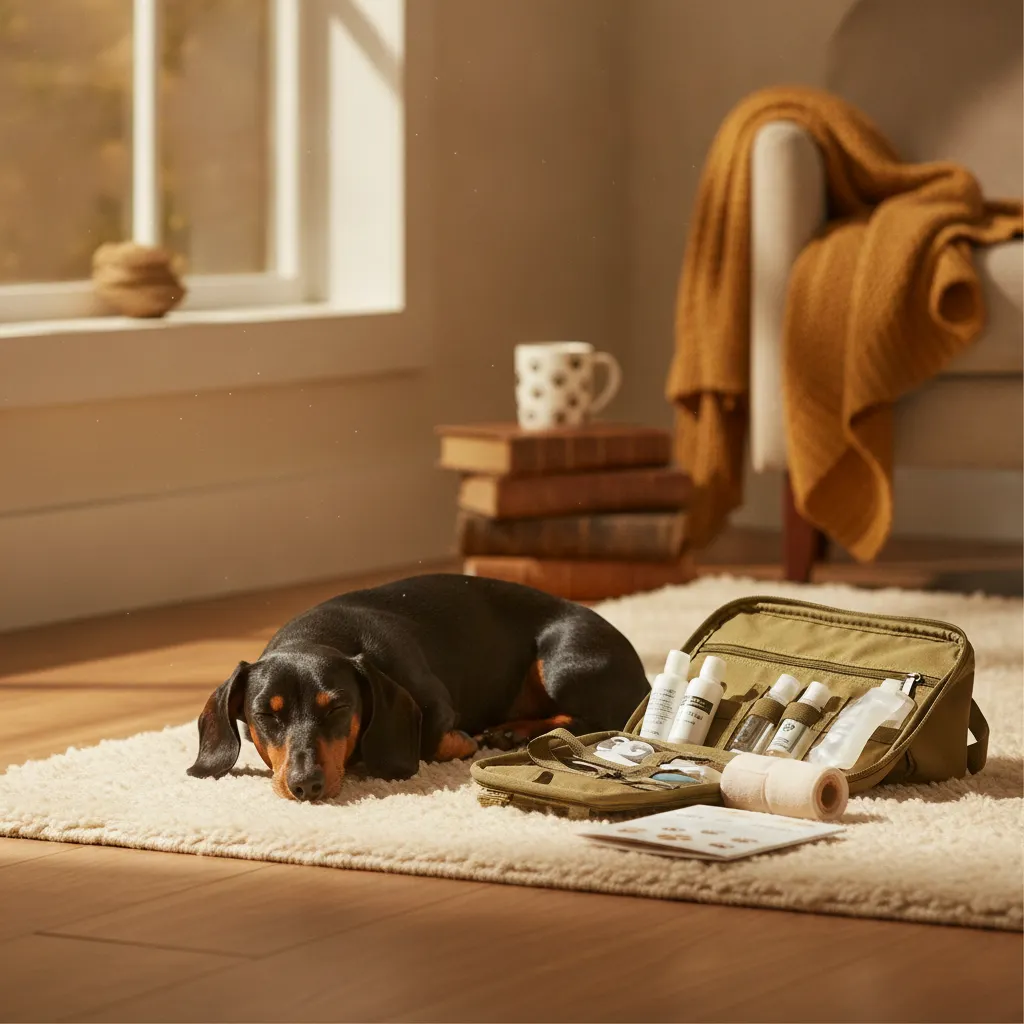
You have the little plastic box. It’s probably tucked under the sink or in the laundry room, filled with antiseptic wipes, some gauze, and that weird sticky wrap that only clings to itself. You bought it thinking, “I’m a responsible dog owner.” You checked the box. But I’m here to tell you something that might sting a little: for a dachshund owner, that kit is mostly useless.
It’s a box of Band-Aids for a problem that requires a backboard. The single greatest health risk to our long little dogs isn’t a scraped paw or a bee sting; it’s a spinal injury. And when a back issue happens—the yelp from jumping off the couch, the sudden wobbly back legs—a roll of gauze isn't going to do a thing. The hardest part isn't the injury itself; it's that feeling of not knowing what to do next, of being unprepared for the one thing you’ve always worried about.
Your current first-aid kit is built on a lie. Not a malicious one, but a lie nonetheless. It’s the lie of generic dog ownership. We see these pre-made kits online and in pet stores, and they lull us into a false sense of security. They’re designed for a golden retriever who might get a foxtail in his ear, not for a low-rider whose entire anatomy is an engineering marvel and a constant source of worry. You’ve tried to be prepared, but you’ve been preparing for the wrong emergency. This isn't about treating an injury; it's about managing a crisis.
The Reframe: Your Doxie Needs a Crisis Kit, Not a First-Aid Kit
Let's shift our thinking entirely. The most critical moments of a back injury happen before you ever get to the vet. Your goal in those first few minutes and hours is not to be a doctor. Your goal is to be a paramedic, a crisis manager. It’s about one thing and one thing only: preventing further damage.
Every movement, every panicked wiggle, every attempt to get comfortable can make a disc injury worse. A standard dachshund first aid kit isn't designed for this. It’s designed for surface wounds. A back-ready crisis kit is designed for containment, stabilization, and communication. It’s not about what you can put on your dog; it’s about what you can put your dog in, and what information you can give to the professionals who will take over.
This isn't about fear-mongering. It's about empowerment. It’s about taking the worst-case scenario and building a calm, methodical plan so that if the moment ever comes, you can act with confidence instead of panic. You can be the calm anchor your dog desperately needs.
How Do You Build a Truly Back-Ready Dachshund First Aid Kit?
Think of your kit in three distinct layers: The tools for immediate immobilization, the binder for critical information, and the supplies for comfort and basic care. This isn't just a list of items; it's a system for managing an emergency.
Layer 1: The Immobilization & Safe Transport System
This is the absolute core of your kit. If you do nothing else, do this. The primary rule of a suspected back injury is strict, immediate confinement. No exceptions.
- A Hard-Sided Crate or Carrier: This is your non-negotiable centerpiece. Not a soft, stylish bag, but a rigid plastic carrier. It should be just large enough for your doxie to lie down comfortably, but not so large they can stand up and turn around easily. In a crisis, this becomes their safe room, their ambulance. It prevents them from moving and exacerbating the injury on the car ride to the emergency vet. If you need help with travel safety, our guide to road tripping with a dachshund has some great tips on securing carriers.
- Rolled Towels or Small Blankets: Keep these inside or next to the crate. You can use them to gently brace your dachshund’s body inside the carrier, packing them in snugly on all sides so they can't slide around during transport. This provides stability and a sense of security.
- A “Sling” Towel: A sturdy bath towel can be used as a makeshift sling to support your dog’s hindquarters if they need help walking to the potty during the initial stages of crate rest (as directed by your vet). You slide it under their belly, hold the ends, and bear the weight of their back half so their spine stays neutral.
Layer 2: The “In Case of Emergency” Information Binder
When you're panicked, your brain doesn't work right. You can't remember phone numbers or medication dosages. This binder is your external brain. Get a simple one-inch binder and some page protectors. It will be the calmest voice in the room.
- Contact Information: On the very first page, in large print: Your regular vet’s name, address, and phone number. The nearest 24/7 emergency animal hospital’s name, address, and phone number. The ASPCA Animal Poison Control Center phone number: (888) 426-4435.
- Medical Records: A copy of your dachshund’s vaccination records, a list of any current medications (with dosages and frequency), and a summary of their medical history, especially any previous back scares.
- Symptom Log: Have a few blank pages ready to go. If you suspect a back issue, start logging immediately. Note the date and time of every observation: Refusal to eat? Yelped when touched where? Wobbly back legs? Pacing and panting? This detailed timeline is invaluable for your veterinarian. Quirks are consistent; problems are a change. A sudden shift in behavior is your biggest clue.
- A Photo of Your Dog: In the unlikely event you get separated or need to make “lost dog” posters in a hurry, having a clear, recent photo is essential.
Layer 3: The Comfort & Care Supplies
This is where some of the more traditional first-aid items come in, but with a doxie-specific focus. These are things you might need while managing crate rest or dealing with secondary issues.
- Puppy Pads: Essential for lining the crate during a back injury, as incontinence can be a symptom.
- Non-Slip Mats or Yoga Mats: If your dog is cleared for limited movement on non-carpeted floors, these provide crucial traction and prevent slips that could cause re-injury.
- Gauze, Self-Adherent Wrap (Vet Wrap), and Antiseptic Wipes: Yes, the standard stuff still has a place! For minor cuts or scrapes that can happen anytime. Just remember, these are for small issues, not the big one.
- Digital Thermometer: For taking a rectal temperature. Know what’s normal for your dog (usually between 101 and 102.5 degrees Fahrenheit). A change in temperature can signal pain or infection.
- Styptic Powder: A lifesaver for a nail trim gone wrong. If you accidentally clip the quick, this will stop the bleeding instantly. The stress of a back injury is enough without adding a bloody paw to the mix. Our fear-free nail trim guide can help you avoid this drama altogether.
- Benadryl (Diphenhydramine): ONLY use this under the explicit direction of your veterinarian. Do not self-prescribe. However, it’s good to have on hand in case your vet advises it for an allergic reaction (like a bee sting). Know the correct dosage for your dog’s weight ahead of time and write it in your binder.
Your vet is always the ultimate authority on your individual dog. This kit is designed to help you get to them safely and provide them with the best possible information to make a diagnosis. It is never, ever a substitute for professional veterinary care.
Putting It All Together: My Promise to Marley & Mia
I have this exact system in place for my two, Marley and Mia. The crate is assembled and ready in a closet. The binder is on the shelf right above it. It’s my physical promise to them that if the worst happens, I won’t lose my head. I will be ready to be the person they need me to be. It has brought me more peace of mind than any amount of worrying ever could.
It’s a heavy topic, I know. Thinking about IVDD can be overwhelming, and it’s easy to feel helpless. But building this kit is an act of taking back control. It transforms vague anxiety into a concrete plan. It’s one of the most profound ways you can say “I love you” to that long little dog who trusts you with their whole life.
Being a prepared doxie parent also means understanding their behavior, which can be the first sign that something is wrong. Knowing why they act the way they do can help you spot subtle signs of pain or discomfort before they become a full-blown crisis. To become a more confident parent, you need to be able to decode their unique language. Get the free Dachshund Behavior Decoder and learn to see the world through their eyes.
Frequently Asked Questions
What is the single most important item in a dachshund first-aid kit?
Without a doubt, a hard-sided crate or carrier. The ability to completely immobilize your dachshund during a suspected back injury is the most critical first step to prevent further damage. Everything else in the kit supports this primary goal of safe confinement and transport to the vet.
Can I give my dachshund human pain medication like Tylenol or Advil?
No, absolutely not. Never give your dog human pain relievers like ibuprofen (Advil) or acetaminophen (Tylenol). They are highly toxic to dogs and can cause severe liver or kidney damage. Always contact your veterinarian for pain management.
How do I know if my dachshund is having a back problem?
Look for sudden changes in behavior. Key signs include yelping when picked up, a hunched back, a tucked tail, wobbly or weak back legs, reluctance to jump or use stairs, and a decreased appetite or energy level. If you see any of these signs, call your vet immediately.
Is this back-ready kit a substitute for a vet visit?
No, never. This specialized dachshund first aid kit is a crisis management tool designed to get your dog to the veterinarian safely and with the least possible risk of making an injury worse. It is a bridge to professional medical care, not a replacement for it.
Where should I keep my dachshund first aid kit?
Keep it in a cool, dry place that is easy to access in a hurry—not buried in the back of a garage. A hall closet, laundry room cabinet, or pantry is a great spot. Make sure everyone in your household knows where it is and what it's for.
Do I need different items for a long-haired vs. a smooth-coated dachshund?
The core back-safety components of the kit are identical for all dachshund coat types. You might add specific grooming tools like a slicker brush or de-matting comb for a long-haired doxie, but the essential items for managing a back-injury crisis remain the same for all dachshunds.
dachshund health · IVDD · dog first aid · pet safety